Texas STAAR Grade 3 Math: Free Worksheets and Topic Guide
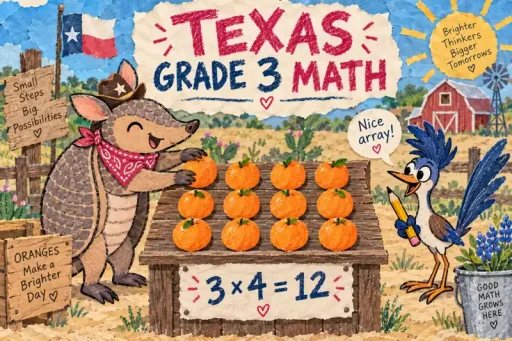
Choose a free Texas Grade 3 math worksheet by topic below. Start with the skill your child is learning in class, then use the STAAR hub for broader review. The 49 existing PDF links include core Grade 3 topics and additional practice; this collection is not an official STAAR test or a complete checklist of assessed skills.
Choose Grade 3 priorities first
Texas Grade 3 TEKS emphasize place value, whole-number operations and fractional units. Practice representing and comparing numbers up to 100,000, adding and subtracting within 1,000, multiplication and division facts through 10 × 10, and multiplication of a two-digit number by a one-digit number. Fraction work includes denominators 2, 3, 4, 6 and 8, number lines, equivalence, and comparisons with the same numerator or denominator.
Geometry and measurement include classifying shapes, rectangle and composite area, polygon perimeter, elapsed time, capacity and weight. Data work uses frequency tables, dot plots, pictographs and scaled bar graphs. Personal financial literacy includes income, spending, saving, credit and charitable giving.
Extra practice is optional: points, lines, rays, parallel and perpendicular lines, angles and line symmetry are explicitly developed in Grade 4 TEKS. Temperature and probability worksheets below are additional enrichment rather than separately named Grade 3 requirements. A worksheet title alone does not establish its standards coverage or test format. Use your teacher’s current plan to select suitable questions.
Free worksheets by topic
Open a topic link to use an existing resource. Choose a manageable amount of practice and ask your child to explain a model or strategy before moving on. The topic notes describe the skill to review; they do not certify every question in a file as Grade 3 STAAR content.
Place Value and Number Sense
- Place Value and the Base-Ten System, find the value of every digit in a multi-digit number
- Reading and Writing Whole Numbers, switch between standard, expanded, and word forms
- Comparing and Ordering Whole Numbers, use <, >, and = to compare whole numbers
- Rounding Whole Numbers, round to the nearest ten or hundred
- Even and Odd Numbers, spot even versus odd by the ones digit
Addition and Subtraction Within 1,000
- Addition Within 1,000, regroup with confidence using place-value columns
- Subtraction Within 1,000, borrow once or many times, the steps are the same
- Estimating Sums and Differences, round first, then add or subtract for a quick check
- Word Problems: Addition and Subtraction, turn one- and two-step stories into number sentences
Multiplication
- Understanding Multiplication, \(a \times b\) as equal groups and as an array
- Multiplication Facts and Strategies, skip-count, double, and the \(\times 9\) trick
- Properties of Multiplication, commutative, associative, identity, zero, distributive
- Multiplying by Multiples of 10, use a basic fact and place value to multiply by tens
- Multiplying Two-Digit by One-Digit, break-apart strategy with tens and ones
- Multiplication Word Problems, equal groups, arrays, and times as many
Division
- Understanding Division, share equally or count groups
- Division Facts and Strategies, ask the multiplication twin to find each quotient
- Relating Multiplication and Division, fact families and missing factors
- Division Word Problems, sharing stories versus grouping stories
Fractions
- Understanding Fractions, name a fraction by counting equal parts
- Fractions on a Number Line, find a fraction by jumping along $0$ to $1$
- Equivalent Fractions, make different fractions that mean the same amount
- Comparing Fractions, same denominator versus same numerator rules
- Whole Numbers as Fractions, write any whole number as a fraction
Patterns and Equations
- Number Patterns and Sequences, find the rule, then continue the list
- Two-Step Word Problems, split into Step 1 and Step 2 and write each result
- Unknown Numbers in Equations, use the inverse operation to find the missing number
- Input-Output Tables, find the rule that turns input into output
Measurement
- Measuring Length, inches, feet, yards, centimeters, meters
- Liquid Volume and Mass, liters, milliliters, grams, kilograms
- Time and Elapsed Time, count up on a clock to find the gap
- Temperature, degrees Fahrenheit with rise, drop, and compare
- Money and Making Change, count coins and find change
Area and Perimeter
- Understanding Area, count unit squares to find area
- Area of Rectangles, area \(= \) length \(\times\) width
- Perimeter of Polygons, add up every side length
- Area and Perimeter of Composite Figures, break into rectangles, then add
Geometry
- Classifying Two-Dimensional Shapes, name polygons by the number of sides
- Classifying Quadrilaterals, squares, rectangles, rhombuses, trapezoids
- Points, Lines, Line Segments, and Rays, the four building blocks of geometry
- Parallel and Perpendicular Lines, side-by-side vs.\ \(90^{\circ}\) crossing
- Classifying Angles, right, acute, obtuse, and straight
- Lines of Symmetry, find the fold lines that match a shape
- Three-Dimensional Shapes, count faces, edges, and vertices
- Partitioning Shapes Into Equal Parts, split into halves, thirds, fourths, and beyond
Data
- Pictographs and Bar Graphs, read graph values and compare categories
- Line Plots, read the marks and compare or total the values; mode and range can be additional vocabulary
- Probability and Chance, label events impossible, unlikely, equally likely, likely, certain
Personal Financial Literacy
- Personal Financial Literacy, earn, save, spend, and figure how long it takes
A short study plan for home or tutoring
Start with equal groups and arrays before timed multiplication facts. For example, three groups of four objects give 3 × 4 = 12; splitting twelve objects into three equal groups gives 12 ÷ 3 = 4. Ask the learner to draw both situations and explain how they are connected.
Next, choose a fraction model or number-line activity. Compare 2/4 and 1/2 using the same size whole, then explain why they occupy the same point on a number line. For measurement, distinguish area (square units inside a figure) from perimeter (units around its boundary).
Review a small set of problems, discuss mistakes, and return to the same idea in a new example. Adjust the session to the learner rather than assuming every worksheet takes the same time. Keep optional extension topics separate from the current Grade 3 lesson.
Use official STAAR guidance alongside skill practice
Single-topic practice helps build understanding, while test preparation also needs mixed problems and familiarity with the assessment format. Check the Texas Education Agency’s STAAR Mathematics resources for assessed curriculum and blueprints. The official Grade 3 mathematics TEKS (§111.5) gives the curriculum expectations; Grade 4 TEKS (§111.6) identifies the geometry extensions noted above.
Continue with the matching STAAR study path
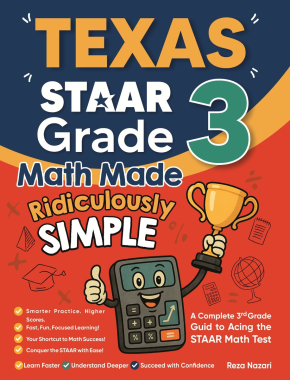
Use the grade chooser below to find relevant practice and lessons. If you want a paid book, review the displayed product page for its contents, format and current price before purchasing.

Related to This Article
More math articles
- Functionalist, Conflict, Feminist, and Interactionist Views of Family
- A monopolist has no independent supply curve
- Religious exemptions
- How to Find Similar Figures?
- How to Solve Compound Inequalities: And, Or and Graphing
- Best Office Chairs for Online Teaching
- The Pacific War and the Atomic Bomb
- 10 Most Common 4th Grade Common Core Math Questions
- CLEP U.S. History I 042: French Revolution, Neutrality, and Jay’s Treaty
- The Best Grade 8 ELA Practice Tests for Wyoming Students







What people say about "Texas STAAR Grade 3 Math: Free Worksheets"?
No one replied yet.