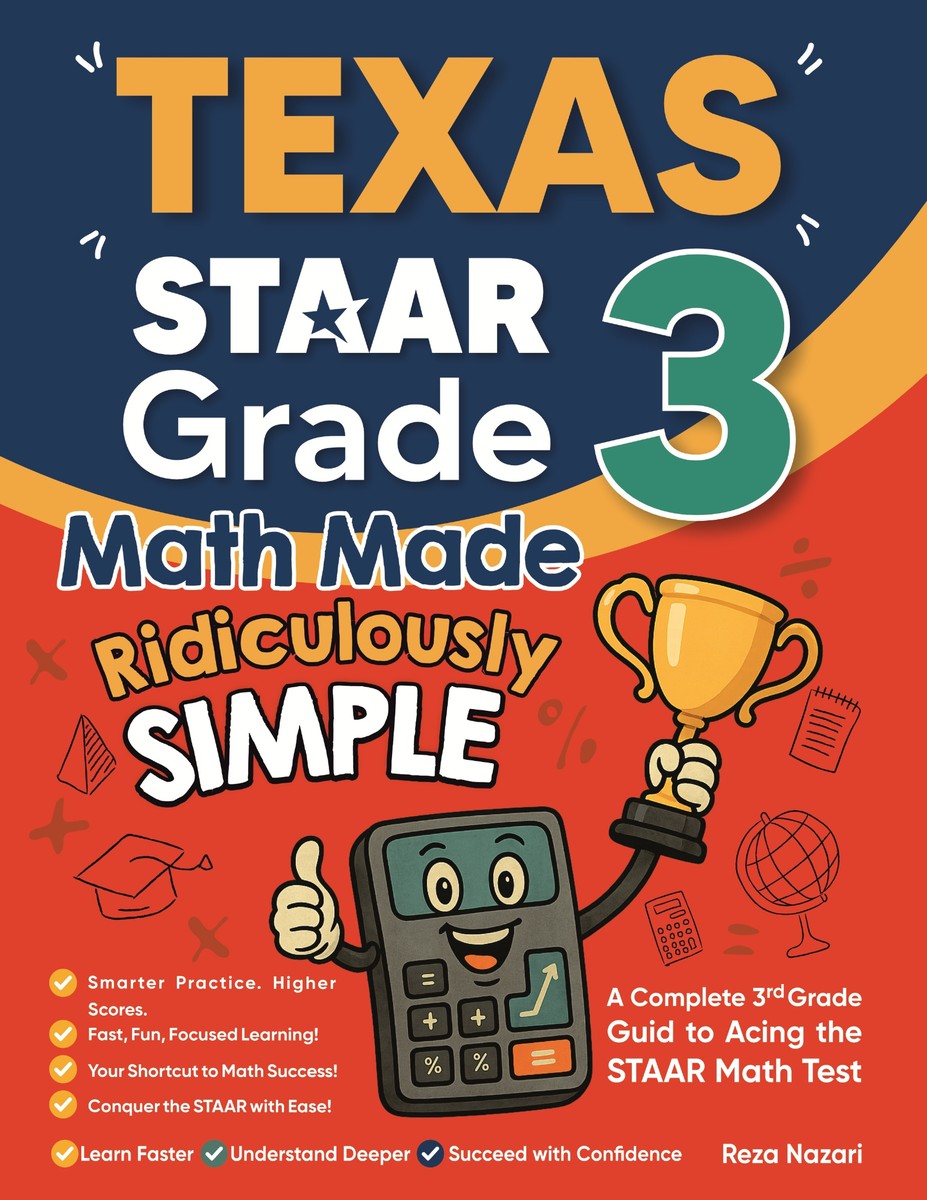
Texas TEKS math guide
Texas Grade 3 Math Standards (TEKS)
A clear, student-friendly guide to every Grade 3 math expectation in the Texas Essential Knowledge and Skills, with practice focus notes for families, teachers, tutors, and STAAR preparation.
Third grade is a major math year in Texas. Students move from basic number work into larger place-value relationships, multiplication and division, fractions, area, perimeter, data displays, elapsed time, and early financial literacy. This guide rewrites the Grade 3 math TEKS in plain language so adults can quickly see what students are expected to understand and what kind of practice will help.
Quick Navigation
Free Grade 3 Math Checklist + Practice Plan
Use this Texas Grade 3 math guide as a printable standards checklist. Start with the overview, mark the skills your student already handles, then choose one weak area for focused review before STAAR or classroom assessments.
Texas Grade 3 Math Standards Overview
The Texas Grade 3 math standards are organized around mathematical process skills and major content strands. Process skills appear throughout the year: students solve real-world problems, choose tools, explain reasoning, use models, and communicate with precise math language. The content standards then build the math students need for STAAR and for later grades.
Number Sense
Place value through 100,000, rounding, comparing numbers, and using number lines to reason about size.
Fractions
Unit fractions, equivalent fractions, number lines, sharing situations, and comparisons with common numerators or denominators.
Operations
Addition and subtraction within 1,000, multiplication facts, division facts, arrays, area models, and one- and two-step word problems.
Geometry & Measurement
Classifying shapes, quadrilaterals, area, perimeter, elapsed time, liquid volume, weight, and fractions on a number line.
Data Analysis
Frequency tables, dot plots, pictographs, bar graphs, scaled intervals, and one- or two-step questions about data.
Financial Literacy
Income, scarcity, spending decisions, credit, saving plans, college savings, and charitable giving.
STAAR Grade 3 Math Practice Focus
For STAAR readiness, students should practice more than isolated skills. The strongest preparation blends computation, visual models, and word problems. A good weekly routine includes place-value review, multiplication and division facts, fraction models, measurement problems, data questions, and short written explanations of how the answer was found.
Use the standards below as a checklist. When a student can explain a skill, model it, solve a problem, and check whether the answer makes sense, that standard is moving from practice to mastery.
Need Focused Grade 3 STAAR Math Practice?
Pair this standards guide with targeted practice so students can move from knowing the TEKS to applying them on test-style questions.
All Texas Grade 3 Math Standards, Rewritten
The codes below follow the Grade 3 TEKS numbering system. The wording is intentionally rewritten in original, family-friendly language for learning and planning. For official policy language, use the Texas Education Agency source documents.
3.1 Mathematical Process Standards
These habits appear across all Grade 3 math topics. Students should learn to solve problems, explain their thinking, choose useful tools, and communicate with clear math language.
| Code | Student-friendly standard and practice focus |
|---|---|
| 3.1(A) | Use math to understand situations from daily life, the community, and future careers. Practice focus: solve word problems that feel realistic, such as shopping, measuring, sharing, planning time, and reading charts. |
| 3.1(B) | Follow a complete problem-solving routine: study the information, choose a plan, solve, justify the answer, and decide whether the solution is reasonable. Practice focus: ask, “What do I know? What do I need? Does my answer make sense?” |
| 3.1(C) | Select helpful tools and strategies, including manipulatives, drawings, pencil and paper, technology, mental math, estimation, and number sense. Practice focus: compare two methods for the same problem. |
| 3.1(D) | Share math ideas with symbols, pictures, diagrams, graphs, words, and spoken explanations. Practice focus: have students explain one answer in at least two ways. |
| 3.1(E) | Create and use models that organize mathematical thinking. Practice focus: turn a word problem into a table, number line, strip diagram, array, or equation. |
| 3.1(F) | Look for relationships among numbers, operations, shapes, and measurements, then use those connections to explain ideas. Practice focus: connect multiplication to arrays, area, skip-counting, and division. |
| 3.1(G) | Use accurate math vocabulary to explain, display, and defend answers. Practice focus: include words such as product, quotient, numerator, denominator, perimeter, area, estimate, and equation. |
Also Preparing for Texas Grade 3 RLA?
Many Texas families review math and reading language arts together during STAAR season. If your student also needs Grade 3 RLA practice, this bundle gives a focused path for reading, language, and test-style preparation.
3.2 Number and Place Value
Students work with whole numbers through 100,000. They learn how place-value positions relate to each other and use that understanding to round, compare, and order numbers.
| Code | Student-friendly standard and practice focus |
|---|---|
| 3.2(A) | Build and break apart numbers up to 100,000 using ten thousands, thousands, hundreds, tens, and ones. Practice focus: write numbers in expanded form and show them with place-value models. |
| 3.2(B) | Describe how the base-ten system works through the hundred thousands place. Practice focus: explain how each place is ten times the place to its right. |
| 3.2(C) | Locate numbers between nearby multiples of 10, 100, 1,000, or 10,000 and use that location to round. Practice focus: place numbers on open number lines before rounding. |
| 3.2(D) | Compare and order whole numbers up to 100,000 using greater than, less than, and equal to symbols. Practice focus: compare from left to right by place value, then justify the symbol used. |
3.3 Fractions
Third graders develop fraction sense with denominators of 2, 3, 4, 6, and 8. They use objects, strip diagrams, area models, and number lines to understand unit fractions, equivalent fractions, and comparisons.
| Code | Student-friendly standard and practice focus |
|---|---|
| 3.3(A) | Represent fractions greater than 0 and up to 1 with denominators of 2, 3, 4, 6, and 8. Practice focus: show the same fraction with counters, area models, strips, and number lines. |
| 3.3(B) | Name the fraction shown by a point on a number line. Practice focus: count equal intervals from 0 and identify the denominator from the number of equal parts. |
| 3.3(C) | Understand a unit fraction such as 1/b as one equal part of a whole divided into b equal parts. Practice focus: describe why 1/6 is one of six equal parts, not simply one small piece. |
| 3.3(D) | Build and decompose fractions as sums of unit fractions with the same denominator. Practice focus: show that 3/8 can be read as 1/8 + 1/8 + 1/8. |
| 3.3(E) | Solve sharing and partitioning problems with fraction pictures. Practice focus: divide objects or sets fairly among people and label the fractional shares. |
| 3.3(F) | Use models to show equivalent fractions with denominators of 2, 3, 4, 6, and 8. Practice focus: compare 1/2, 2/4, 3/6, and 4/8 on the same number line. |
| 3.3(G) | Explain why two fractions are equivalent when they land on the same number-line point or cover the same amount of the same-size whole. Practice focus: justify equivalence with words and a model. |
| 3.3(H) | Compare two fractions with the same numerator or the same denominator using reasoning, models, words, and symbols. Practice focus: explain why 3/8 is less than 3/4 and why 1/3 is greater than 1/6. |
3.4 Whole Number Operations
This strand builds efficient computation. Students add and subtract within 1,000, estimate, understand money values, develop multiplication and division facts, and solve one- and two-step problems.
| Code | Student-friendly standard and practice focus |
|---|---|
| 3.4(A) | Solve one- and two-step addition and subtraction problems within 1,000 using place value, operation properties, and inverse relationships. Practice focus: use equations, number lines, and checking with the opposite operation. |
| 3.4(B) | Estimate sums and differences by rounding to the nearest 10 or 100, or by using compatible numbers. Practice focus: estimate first, solve exactly, then compare both answers. |
| 3.4(C) | Find the total value of a group of coins and bills. Practice focus: count mixed bills and coins, then write the amount using dollar notation. |
| 3.4(D) | Find the total number of objects in equal groups or arrays up to 10 by 10. Practice focus: connect equal groups and arrays to multiplication equations. |
| 3.4(E) | Represent multiplication with repeated addition, equal groups, arrays, area models, equal jumps on a number line, and skip-counting. Practice focus: show one fact in several forms. |
| 3.4(F) | Recall multiplication facts through 10 by 10 and the related division facts. Practice focus: practice fact families such as 6 x 7 = 42, 7 x 6 = 42, 42 / 6 = 7, and 42 / 7 = 6. |
| 3.4(G) | Multiply a two-digit number by a one-digit number using strategies and algorithms, including the standard algorithm. Practice focus: compare partial products, area models, mental math, and the standard method. |
| 3.4(H) | Find how many objects are in each group when a set is shared equally. Practice focus: model division as fair sharing and equal groups. |
| 3.4(I) | Decide whether a number is even or odd using divisibility ideas. Practice focus: pair objects, skip-count by 2, and look at the ones digit. |
| 3.4(J) | Use multiplication to find division answers. Practice focus: solve 56 / 8 by asking, “8 times what number equals 56?” |
| 3.4(K) | Solve one- and two-step multiplication and division problems within 100 using objects, pictures, arrays, area models, properties, and known facts. Practice focus: underline the question, choose an operation, and show the strategy. |
3.5 Algebraic Reasoning
Students use equations, tables, number pairs, strip diagrams, and comparison language to represent mathematical relationships.
| Code | Student-friendly standard and practice focus |
|---|---|
| 3.5(A) | Represent one- and two-step addition and subtraction problems up to 1,000 with pictures, number lines, and equations. Practice focus: match the same story to a model and an equation. |
| 3.5(B) | Represent and solve multiplication and division problems within 100 using arrays, strip diagrams, and equations. Practice focus: draw a model before writing the equation. |
| 3.5(C) | Describe multiplication as a comparison, such as one quantity being several times as much as another. Practice focus: translate “3 times as many” into a multiplication expression. |
| 3.5(D) | Find an unknown whole number in a multiplication or division equation. Practice focus: solve missing-factor and missing-product equations with fact families. |
| 3.5(E) | Use number pairs in a table and verbal descriptions to show real-world relationships. Practice focus: make input-output tables from patterns such as tickets sold and money collected. |
3.6 Geometry and Area
Students classify two- and three-dimensional figures, describe quadrilaterals, and use multiplication to understand area.
| Code | Student-friendly standard and practice focus |
|---|---|
| 3.6(A) | Sort and classify two- and three-dimensional figures by their attributes, including cones, cylinders, spheres, prisms, and cubes. Practice focus: use vocabulary such as faces, edges, vertices, curved surface, and base. |
| 3.6(B) | Identify and draw quadrilaterals, including rhombuses, parallelograms, trapezoids, rectangles, and squares, based on their attributes. Practice focus: explain why a shape belongs or does not belong in a category. |
| 3.6(C) | Find the area of rectangles with whole-number side lengths by multiplying rows by the number of unit squares in each row. Practice focus: connect area to arrays and multiplication facts. |
| 3.6(D) | Break composite figures made of rectangles into smaller rectangles and add their areas. Practice focus: outline the smaller rectangles, find each area, then add. |
| 3.6(E) | Divide matching two-dimensional figures into equal-area parts and describe each part as a unit fraction of the whole. Practice focus: show that equal shares can have different shapes if the areas are equal. |
3.7 Measurement
Students use measurement tools and strategies for fractions on number lines, perimeter, elapsed time, liquid volume, and weight.
| Code | Student-friendly standard and practice focus |
|---|---|
| 3.7(A) | Show halves, fourths, and eighths as distances from zero on a number line. Practice focus: divide the interval from 0 to 1 into equal parts and label each point. |
| 3.7(B) | Find the perimeter of a polygon or find a missing side length when the perimeter is known. Practice focus: add all side lengths and use subtraction for the missing side. |
| 3.7(C) | Solve problems involving time intervals in minutes using tools or pictures. Practice focus: use clocks, timelines, and number lines to add or subtract elapsed time. |
| 3.7(D) | Decide whether a situation should be measured with liquid volume or weight. Practice focus: sort examples such as a bottle of juice, a bag of apples, a fish tank, and a backpack. |
| 3.7(E) | Measure liquid volume or weight with suitable tools and units. Practice focus: match measuring cups, scales, liters, milliliters, grams, kilograms, ounces, and pounds to real tasks. |
3.8 Data Analysis
Students collect, organize, display, and interpret categorical data. They need practice reading scales carefully and answering multi-step questions from displays.
| Code | Student-friendly standard and practice focus |
|---|---|
| 3.8(A) | Summarize a data set with more than one category using a frequency table, dot plot, pictograph, or bar graph with scaled intervals. Practice focus: choose a display and label the title, categories, and scale. |
| 3.8(B) | Solve one- and two-step questions using data from frequency tables, dot plots, pictographs, and bar graphs. Practice focus: answer how many more, how many fewer, total, and difference questions. |
3.9 Personal Financial Literacy
Texas includes financial literacy in Grade 3 math. Students learn how work connects to income and how people make choices about spending, saving, credit, and giving.
| Code | Student-friendly standard and practice focus |
|---|---|
| 3.9(A) | Explain how labor, skills, education, and effort can connect to income. Practice focus: discuss how different jobs earn money and what skills those jobs use. |
| 3.9(B) | Describe how scarcity or availability can affect cost. Practice focus: compare prices when an item is easy to find versus hard to find. |
| 3.9(C) | Identify possible costs and benefits of planned and unplanned spending. Practice focus: compare buying with a plan to buying without thinking ahead. |
| 3.9(D) | Explain that credit means borrowing when a person wants or needs something before they can fully pay for it, and that borrowed money must be repaid, usually with interest. Practice focus: talk through simple borrowing examples. |
| 3.9(E) | List reasons to save money and explain how a savings plan can help with future goals, including college. Practice focus: create a simple goal, amount, and weekly saving plan. |
| 3.9(F) | Recognize financial choices involving earning, spending, saving, credit, and charitable giving. Practice focus: sort everyday money decisions into categories. |
Latest Texas Grade 3 releases
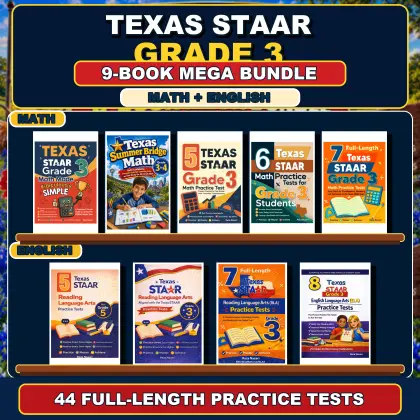
Texas Grade 3 STAAR Success Library: 8 Essential Math + RLA Resources
Use these newest Texas Grade 3 resources to build a balanced STAAR plan: math standards practice, full math review, reading language arts practice tests, and complete RLA preparation. Click any cover to open the matching resource.
How to Use This Texas Grade 3 Math Checklist
- Start with the code. Choose one TEKS code, such as 3.3(F) for equivalent fractions or 3.4(K) for multiplication and division word problems.
- Teach the idea with a model. Use number lines, arrays, strip diagrams, area models, tables, or real objects before jumping to shortcuts.
- Practice in context. Add word problems so students learn when to use the skill, not just how to calculate.
- Ask for an explanation. Students should be able to say or write why their answer is reasonable.
- Review weekly. Mix older standards with new ones so skills stay fresh for STAAR and classroom assessments.
Texas Grade 3 Math Standards FAQ
What are the Texas Grade 3 Math Standards called?
They are part of the Texas Essential Knowledge and Skills, usually called the TEKS. For math, Grade 3 standards include process skills, number and operations, fractions, algebraic reasoning, geometry, measurement, data analysis, and personal financial literacy.
Are the Grade 3 math TEKS the same as STAAR?
No. The TEKS describe what students should learn. STAAR is the state assessment that measures how well students can apply eligible grade-level skills. Strong preparation should focus on understanding the TEKS, not memorizing test tricks.
What should Texas third graders practice most?
High-value practice areas include place value through 100,000, rounding, addition and subtraction within 1,000, multiplication and division facts, one- and two-step word problems, fraction models, area, perimeter, elapsed time, and data interpretation.
How can parents use this guide at home?
Pick one standard at a time, read the student-friendly explanation, and practice with two or three problems. Ask the student to draw a model and explain the answer in words. Short, consistent practice works better than trying to cover everything in one long session.
Where can I find official Texas Grade 3 TEKS wording?
This page is an independent, rewritten guide. For official wording and current state documents, visit the Texas Education Agency TEKS page.
Source Note
This independent guide paraphrases the Texas Grade 3 mathematics TEKS for readability and learning support. It is not official TEA wording and is not affiliated with the Texas Education Agency. For official standards and assessment documents, use the TEA links listed in the page metadata.
For more third-grade support, visit the Grade 3 Math Online Center or browse Grade 3 math worksheets.