How to Convert Fractions to Decimals (and Back Again)

TL;DR: To turn a fraction into a decimal, divide the top by the bottom. That is the whole move. To go the other way, write the decimal over its place value and simplify, so 0.6 becomes 6 over 10, which trims down to 3 over 5. The smart shortcut is to memorize the common conversions like one-half, one-fourth, one-fifth, and one-eighth so you don’t have to grind through the division every single time. Speed comes from those few you know cold.
Key takeaways:
- Fraction to decimal: divide numerator by denominator (top by bottom).
- Decimal to fraction: write digits over place value, then simplify.
- Repeating decimals come from denominators with factors other than 2 and 5.
- Memorize: \(1/2 = 0.5, 1/4 = 0.25, 1/5 = 0.2, 1/8 = 0.125, 1/3 \approx 0.333\).
- Percent is just a decimal moved two places: \(0.75 = 75\%\).
Fractions and decimals are two ways to write the same number, and once you can flip between them in seconds, ratios, percents, and word problems all get easier. Here’s a clean, no-nonsense way to learn it.
This guide covers every direction you can convert: fraction to decimal, terminating decimal back to a fraction, repeating decimal to a fraction (the algebra trick), and decimal to percent. Whatever your test asks for, you’ll be ready.
Fraction → decimal: just divide
A fraction is a division statement. The top number goes inside the long-division box; the bottom number goes outside.
- \(\tfrac{3}{4} = 3 \div 4 = 0.75\).
- \(\tfrac{7}{8} = 7 \div 8 = 0.875\).
- \(\tfrac{1}{3} = 1 \div 3 = 0.3333\ldots = 0.\overline{3}\) (the bar means it repeats).
Some fractions give clean terminating decimals (they end). Others give repeating decimals. The pattern: if the bottom of the simplified fraction has only 2s and 5s as factors, it terminates. Otherwise, it repeats.
Why this rule works. Decimal notation is base-10. The denominators of all terminating decimals must therefore be made up of the prime factors of 10: namely, 2 and 5. Any other prime factor in the denominator forces a repeating tail.
Decimal → fraction: count the places
Look at how many digits are after the decimal point.
- One digit → over 10.
- Two digits → over 100.
- Three digits → over 1000.
Then simplify.
- \(0.6 = \tfrac{6}{10} = \tfrac{3}{5}\).
- \(0.25 = \tfrac{25}{100} = \tfrac{1}{4}\).
- \(0.375 = \tfrac{375}{1000} = \tfrac{3}{8}\).
With whole-number parts. \(2.75 = 2 + \tfrac{75}{100} = 2\tfrac{3}{4} = \tfrac{11}{4}\).
Repeating decimal → fraction (the algebra trick)
To turn \(0.\overline{6}\) into a fraction:
- Let \(x = 0.6666\ldots\).
- Multiply by 10: \(10x = 6.6666\ldots\).
- Subtract: \(10x – x = 6 \to 9x = 6 \to x = \tfrac{6}{9} = \tfrac{2}{3}\).
For a two-digit repeat like \(0.\overline{27}\), multiply by 100 instead.
Two-digit example. Convert \(0.\overline{27}\).
- \(x = 0.272727\ldots\).
- \(100x = 27.272727\ldots\).
- \(100x – x = 27 \to 99x = 27 \to x = \tfrac{27}{99} = \tfrac{3}{11}\).
Mixed (partly repeating) example. Convert \(0.1\overline{6}\) (the 6 repeats but the 1 does not).
- \(x = 0.1666\ldots\), so \(10x = 1.666\ldots\).
- \(100x = 16.666\ldots\).
- Subtract: \(90x = 15 \to x = \tfrac{15}{90} = \tfrac{1}{6}\).
Five conversions worth memorizing
| Fraction | Decimal |
|---|---|
| 1/2 | 0.5 |
| 1/4 | 0.25 |
| 1/5 | 0.2 |
| 1/8 | 0.125 |
| 1/3 | 0.333.. |
These five power through 80% of test problems.
Bonus table, fractions with denominators of 8 and 16
These are common on SAT/ACT problems involving measurements.
| Fraction | Decimal |
|---|---|
| 1/8 | 0.125 |
| 3/8 | 0.375 |
| 5/8 | 0.625 |
| 7/8 | 0.875 |
| 1/16 | 0.0625 |
| 3/16 | 0.1875 |
Knowing 1/8 = 0.125 gives you all of these instantly, just add 0.125 each step.
Common mistakes
- Forgetting to simplify after converting decimals → fractions.
- Reading \(0.\overline{3}\) as “exactly 0.3”. They’re different numbers.
- Dividing in the wrong direction (always top ÷ bottom).
- Mis-counting the number of decimal places when converting to a fraction.
- Treating \(0.999\ldots\) as less than 1. It actually equals 1.
Quick practice
- Convert \(\tfrac{5}{8}\) to a decimal. Answer: 0.625.
- Convert 0.04 to a fraction. Answer: \(\tfrac{1}{25}\).
- Convert \(0.\overline{45}\) to a fraction. Answer: \(\tfrac{5}{11}\).
- Will \(\tfrac{7}{40}\) terminate? Answer: Yes, 40 = \(2^3 \cdot 5\), only 2s and 5s.
- Convert \(\tfrac{11}{20}\) to a decimal. Answer: 0.55.
- Convert \(0.0\overline{6}\) to a fraction. Answer: \(\tfrac{1}{15}\).
- Will \(\tfrac{9}{15}\) terminate? Answer: Simplify first to \(\tfrac{3}{5}\). Yes, terminates as 0.6.
- Convert \(\tfrac{17}{25}\) to a decimal. Answer: 0.68.
Connecting fractions, decimals, and percents
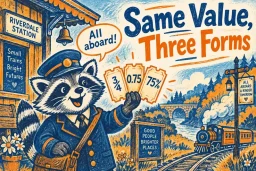
The three forms are interchangeable, and being able to flip between them instantly is one of the biggest test-day advantages you can build.
| Form | How to convert to the other two |
|---|---|
| Fraction | Decimal: divide top by bottom. Percent: divide, then × 100. |
| Decimal | Fraction: place value, then simplify. Percent: × 100. |
| Percent | Decimal: ÷ 100. Fraction: place over 100, then simplify. |
The most common SAT/ACT trick is mixing forms inside the same problem, for example, “What is 25% of \(\tfrac{4}{5}\)?” If you’re fluent in all three forms, you’d see this as \(\tfrac{1}{4} \times \tfrac{4}{5} = \tfrac{1}{5} = 0.2 = 20\%\).
The clever 0.999.. = 1 explanation
This surprises a lot of students: \(0.\overline{9} = 1\) exactly. Here’s the proof using the algebra trick from earlier:
- Let \(x = 0.999\ldots\).
- \(10x = 9.999\ldots\).
- Subtract: \(9x = 9 \to x = 1\).
It’s not “almost” 1. It is 1, written in a different form.
Working with negative fractions and decimals
The conversion rules don’t change for negatives, just keep the sign with the fraction throughout.
- \(-\tfrac{3}{4} = -0.75\).
- \(-0.625 = -\tfrac{5}{8}\).
- \(-1\tfrac{1}{2} = -1.5 = -\tfrac{3}{2}\).
A common mistake: dropping the negative sign halfway through a multi-step conversion. Anchor the sign at the start and don’t lose track of it.
Why this skill matters
Fluency between fractions and decimals is foundational for:
- Probability (often written as fractions, but tested as decimals or percents).
- Financial math (interest rates, sales tax, discounts).
- Statistics (data is often in decimals; ratios in fractions).
- Measurement (rulers use fractions; metric uses decimals).
- All standardized tests, the SAT explicitly mixes forms in the answer choices.
FAQ
What’s the easiest way to convert a fraction to a decimal?
Long division: top divided by bottom.
How do I know if a fraction will give a terminating decimal?
Simplify it first. If the denominator factors into only 2s and 5s, it terminates.
How do I turn a repeating decimal into a fraction?
Use the algebra trick above, set the decimal equal to \(x\), multiply to shift the repeat, and subtract.
Can every decimal be written as a fraction?
Every rational decimal, yes. Irrational decimals (like \(\pi\) or \(\sqrt{2}\)) cannot.
Are fraction-to-decimal conversions on standardized tests?
Absolutely. The SAT, ACT, GED, and TEAS all rely on you being fluent here.
How do I convert a fraction to a percent?
Convert the fraction to a decimal, then multiply by 100. \(\tfrac{3}{8} = 0.375 = 37.5\%\).
What if my decimal is mixed (some repeating, some not)?
Use the algebra trick, but multiply by powers of 10 to shift both the non-repeating and repeating parts.
Are repeating decimals considered rational?
Yes. Every repeating decimal is a ratio of two integers, so it’s rational.
How do I know if a fraction will give a terminating or repeating decimal?
Reduce the fraction first. If the simplified denominator’s only prime factors are 2 and/or 5, the decimal terminates. Anything else, 3, 7, 11, 13, and the decimal will repeat. Example: \(\tfrac{7}{40}\) terminates because \(40 = 2^3 \cdot 5\). But \(\tfrac{5}{12}\) repeats because \(12 = 2^2 \cdot 3\).
Are irrational numbers also decimals?
Yes. They’re decimals that never terminate and never repeat. Famous examples: \(\pi \approx 3.14159\ldots\), \(\sqrt{2} \approx 1.41421\ldots\), and \(e \approx 2.71828\ldots\). They can be written as decimals but never as exact fractions.
Why do bankers and scientists prefer decimals over fractions?
Decimals plug straight into calculators, line up neatly in columns, and are easier to compare at a glance. A scientist who writes “0.0042” can immediately tell it’s smaller than “0.0067.” Comparing \(\tfrac{42}{10000}\) to \(\tfrac{67}{10000}\) is just as easy, once you reduce them, but takes more steps.
Is 0.5 a fraction or a decimal?
It’s a decimal. But it’s exactly equal to the fraction \(\tfrac{1}{2}\). Numbers don’t “belong” to one form. They just have multiple equivalent representations.
How do I convert a mixed number to a decimal?
Keep the whole part. Convert the fractional part to a decimal. Add them. \(3\tfrac{1}{4} = 3 + 0.25 = 3.25\).
Speed-conversion table to memorize
| Fraction | Decimal | Percent |
|---|---|---|
| \(\tfrac{1}{2}\) | 0.5 | 50% |
| \(\tfrac{1}{3}\) | 0.333… | 33.3% |
| \(\tfrac{2}{3}\) | 0.666… | 66.7% |
| \(\tfrac{1}{4}\) | 0.25 | 25% |
| \(\tfrac{3}{4}\) | 0.75 | 75% |
| \(\tfrac{1}{5}\) | 0.2 | 20% |
| \(\tfrac{1}{8}\) | 0.125 | 12.5% |
| \(\tfrac{1}{10}\) | 0.1 | 10% |
Know these 8 cold and you’ll solve half the SAT percent/fraction problems on sight, no scratchwork needed.
One last reminder
Progress in math compounds. A 1% improvement every day for 100 days yields nearly a 3x improvement overall, because each new concept builds on the last. The students who pull ahead aren’t the ones who study the longest. They’re the ones who study consistently, review their mistakes, and refuse to skip the foundations. Show up tomorrow. Then show up the day after. The results take care of themselves.
If you found something useful here, save this article and revisit it after your next practice session. You’ll catch nuances on the second read that you missed on the first, because by then you’ll have the experience to recognize them. Happy practicing.
Want more practice? Grab our middle-school bundle or browse 5th-grade worksheets.
Recommended EffortlessMath Books
For a workbook that drills fraction-decimal conversion alongside the rest of pre-algebra, the Pre-Algebra for Beginners walks through every topic with worked examples. For elementary-level practice, the Common Core Grade 5 Math Workbook builds fraction-decimal fluency at the right level.

Pre-Algebra for Beginners 2026 The Ultimate Step by Step Guide to Preparing for the Pre-Algebra Test
Frequently Asked Questions
How do I convert a fraction to a decimal?
Divide the numerator (top) by the denominator (bottom). \(3/4\) is \(3 \div 4 = 0.75\). \(7/8\) is \(7 \div 8 = 0.875\). Use long division if no calculator is allowed. If the division doesn’t terminate, you have a repeating decimal, round to the requested decimal place or use the bar notation.
How do I convert a decimal to a fraction?
Read the decimal as a place-value reading. \(0.7\) is seven tenths = \(7/10\). \(0.45\) is forty-five hundredths = \(45/100 = 9/20\). Then simplify by dividing top and bottom by the greatest common divisor. The number of decimal places tells you the denominator: one place = 10, two places = 100, three places = 1000.
What’s a repeating decimal?
A repeating decimal has a digit (or block of digits) that repeats forever. \(1/3 = 0.3333\ldots\) (the 3 repeats); \(1/7 = 0.142857142857\ldots\) (the 6-digit block 142857 repeats). Write a bar over the repeating part: \(0.\overline{3}\) or \(0.\overline{142857}\). They come from denominators with prime factors other than 2 and 5.
How do I convert a repeating decimal to a fraction?
For a single-digit repeating block, put it over 9. \(0.\overline{3} = 3/9 = 1/3\); \(0.\overline{7} = 7/9\). For a two-digit block, put it over 99: \(0.\overline{45} = 45/99 = 5/11\). General rule: a block of \(n\) repeating digits goes over \(n\) nines. If there’s a non-repeating part first, the algebra gets longer.
How do I convert a fraction to a percent?
Two steps. First, convert the fraction to a decimal: \(3/4 = 0.75\). Then move the decimal point two places right and add the percent sign: \(0.75 = 75\%\). Shortcut: multiply the fraction by 100. \(3/4 \times 100 = 75\%\). Same answer either way.
How do I convert a percent to a fraction?
Drop the percent sign and put the number over 100. Then simplify. \(40\% = 40/100 = 2/5\). \(85\% = 85/100 = 17/20\). For percents with decimals (like \(12.5\%\)), multiply top and bottom by 10 first to clear the decimal: \(12.5/100 = 125/1000 = 1/8\).
What’s an easy way to remember common conversions?
Memorize the “big eight”: \(1/2 = 0.5\), \(1/3 \approx 0.333\), \(1/4 = 0.25\), \(1/5 = 0.2\), \(1/8 = 0.125\), \(1/10 = 0.1\), \(2/3 \approx 0.667\), \(3/4 = 0.75\). Most other test fractions are multiples of these. \(3/8\) is \(3 \times 0.125 = 0.375\). \(7/10\) is just \(0.7\).
Why does division give the decimal form?
A fraction \(a/b\) literally means \(a \div b\). The fraction bar is shorthand for division. So \(3/4\) and \(3 \div 4\) are the same calculation written two ways. When you divide, you get the decimal expansion of that quotient.
What if the decimal doesn’t end?
If the decimal terminates (like \(0.75\)), the original fraction’s denominator (in lowest terms) has only 2’s and 5’s as prime factors. If it repeats forever (like \(0.333\ldots\)), the denominator has other prime factors. Both are exact, the repeating decimal is exactly \(1/3\), not an approximation.
Where does fraction-decimal conversion show up on tests?
Everywhere. Conversion problems appear on the SAT, ACT, GED, HiSET, TASC, ASVAB, AFOQT, ALEKS, ISEE, SSAT, Praxis Core, TEAS, and every state grade 4-8 math test. Memorize the common conversions so you can switch forms in your head. It saves time on every other problem that uses fractions or percents.
Related EffortlessMath Lessons
If a topic on this page feels rusty, these short lessons go deeper:

Related to This Article
More math articles
- FREE ISEE Middle Level Math Practice Test
- The Ohio OST Grade 3 Math Worksheet Pack — 49 Free Printable Pages with Solutions
- 4th Grade English Worksheets for North Carolina (EOG): 57 Free Printable PDFs
- The Best Grade 4 Math Book for South Dakota Students
- DNA Replication Enzymes: Roles and Worked Examples
- The Best Grade 4 Math Book for Nebraska Students
- Free Grade 6 English Worksheets for Nevada Students
- FTCE Math FREE Sample Practice Questions
- What Are the 12 Algebraic Formulas?
- Top 10 CLEP College Algebra Practice Questions



What people say about "How to Convert Fractions to Decimals and Back"?
No one replied yet.