Civil War Turning Points: Major Campaigns and Their Consequences
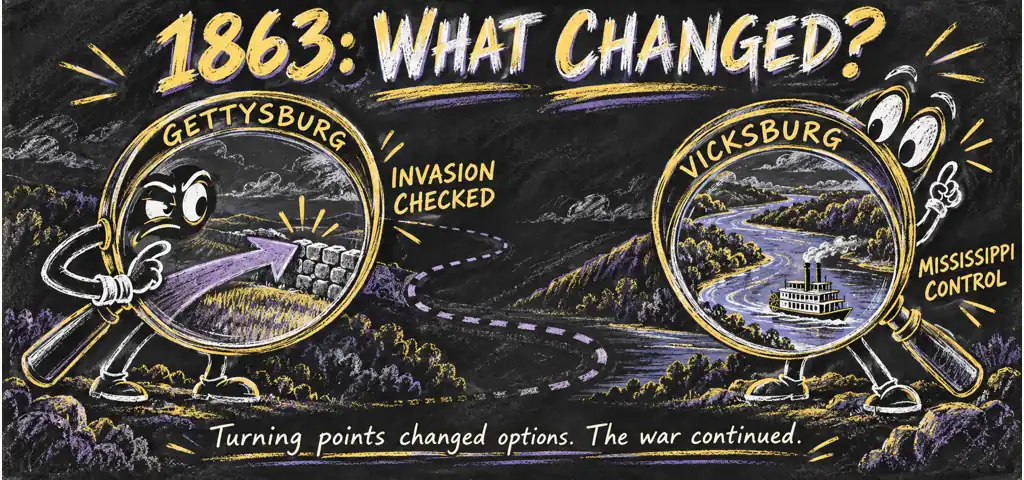
Civil War turning points changed what the armies and governments could do next. Compare Antietam, Gettysburg, Vicksburg and Atlanta by their military and political consequences. This CLEP U.S. History I lesson connects campaigns to emancipation, river control and the 1864 election, then asks you to test those connections against historical sources.
U.S. History to 1877 | Chapter 18 | Lesson 18.2
How Did Early Campaigns Change the War?
First Bull Run ended hopes for a short war. In the West, Union victories at Forts Henry and Donelson opened routes into Tennessee. New Orleans fell in 1862. Antietam stopped Lee’s first northern invasion and gave Lincoln the opportunity to announce preliminary emancipation. In 1863, Gettysburg ended Lee’s second invasion while Vicksburg removed a major Confederate stronghold on the Mississippi. Its surrender on July 4, followed by Port Hudson’s on July 9, opened the river to Union control. These victories did not end the war, but together they narrowed Confederate strategic choices.
Explain the Consequence, Not Just the Battle Name
Grant’s 1864 Overland Campaign imposed terrible losses while maintaining pressure on Lee. Sherman captured Atlanta, strengthening Lincoln politically, and marched through Georgia to damage transport, supplies, and Confederate morale. “Turning point” should be used carefully: it identifies a change in strategic direction, not a moment after which no uncertainty remained.
The western and eastern theaters interacted. Vicksburg severed a major trans-Mississippi connection. Gettysburg ended an invasion but did not destroy Lee’s army. Atlanta mattered because military news affected the 1864 presidential election and therefore the future of Union war policy. A turning-point claim is strongest when it names the mechanism—territorial control, army loss, diplomatic effect or political consequence—instead of treating fame as proof.
Civil War Turning Points in Sequence
Keep the event and its consequence together. These selected dates trace different kinds of change; they are not a complete battle list.
| Event | What changed? |
|---|---|
| Antietam, September 17, 1862 | Lee’s first northern invasion was checked. Lincoln issued the preliminary Emancipation Proclamation on September 22. |
| Gettysburg, July 1–3, 1863 | Lee’s second northern invasion ended, but his army continued fighting. |
| Vicksburg, July 4, 1863 | The fortress surrendered. With Port Hudson’s surrender on July 9, Union forces controlled the Mississippi and divided Confederate territory. |
| Atlanta, September 2, 1864 | Union occupation brought a military success that strengthened northern morale and Lincoln’s reelection prospects. |
| Appomattox, April 9, 1865 | Lee surrendered the Army of Northern Virginia. Other Confederate forces surrendered separately afterward. |
See the Battlefields in Context
History Recolored offers a visual route through this topic. As you watch, compare its explanation with the source limits in the written lesson.
Video: Civil War Battlefields – Then & Now – Antietam, Gettysburg, Vicksburg & More, History Recolored.
Check your understanding
- Which pair in 1863 most directly improved Union strategic position?
- Bull Run and Fort Sumter.
- Antietam and Shiloh.
- Gettysburg and Vicksburg.
- Atlanta and Appomattox.
- Hampton Roads and Trent.
- Antietam mattered politically because the battle
- destroyed Lee’s army and ended the eastern war.
- opened the route for immediate Union occupation of Richmond.
- gave the Union control of the Mississippi River.
- persuaded Britain to recognize Confederate independence.
- gave Lincoln an occasion to issue the preliminary Emancipation Proclamation.
- Select all effects of Vicksburg:
- Mississippi control,
- Confederate division,
- improved Union logistics,
- immediate surrender of Lee,
- strategic pressure in the West.
- Define a turning point without claiming that later outcomes were certain.
Write a brief response using a named fact from the lesson.
Open the answers and reasoning
Independent preparation. CLEP is a registered trademark of the College Board, which does not endorse this lesson.

Related to This Article
More math articles
- 5 Hidden Math Concepts Behind Today’s Most Popular Financial Platforms
- Religion
- Area of a Parallelogram
- TExES Core Subjects EC-6 Math Flashcards
- FREE CLEP College Algebra Practice Test
- 6th Grade OST Math FREE Sample Practice Questions
- Introduction to Sequences and Series: Fundamentals, Types, and Applications
- Entry and Economic Profit in Monopolistic Competition
- Free Grade 4 English Worksheets for South Dakota Students
- The Ultimate TASC Math Formula Cheat Sheet





What people say about "Civil War Turning Points: Major Campaigns and Their Consequences"?
No one replied yet.