CLEP U.S. History I 095: Lincoln-Douglas Debates, Election of 1860, and Secession
Lesson 17.6 of Chapter 17 of the U.S. History to 1877 study guide on Effortless Math covers CLEP U.S. History I 095: Lincoln-Douglas Debates, Election of 1860, and Secession: the key terms, the core ideas, and worked examples showing how this topic is tested on the exam.
U.S. History to 1877 | Chapter 17 | Lesson 17.6
In the 1858 Illinois Senate debates, Lincoln opposed slavery’s expansion while Douglas defended popular sovereignty. At Freeport, Douglas argued that territorial residents could effectively exclude slavery by refusing protective legislation, a position that helped him in Illinois but alienated southern Democrats. In 1860, Democrats split into northern and southern tickets. Lincoln won without carrying the Deep South, demonstrating that a sectional party could capture the presidency.
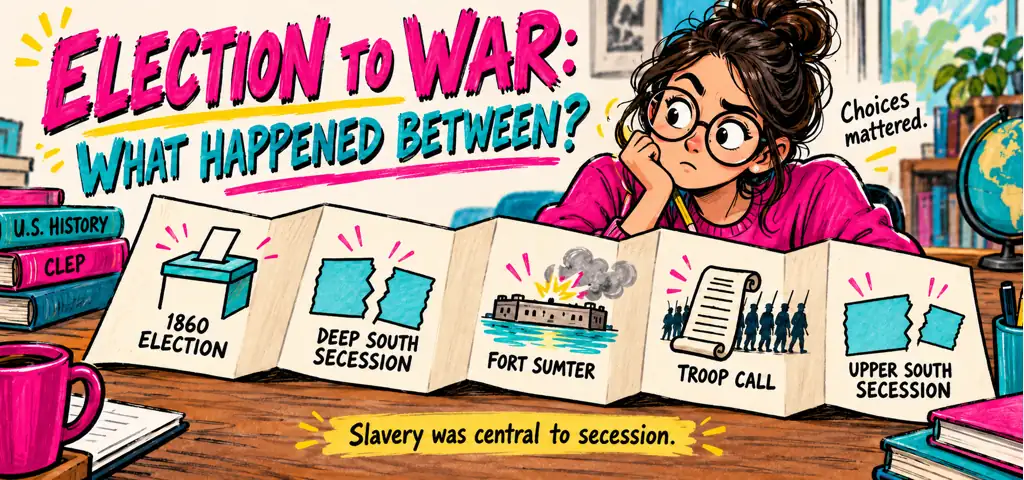
South Carolina seceded in December 1860, followed by other Deep South states before Lincoln took office. Secession declarations and commissioners centered slavery and the perceived threat to slaveholding security. Several Upper South states initially remained. Compromise proposals failed, and the Confederate attack on Fort Sumter in April 1861 led Lincoln to call for troops. Four more slave states then seceded. This sequence matters because it shows choices and stages rather than an automatic march to war.
Lincoln’s victory created a crisis of expected policy, not an immediate federal abolition order. Republicans denied slavery’s right to expand while promising not to interfere with it in states where it existed. Secessionists nevertheless argued that losing control of the executive threatened slavery’s long-term security and the return of fugitives. Unionists in the Upper South initially rejected immediate secession. The demand for troops after Sumter altered their calculation by making armed coercion of seceded states the next concrete issue.
Modeled chronology Election, Deep South secession, Confederate formation, Fort Sumter, troop call, Upper South secession. A question may ask which event changed the Upper South calculation. The answer is the call for troops after Fort Sumter, not Lincoln’s election alone.
Watch, then test the claim
Heimler's History traces the people and chronology behind this lesson. Listen for the evidence that sharpens the written account, then try the questions below.
Video: The Election of 1860 and SECESSION [APUSH Review Unit 5 Topic 7] Period 5: 1844-1877, Heimler's History.
Check your understanding
- Lincoln’s 1860 victory was possible largely because
- Republicans won majorities across the Deep South.
- John Bell withdrew and endorsed the Republican ticket.
- Democrats split while Republicans dominated the North.
- Republicans formed a coalition with southern Democrats.
- the Supreme Court excluded Breckinridge from the ballot.
- The Freeport Doctrine argued that territorial residents could
- pass an emancipation law overriding the Supreme Court.
- require Congress to restore the Missouri Compromise line.
- exclude slaveholders through a special residency rule.
- postpone statehood until slavery disappeared from the territory.
- discourage slavery by withholding protective local legislation.
- Select all stages before full Upper South secession:
- Lincoln elected,
- Deep South secedes,
- Confederacy forms,
- Fort Sumter attacked,
- Lincoln calls troops.
- Explain why the election of 1860 made secession possible without making civil war unavoidable.
Write a brief response using a named fact from the lesson.
Open the answers and reasoning
Independent preparation. CLEP is a registered trademark of the College Board, which does not endorse this lesson.

Related to This Article
More math articles
- How to Interpret Remainders of Division Bigger Numbers Via One-digit Numbers
- The Best Grade 7 ELA Practice Tests for Mississippi Students
- Sequence and Chronology
- Self-incrimination
- Free Grade 7 English Worksheets for North Dakota Students
- 8th Grade PSSA Math FREE Sample Practice Questions
- Contagion, Convergence, and Emergent Norms
- Setting and Context
- Free California CAASPP Grade 5 Math Practice: 49 Printable PDFs for Classrooms, Tutors, and Parents
- Calculus Books for High School Students: Compare 5 Options













What people say about "Lincoln-Douglas, 1860 and Secession"?
No one replied yet.