YOUR CLEP STUDY COMPANION
CLEP U.S. History I 102: Union Victory and the War’s Consequences
Lesson 18.7 of Chapter 18 of the U.S. History to 1877 study guide on Effortless Math covers CLEP U.S. History I 102: Union Victory and the War's Consequences: the key terms, the core ideas, and worked examples showing how this topic is tested on the exam.
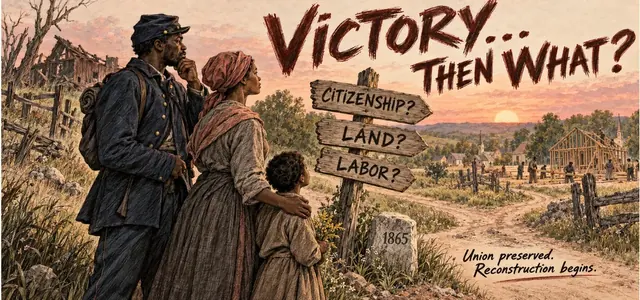
Lesson 18.7 of Chapter 18 of the U.S. History to 1877 study guide on Effortless Math covers CLEP U.S. History I 102: Union Victory and the War’s Consequences: the key terms, the core ideas, and worked examples showing how this topic is tested on the exam.
U.S. History to 1877 | Chapter 18 | Lesson 18.7
Union victory resulted from cumulative advantages converted into coordinated military and political power: manpower, finance, industry, transport, naval control, western victories, emancipation, Black enlistment, and leadership that maintained pressure. Confederate defeat also came from blockade, battlefield loss, infrastructure destruction, internal class conflict, desertion, and the collapse of enslaved labor. No single factor explains the outcome.
At Appomattox in April 1865, Lee surrendered the Army of Northern Virginia. Other Confederate forces followed. Lincoln’s assassination days later transformed the political setting for Reconstruction. The war preserved the Union, abolished slavery through the Thirteenth Amendment, devastated the South, strengthened federal power, and left unresolved the civil and political status of four million freed people. The peace therefore opened a constitutional struggle rather than restoring the old Union unchanged.
Appomattox was a decisive surrender, not the single moment when every Confederate force capitulated. Joseph E. Johnston surrendered to William T. Sherman in North Carolina later in April, and other forces surrendered afterward. Precise wording prevents a famous symbolic scene from erasing the war’s geographic scale. It also keeps military surrender separate from the legal abolition ratified in December and the political work of Reconstruction.
Modeled synthesis A strong “why did the Union win?” answer groups evidence: material capacity, strategy, emancipation/manpower, and Confederate weakness. A list without causal links is weaker than an explanation of how those factors reinforced one another.
See the history take shape
Heimler's History offers a visual route through this topic. As you watch, compare its explanation with the source limits in the written lesson.
Video: MILITARY Conflict in the CIVIL WAR [APUSH Review Unit 5 Topic 8] Period 5: 1844-1877, Heimler's History.
Check your understanding
- Which is the best explanation of Union victory?
- superior resources alone made command decisions unimportant.
- foreign neutrality by itself compelled Confederate surrender.
- Confederate internal dissent mattered more than every battlefield development.
- multiple material, military, political, and emancipation factors reinforced one another.
- the 1863 victories made the 1864 election and later campaigns irrelevant.
- The most important constitutional transformation completed by the war was
- a permanent presidential power to suspend habeas corpus nationwide.
- abolition of slavery through the Thirteenth Amendment.
- transfer of ordinary elections from civilians to military officers.
- replacement of state governments with one unitary national system.
- restriction of national citizenship to honorably discharged veterans.
- Select all consequences:
- preserved Union,
- strengthened federal state,
- southern devastation,
- unresolved citizenship questions,
- end of legal slavery.
- Explain why the war’s end created rather than completed Reconstruction.
Write a brief response using a named fact from the lesson.
Open the answers and reasoning
Independent preparation. CLEP is a registered trademark of the College Board, which does not endorse this lesson.

Related to This Article
More math articles
- Free Grade 5 English Worksheets for Maine Students
- Rounding Numbers
- Bureaucratic hierarchy
- Republican Governance, Tax Policy, and Normalcy
- How to Calculate the Areas of Triangles and Quadrilaterals
- ASVAB Arithmetic and Mathematics Preview
- The Best Grade 3 ELA Practice Tests for Mississippi Students
- Free Grade 4 English Worksheets for Common Core Students
- Let’s Chat: How to Simplify the Steps to Solve Two-step Equations
- The Best Grade 8 Math Book for Utah Students


















What people say about "Union Victory and the War's Consequences"?
No one replied yet.