CLEP U.S. History I 098: Emancipation as Policy and Process
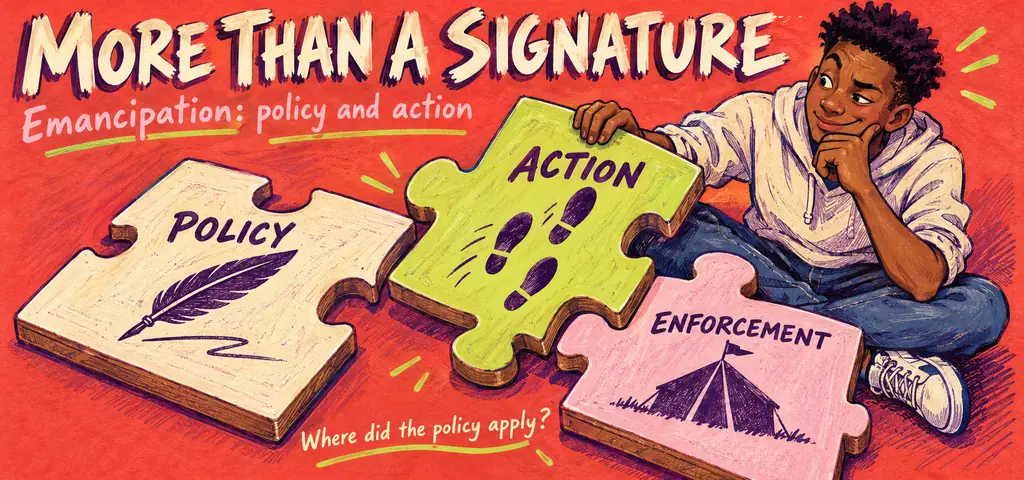
Lesson 18.3 of Chapter 18 of the U.S. History to 1877 study guide on Effortless Math covers CLEP U.S. History I 098: Emancipation as Policy and Process: the key terms, the core ideas, and worked examples showing how this topic is tested on the exam.
U.S. History to 1877 | Chapter 18 | Lesson 18.3
Enslaved people made emancipation a wartime reality by fleeing to Union lines, withdrawing labor, providing intelligence, and forcing commanders and lawmakers to decide their status. Congress passed confiscation acts and prohibited the return of people who had escaped to Union forces. Lincoln initially emphasized Union, border-state loyalty, and gradual plans, but military conditions and antislavery pressure shifted policy.
The Emancipation Proclamation, effective January 1, 1863, declared freedom in designated areas still in rebellion. It exempted loyal slave states and specified Union-held areas, so it did not instantly free every enslaved person. Its importance lay in making emancipation a Union war aim, authorizing Black enlistment, and so that Union advance carried a freedom policy. The Thirteenth Amendment was necessary to abolish slavery nationally.
Policy developed through a sequence: commanders first confronted freedom seekers, Congress defined “contraband” and confiscation rules, enslaved people created facts on the ground, and Lincoln issued preliminary and final proclamations under war powers. Freedom still depended on where Union authority reached, which is why military advance and Black action remained essential after January 1863. The Thirteenth Amendment then removed the rebellion-based geographic limit and supplied national constitutional abolition.
Modeled scope check Ask where and under what authority the proclamation operated: presidential war power against rebellion. That explains both its power and its exemptions.
See the history take shape
Watch this account from Khan Academy with one question in mind: which evidence makes the lesson's strongest claim hold up?
Video: Emancipation Proclamation | The Civil War era (1844-1877) | US History | Khan Academy, Khan Academy.
Check your understanding
- The proclamation directly applied to
- enslaved people in loyal border states but not the Confederacy.
- every location where slavery was legal on January 1, 1863.
- only places already occupied by Union armies and specifically exempted.
- designated areas still in rebellion.
- all territories while leaving rebellious states unchanged.
- Which development made abolition national and permanent in constitutional law?
- Confiscation Act alone.
- Thirteenth Amendment.
- Preliminary proclamation.
- Gettysburg Address.
- Homestead Act.
- Select all roles enslaved people played in emancipation:
- escape,
- labor withdrawal,
- intelligence,
- enlistment,
- pressure on Union policy.
- Explain why emancipation should be understood as both federal policy and self-liberating action.
Write a brief response using a named fact from the lesson.
Open the answers and reasoning
Independent preparation. CLEP is a registered trademark of the College Board, which does not endorse this lesson.

Related to This Article
More math articles
- Roles, Conflict, Strain, and Exit
- What “Provably Fair” Actually Proves (And What It Doesn’t)
- Barriers to third-party success
- Top 10 Tips You MUST Know to Retake the PERT Math
- Alabama ACAP Algebra 1 Free Worksheets: 64 Printable PDFs with Step-by-Step Answer Keys
- Free Grade 5 English Worksheets for Virginia Students
- Grade 2 English Worksheets for Hawaii Students — Free PDFs
- 10 Most Common 5th Grade MCAS Math Questions
- Free Grade 3 English Worksheets for New Mexico Students
- Find mutually beneficial terms of trade

















What people say about "Emancipation as Policy and Process"?
No one replied yet.