The Freedmen’s Bureau and the Meanings of Freedom
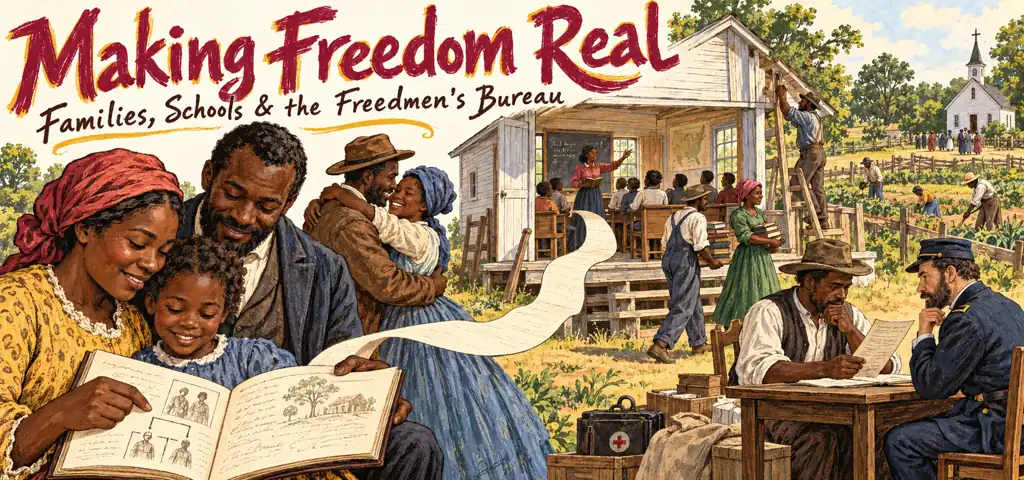
Chapter 1 of the CLEP History of the United States II study guide on Effortless Math covers The Freedmen’s Bureau and the Meanings of Freedom: the key terms, the core ideas, and worked examples showing how this topic is tested on the exam.
CLEP History of the United States II, Chapter 1
Freedom becomes a daily negotiation
For an emancipated family in 1865, freedom could begin with a search: a spouse sold away years earlier, children placed with another owner, wages for the first paid harvest, a school that had never been legally available, or a courthouse willing to recognize a marriage. The federal government had ended slavery, but freedom had to be made real in households, workplaces, and local institutions. Congress created the Bureau of Refugees, Freedmen, and Abandoned Lands in March 1865 as a temporary War Department agency. Commonly called the Freedmen's Bureau, it assisted formerly enslaved people and destitute Southern refugees during the transition from war to peace.
What the Bureau actually did
Under Commissioner Oliver O. Howard, Bureau agents distributed emergency food and clothing, supervised labor contracts, helped establish schools, reunited families, recorded marriages, supported hospitals, and sometimes heard disputes in Bureau courts where local justice was hostile. The agency worked with Black communities, northern aid societies, missionaries, and teachers rather than acting alone. It aided some impoverished white Southerners as well. Its portfolio shows why emancipation was more than a single legal event: people emerging from slavery needed access to institutions that slave law had denied, while war had displaced civilians and disrupted the regional economy.
Education and institution building
Freedpeople treated literacy and education as tools of independence. Adults and children filled classrooms, raised money, donated buildings, and supported teachers. The Bureau contributed funds, transport, protection, and coordination. Black communities supplied the demand, labor, and much of the local leadership. Congress chartered Howard University in 1867 and named it for Bureau commissioner Oliver O. Howard. Fisk University grew from the same postwar movement. In 1871 its Jubilee Singers began touring to save the struggling school and introduced wider audiences to spirituals shaped in slavery. Northern aid mattered, but the students, parents, congregations, and organizers were not passive recipients. They were building institutions around goals already their own.
Land and the limits of economic independence
Many freedpeople saw landownership as essential because dependence on enslavers could reproduce coercion. During the war, General William T. Sherman's Special Field Orders No. 15 reserved coastal land in parts of South Carolina, Georgia, and Florida for Black settlement. The order inspired the phrase "forty acres and a mule." The Bureau initially controlled some abandoned or confiscated land, but President Johnson restored much of it to pardoned owners. A smaller experiment survived near Washington, where the Bureau sold one-acre Barry Farm lots to freed families on installments. Most families received no redistributed land and instead entered wage contracts, tenancy, or sharecropping. That lost opportunity deepened the South's long economic vulnerability.
Savings and self-governing institutions
Freedom also meant controlling savings and building organizations beyond white supervision. Independent Black churches hosted worship, political meetings, classrooms, and mutual aid. In Houston, formerly enslaved residents pooled money in 1872 to buy Emancipation Park for Juneteenth celebrations. Congress had also chartered the Freedman's Savings and Trust Company in 1865. Despite its official-sounding name, it was a private corporation, not a Bureau program, and Congress did not insure its deposits. Managers later steered savings into speculative real-estate and railroad loans. The Panic of 1873 helped sink the bank in 1874, costing many depositors dearly. Black institution building was real, but federal prestige did not guarantee federal protection.
Federal education efforts meet political limits
Reconstruction produced national education experiments as well as Southern schools. Congress created a Department of Education in 1867 to collect information. Fears of federal control over local schools led lawmakers to reduce it to an Interior Department office in 1869. Later proposals met similar limits. James G. Blaine's failed amendment of 1875 sought to keep public school funds from sectarian control. That same year, Republicans removed Charles Sumner's school-equality clause from the Civil Rights Act to save the bill's remaining public-accommodations protections. Congress could promote education, but local control, religious conflict, race, and declining Republican power narrowed what national lawmakers were willing to require.
Labor contracts: protection and control
Bureau agents often negotiated or approved annual labor contracts between planters and freed workers. At their best, contracts recognized wages, family labor choices, and legal claims that slavery had erased. Yet agents also prioritized resuming cotton production and sometimes compelled workers to sign agreements or punished those labeled idle. Freedpeople sought shorter hours, control over women's and children's labor, the right to cultivate family plots, and freedom from gang labor and whipping. Planters wanted a disciplined, dependent workforce. The Bureau stood inside that conflict, sometimes checking abuse and sometimes enforcing an unequal labor order. Federal assistance was therefore meaningful but neither neutral nor sufficient.
Political attack and limited capacity
The Bureau faced violent white resistance, hostile local officials, too few agents, short funding, and an enormous geographic assignment. Johnson vetoed an expansion bill in February 1866, arguing that it extended military power and favored one class of citizens. Congress failed to override that first veto but passed a revised measure in July and overrode him. Most Bureau operations ended in 1872. Its limited life did not erase its achievements, especially in schooling, family records, relief, and legal advocacy. It does show a recurring Reconstruction problem: rights announced nationally depended on enforcement amid determined local opposition.
infer a meaning of freedom
Suppose a source describes freed parents withdrawing children from field labor and enrolling them in school.
Distinguish agency from paternalism
Two oversimplifications appear often. One says the Bureau single-handedly "gave" freedom, schools, and welfare to former slaves. The other dismisses it because it failed to redistribute land or eliminate poverty. The evidence supports a more precise judgment. The Bureau provided unprecedented, if temporary, federal intervention and made tangible gains possible; freedpeople themselves defined priorities and built institutions; white resistance and federal limits restricted the results. Chronologically, the Bureau was created in March 1865, Johnson opposed its expansion in 1866, Congress renewed it over his veto, and most functions ended by 1872. Its history previews the broader rise and retreat of federal Reconstruction.
Watch the history in motion
This short lesson adds voices, images, and chronology to the ideas you just studied.
Video: Freedmen's Bureau, NBC News Learn.
Try four CLEP-style questions
- Which description correctly identifies the Freedmen's Bureau's institutional status?
- A permanent Cabinet department serving formerly enslaved people through continuing congressional appropriations
- A private missionary association funded by northern churches and voluntary societies
- A federal tribunal with authority to supplant southern state courts in ordinary civil cases
- A temporary War Department agency assisting freedpeople and destitute refugees
- A federally chartered savings bank that combined deposits with emergency relief administration
- The restoration of abandoned Southern land to pardoned former owners most directly limited which freedpeople's claim about the meaning of freedom?
- That marriages and parent-child relationships should receive legal recognition
- That families should gain independent access to productive property rather than remain dependent on former enslavers' land
- That labor contracts should state wages, limit physical punishment, and guarantee workers an unrestricted choice of employers
- That communities should build schools and churches under their own leadership
- That Black men should participate in elections and public office
- How did Bureau work on family records differ from its supervision of labor contracts?
- Contract supervision consistently increased family control over women's and children's work, while marriage registration chiefly restored planter authority.
- Family registration principally assigned confiscated acreage, while contract review transferred crop ownership to laborers.
- Marriage and kinship records generally recognized family autonomy, while contract supervision could protect wages yet also pressure workers into an unequal labor system.
- Family registration depended on state recognition alone, while contract supervision occurred without any Bureau role.
- Both activities gave useful federal assistance, but neither altered the legal standing of freed families or bargaining power between laborers and landowners.
- A Bureau register records freed couples seeking legal marriages and parents seeking formal recognition of their children. This evidence best illustrates freedom as
- the right to negotiate a crop contract with a landowner
- independent ownership of the land a family cultivated
- emergency access to federal food and medical relief
- political equality secured through voting and officeholding
- family autonomy and legal recognition of relationships slavery had denied
Check your answers and reasoning
Independent preparation. CLEP is a registered trademark of the College Board, which does not endorse this lesson.

Related to This Article
More math articles
- Foreign and defense policy
- How the Supreme Court Chooses and Decides Cases
- Point-of-Use Care and Soiled-Item Transport
- Grade 2 English Practice for Arkansas Second Graders
- Massachusetts MCAS Grade 4 Math Free Worksheets: Printable PDF Practice with Student-Friendly Keys
- Enhanced ACT Math 2026: The New 45-Question Section, Explained
- How Traditional News Media Shapes Politics
- How to Simplify Radical Expressions? (+FREE Worksheet!)
- Feminist Theory and Intersectionality
- How to Solve Venn Diagrams and the Addition Rule?

















What people say about "The Freedmen's Bureau and Meanings of Freedom"?
No one replied yet.