Black Codes and the Civil Rights Act of 1866
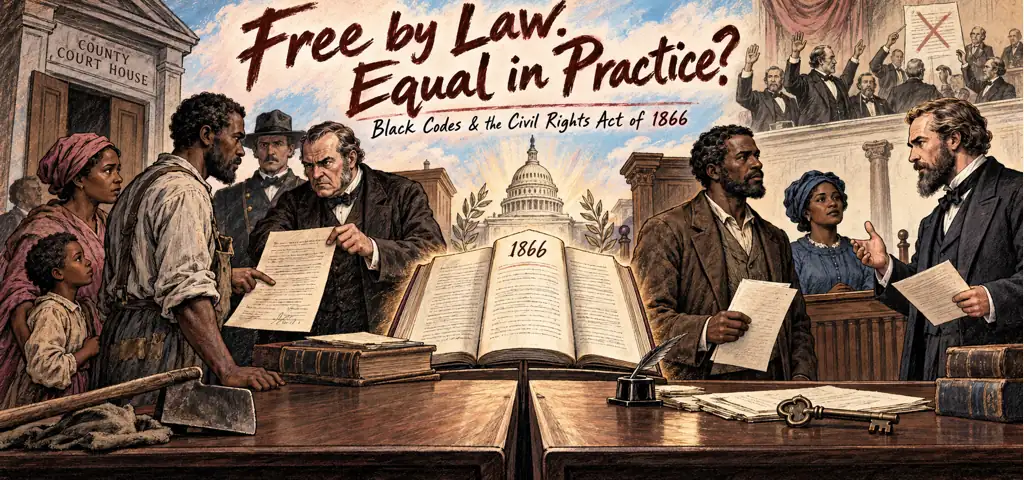
Chapter 1 of the CLEP History of the United States II study guide on Effortless Math covers Black Codes and the Civil Rights Act of 1866: the key terms, the core ideas, and worked examples showing how this topic is tested on the exam.
CLEP History of the United States II, Chapter 1
Emancipation meets state law
In late 1865, a freedman could be legally free yet arrested for lacking proof of employment, fined, and then forced to work off the penalty. Southern legislatures enacted Black Codes to regulate the movement, labor, and civil status of formerly enslaved people. The codes varied by state. Some recognized Black marriages, property ownership, and access to courts because emancipation made a separate legal regime unavoidable. At the same time, vagrancy laws, labor-contract rules, apprenticeship provisions, and occupational restrictions attempted to secure plantation labor and preserve white authority. Their mixture of limited civil recognition and coercion makes them more revealing than the simple claim that they restored slavery unchanged.
How coercion worked after slavery
Mississippi required many Black workers to show annual labor contracts and imposed penalties for leaving before the term ended. Vagrancy provisions allowed officials to arrest people deemed idle or without lawful employment; inability to pay a fine could lead to compulsory labor. Apprenticeship laws permitted courts to bind Black children, often to former enslavers, when officials declared parents unable to support them. Other rules restricted firearms, assembly, land rental, or access to certain occupations. The Thirteenth Amendment had abolished property in human beings, but its exception for punishment after criminal conviction gave discriminatory policing and sentencing particular power. Law could manufacture dependence without formally declaring a person enslaved.
The codes reshape northern politics
Reports of Black Codes and anti-Black violence undercut President Johnson's claim that loyal, republican government had returned. Many northern voters who had not supported sweeping racial equality nevertheless concluded that emancipation required federal protection. Republicans argued that if states could define freedom so narrowly, the result of the Civil War was insecure. The codes thus caused more than local suffering: they helped move moderate Republicans toward stronger congressional Reconstruction. Causation runs through evidence and politics-Southern policy demonstrated a problem, congressional investigation publicized it, and Republican lawmakers built a national legal response.
The Civil Rights Act defines national equality
The Civil Rights Act of 1866 declared people born in the United States and not subject to a foreign power to be citizens, excluding "Indians not taxed" under the period's language. It guaranteed citizens of every race the same rights to make and enforce contracts, sue, testify, inherit, purchase, lease, sell, hold, and convey property, and receive the benefit of laws for person and property. Federal courts and officials could act against violations. The statute attacked the civil disabilities at the heart of Black Codes. It did not establish universal suffrage, integrate schools, or redistribute land; civil rights in this act meant a defined set of legal capacities.
Veto, override, and constitutional uncertainty
Johnson vetoed the bill in March 1866. He argued that Congress was creating unequal federal favoritism, intruding on state authority, and legislating while eleven states lacked representation. Congress overrode the veto in April, the first override of a presidential veto on a major piece of legislation. Republicans relied partly on the Thirteenth Amendment's enforcement power, reasoning that eliminating slavery included eliminating its badges and incidents. Yet some doubted whether an ordinary law could securely prevent a future Congress or hostile courts from narrowing citizenship. That concern helped produce the Fourteenth Amendment, which placed birthright citizenship and equal legal protection in the Constitution.
Civil rights are not the same as political rights
A vital distinction separates civil rights from political rights in the immediate postwar debate. The 1866 act protected legal personhood, contracts, property, and court access. Voting was generally treated as a political right and remained controlled by states until Reconstruction policy and the Fifteenth Amendment imposed new limits. A test distractor may claim that the act granted all Black men the ballot; it did not. Nor did citizenship automatically produce effective equality. Local juries, sheriffs, judges, employers, and armed groups could obstruct formally recognized rights, which is why enforcement and federal jurisdiction mattered.
connect statute to cause
Consider a statutory phrase granting citizens the same right in every state and territory to make and enforce contracts regardless of race.
Chronology, result, and limit
The order clarifies the constitutional escalation. The Thirteenth Amendment became effective in December 1865. Black Codes appeared during presidential restoration in 1865 and early 1866. Congress passed the Civil Rights Act over Johnson's veto in April 1866, then sent the Fourteenth Amendment to the states in June. The act established a major national principle and remains significant, but coercion did not disappear. Its enforcement competed with hostile local power and later judicial narrowing. The proper conclusion is neither that the law instantly secured equality nor that it meant nothing; it created enforceable federal claims and revealed why constitutional change was necessary.
Watch the history in motion
This short lesson adds voices, images, and chronology to the ideas you just studied.
Video: RECONSTRUCTION [APUSH Review Unit 5 Topic 10] Period 5: 1844-1877, Heimler's History.
Try four CLEP-style questions
- Black Codes were primarily designed to
- make limited recognition of Black marriages the foundation of equal political citizenship
- control freedpeople's labor and preserve white authority after slavery
- restore every feature of antebellum slave law without adapting it to formal emancipation
- transfer regulation of plantation contracts from states to the Freedmen's Bureau
- supplant coercive labor rules with uniformly voluntary wage bargaining
- Why did the Black Codes strengthen support for congressional Reconstruction?
- They showed that the Thirteenth Amendment had transferred voting qualifications directly to Congress.
- They convinced Johnson that military districts should supersede his restoration governments.
- They demonstrated that state courts had already enforced the Civil Rights Act uniformly.
- They led Southern legislators to invite federal supervision of labor contracts.
- They demonstrated that rapid restoration could leave emancipation without meaningful civil protection.
- How did the Civil Rights Act of 1866 differ from the Fifteenth Amendment?
- The act constitutionalized birthright citizenship, while the amendment abolished involuntary servitude.
- The act protected specified civil capacities, while the amendment later barred racial discrimination in voting rights.
- The act prohibited racial voting restrictions nationwide, while the amendment protected contracts and court access under federal law.
- The act regulated presidential removals, while the amendment prescribed state readmission.
- The act applied only in federal territories, while the amendment constrained only Congress.
- A law guarantees all citizens the same right to make contracts, own property, and use courts. Which development does it most directly reflect?
- The Reconstruction Act of 1867
- The Freedmen's Bureau Act of 1865
- The Civil Rights Act of 1866
- The Fifteenth Amendment
- The Enforcement Act of 1870
Check your answers and reasoning
Independent preparation. CLEP is a registered trademark of the College Board, which does not endorse this lesson.

Related to This Article
More math articles
- Multistep Chemistry Problems: Connect Moles, Gas Volume, and Assumptions
- Free Grade 7 English Worksheets for Wisconsin Students
- What Level of Math is Tested on the PSAT/NMSQT?
- Liters and Milliliters for 4th Grade
- How to Solve Linear Equations: Step-by-Step with Examples
- Digital SAT Math Practice Test PDF with Answers (2026)
- Journey to the Edge: A Meticulous Exploration of One-Sided Limits
- Shop Safety, PPE, and First Checks
- Top 10 5th Grade ACT Aspire Math Practice Questions
- Free Grade 7 English Worksheets for Mississippi Students



















What people say about "Black Codes and the Civil Rights Act of 1866"?
No one replied yet.