The Thirteenth, Fourteenth, and Fifteenth Amendments
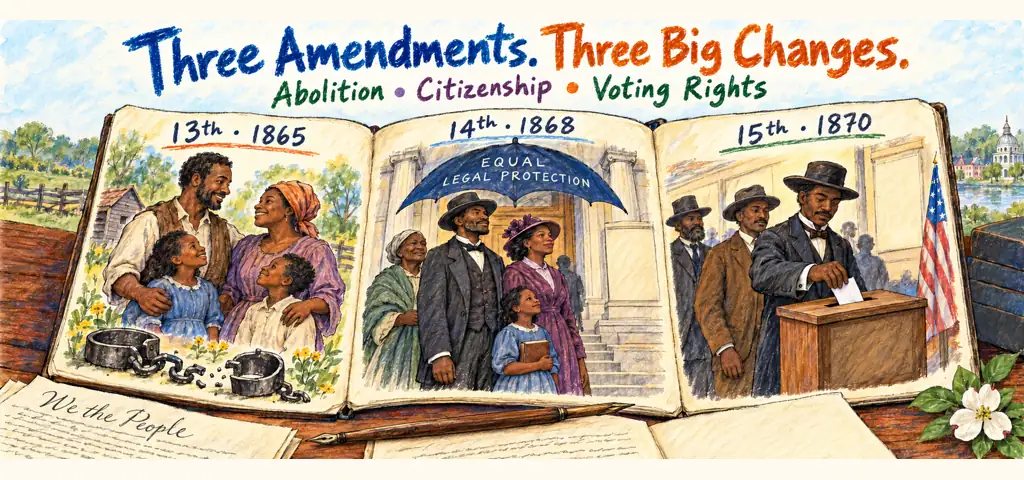
Chapter 1 of the CLEP History of the United States II study guide on Effortless Math covers The Thirteenth, Fourteenth, and Fifteenth Amendments: the key terms, the core ideas, and worked examples showing how this topic is tested on the exam.
CLEP History of the United States II, Chapter 1
Three amendments, three constitutional jobs
The Reconstruction Amendments changed the constitutional order in stages. The Thirteenth Amendment abolished slavery in 1865, except as punishment for a crime after conviction. The Fourteenth, ratified in 1868, constitutionalized national and state citizenship, due process, and equal protection while adding rules concerning representation, former officeholders who had joined insurrection, and public debt. The Fifteenth, ratified in 1870, prohibited the United States or a state from denying or abridging the right to vote because of race, color, or previous condition of servitude. Treating the three as interchangeable hides both their distinct language and the gaps opponents later exploited.
The Thirteenth Amendment: abolition and enforcement
Section 1 destroyed the legal institution of chattel slavery throughout the nation; emancipation no longer depended only on wartime proclamation or state action. Section 2 authorized Congress to enforce abolition through appropriate legislation. That power supported laws aimed at conditions understood as badges or incidents of slavery, including the Civil Rights Act of 1866. The punishment exception, however, permitted involuntary servitude after criminal conviction. Southern states later combined discriminatory criminal laws, fines, and convict leasing in ways that coerced Black labor. The amendment was revolutionary in ending ownership of people, but abolition did not itself define citizenship, equality before state law, or suffrage.
The Fourteenth Amendment: citizenship and state power
The Citizenship Clause overturned the logic of Dred Scott by declaring people born or naturalized in the United States and subject to its jurisdiction citizens of the nation and their state. The Privileges or Immunities Clause barred states from abridging privileges or immunities of U.S. citizens. The Due Process Clause restricted states from depriving any person of life, liberty, or property without due process; the Equal Protection Clause required equal protection of the laws. The word "person" in the latter clauses matters because their protection is not confined to citizens. These provisions made state conduct a direct constitutional concern and later became central to incorporation and civil-rights litigation.
The Fourteenth was also a Reconstruction settlement
The amendment's later sections addressed immediate postwar problems. Section 2 reduced representation when a state denied adult male citizens the vote, though Congress did not effectively use that penalty against Southern disfranchisement. Its word "male" angered suffragists such as Elizabeth Cady Stanton and Susan B. Anthony, who wanted the postwar settlement to enfranchise women too. Section 3 disqualified certain officeholders who had sworn to support the Constitution and then joined insurrection, unless Congress removed the disability. Section 4 validated Union debt while rejecting Confederate debt and compensation for emancipation. Congress also required former Confederate states to ratify the amendment before readmission under congressional Reconstruction.
The Fifteenth Amendment and its loopholes
The Fifteenth Amendment barred governments from denying the vote because of race and gave Congress enforcement power. The 1868 election sharpened Republican interest: Grant's narrow popular majority depended on Black voters in the reconstructed South, while several northern states excluded Black men. Congress proposed the amendment in February 1869. It did not ban sex discrimination, poll taxes, or literacy tests by name, and it did not guarantee fair administration. Southern officials later combined facially neutral rules with violence, fraud, and selective enforcement to disfranchise Black voters. The Twenty-fourth Amendment and Voting Rights Act addressed some devices. A broad constitutional promise can still be weakened by evasive policy and inadequate enforcement.
Federalism is transformed, not erased
Before the Civil War, the Bill of Rights chiefly restricted the federal government, and states largely controlled civil status and voting qualifications. The Reconstruction Amendments imposed new prohibitions on states and gave Congress explicit enforcement powers. This created constitutional tools for national protection of individual rights. It did not abolish states or make every private wrong a federal constitutional violation. The state-action distinction later allowed courts to limit federal remedies against private discrimination. Reconstruction thus produced a new federalism: states retained major authority, but citizenship and rights could no longer be described as exclusively state-created matters.
assign the correct amendment
Imagine three cases: Congress bans labor coerced like slavery; a state court denies one racial group equal protection; and a state constitution limits voting to white men.
Chronology and common confusions
Remember the order by function: abolition in 1865, citizenship and state duties in 1868, racial voting protection in 1870. Congress pursued the Fourteenth Amendment after the Civil Rights Act of 1866 so citizenship and limits on state action would not depend on an ordinary statute that a later Congress could repeal. The amendment did not instantly apply the entire Bill of Rights to the states; the Supreme Court developed incorporation later through due process. Nor did the Fifteenth enfranchise women; the Nineteenth did so in 1920. The Reconstruction amendments created durable powers and promises, but legislation, courts, presidents, officials, and voters determined their practical reach.
Watch the history in motion
This short lesson adds voices, images, and chronology to the ideas you just studied.
Video: Civil War Amendments, American Battlefield Trust.
Try four CLEP-style questions
- Which amendment first made birthright national citizenship an explicit constitutional rule?
- The Fourteenth, through its Citizenship Clause
- The Thirteenth, through its prohibition of slavery
- The Civil Rights Act of 1866, because an ordinary statute is itself a constitutional amendment
- The Nineteenth, through its prohibition of sex discrimination in voting
- The Fifteenth, through its protection against racial voting discrimination
- Why did congressional Republicans pursue the Fourteenth Amendment after enacting the Civil Rights Act of 1866?
- To restore the three-fifths rule for congressional representation and preserve the antebellum allocation of seats among the states
- To return the definition of citizenship exclusively to state legislatures
- To limit the Civil Rights Act to conduct by federal officials
- To place citizenship and limits on state action in the Constitution rather than rely only on an ordinary statute
- To eliminate the need for courts and congressional enforcement legislation
- Which comparison of the Thirteenth and Fourteenth Amendments is most accurate?
- The Thirteenth constrained only state governments, while the Fourteenth reached only federal conduct.
- The Thirteenth barred racial voting restrictions in state and federal elections, while the Fourteenth ended slavery and involuntary servitude except after criminal conviction.
- The Thirteenth ended slavery, while the Fourteenth defined citizenship and restricted state denial of due process and equal protection.
- The Thirteenth defined national citizenship, while the Fourteenth principally regulated presidential pardons.
- Both imposed the same prohibition but assigned enforcement to different branches.
- Place these developments in chronological order: (1) Fifteenth Amendment ratified; (2) Fourteenth Amendment ratified; (3) Thirteenth Amendment ratified.
- 1, 2, 3
- 2, 3, 1
- 2, 1, 3
- 3, 1, 2
- 3, 2, 1
Check your answers and reasoning
Independent preparation. CLEP is a registered trademark of the College Board, which does not endorse this lesson.

Related to This Article
More math articles
- Microorganisms and Resistance
- The Role Played by Infinity in Limits
- How to do well on the PSAT test?
- Production explains the U shapes
- How to Unravel One-to-One Functions
- Word Problems: Multiplication for 4th Grade
- Printable Algebra 1 Worksheets with Answers (Free PDFs)
- The Best Grade 5 ELA Practice Tests for Oklahoma Students
- Minnesota MCA Grade 6 Math Free Worksheets: Printable Grade 6 Math Practice You Can Download Free
- Unemployment, Migration, Family Survival, and Depression Culture



















What people say about "Thirteenth, Fourteenth, Fifteenth Amendments"?
No one replied yet.