Congressional Reconstruction and Johnson’s Impeachment
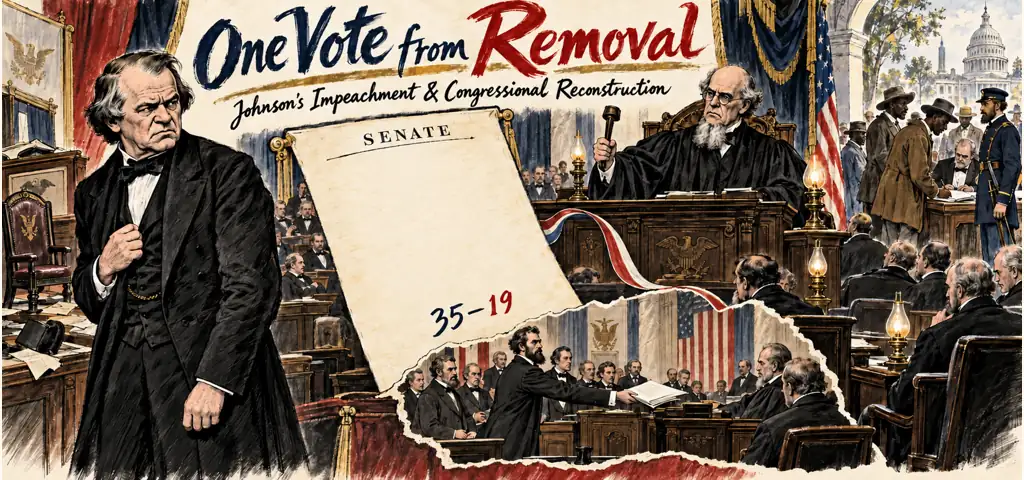
Chapter 1 of the CLEP History of the United States II study guide on Effortless Math covers Congressional Reconstruction and Johnson’s Impeachment: the key terms, the core ideas, and worked examples showing how this topic is tested on the exam.
CLEP History of the United States II, Chapter 1
Congress takes control
By 1867, repeated veto confrontations, Southern violence, and rejection of the Fourteenth Amendment persuaded most congressional Republicans that presidential restoration had failed. The Reconstruction Act of March 1867 divided ten unreconstructed former Confederate states into five military districts; Tennessee had already been readmitted after ratifying the Fourteenth Amendment. Military commanders supervised registration of eligible voters. States had to write new constitutions providing Black male suffrage, ratify the Fourteenth Amendment, and obtain congressional approval before full representation. This was congressional, often called Radical, Reconstruction: not permanent military dictatorship, but military supervision tied to a constitutional process for creating new civilian governments.
Why 1867 was a turning point
Johnson had organized restored governments mainly through pardoned white voters and presidential authority. Congress now required new electorates that included Black men and temporarily excluded some former Confederate leaders. Later Reconstruction Acts clarified registration and military power. Congress could also reverse readmission when a state broke the terms. In 1869 it returned Georgia to military rule after legislators expelled thirty-three Black members while seating white men disqualified by the Fourteenth Amendment. The policy joined loyal government to a constituency able to defend emancipation. That federal condition on state restoration was radical by prior American standards. Yet Congress neither transferred most land to freedpeople nor permanently excluded every former Confederate.
A struggle over administration
Congress feared Johnson would remove officials who enforced its policy. The Tenure of Office Act of 1867 required Senate consent before he removed certain Senate-confirmed officers. The Command of the Army provision routed presidential and War Department orders through General Ulysses S. Grant and protected Grant from removal without Senate consent. The Tenure Act's uncertain application to Secretary of War Edwin M. Stanton triggered the impeachment crisis. Johnson suspended Stanton while the Senate was away, but senators refused to concur. In February 1868 Johnson removed him anyway and named Lorenzo Thomas as interim secretary. The House treated the move as deliberate defiance of the statute and quickly approved impeachment proceedings.
Impeachment is an accusation, not removal
The House of Representatives impeached Johnson on February 24, 1868. Eleven articles followed, most centered on violation of the Tenure of Office Act, with another attacking his inflammatory public speeches. Under the Constitution, the House impeaches by majority vote; the Senate conducts a trial, and conviction and removal require two-thirds of senators present. Chief Justice Salmon P. Chase presided because the president was tried. On three articles, the Senate voted 35 guilty to 19 not guilty-one vote short of the necessary two-thirds. The Senate then adjourned without voting on the remaining articles. Johnson therefore was impeached but not convicted or removed.
Why some Republicans voted to acquit
The seven Republican senators who joined Democrats for acquittal had varied motives. Some doubted the Tenure of Office Act covered Stanton, who had been appointed by Lincoln; some feared turning policy conflict into grounds for removing a president; some disliked the prospect of Senate president pro tempore Benjamin Wade succeeding Johnson; and some believed Johnson had already been politically contained. Evidence of political pressure and patronage circulated, but a single explanation cannot account for every vote. The constitutional issue was larger than Johnson's conduct: how far could impeachment be used to resolve a fundamental struggle between Congress and the executive?
Johnson loses the policy war
Acquittal did not restore Johnson's control of Reconstruction. Congress had overridden key vetoes, enacted military Reconstruction, and imposed constitutional conditions. Johnson promised greater compliance as the trial approached and completed his term in March 1869. Ulysses S. Grant, the Republican victor in 1868, supported congressional Reconstruction more reliably. In 1869 Congress passed the Fifteenth Amendment and states ratified it in 1870. The episode thus separates personal survival from institutional success: Johnson survived the Senate trial, but the congressional program he opposed largely governed the next phase.
distinguish the constitutional steps
A test item may say that Johnson was "impeached by Congress and narrowly remained president".
Limits and later perspective
Do not confuse the Reconstruction Acts with the amendments. The acts set restoration procedures; the amendments changed the Constitution. Military districts did not erase civil life, and the Army could not guarantee safety everywhere. In Ex parte McCardle (1869), Congress repealed the statute giving the Supreme Court jurisdiction over a pending habeas challenge to military Reconstruction. The Court accepted Congress's power to make exceptions to its appellate jurisdiction and dismissed the case without ruling on Reconstruction's validity. Congress revised the Tenure of Office Act in 1869 and repealed it in 1887; later doctrine rejected a comparable removal restriction in another setting. Institutional power, party conflict, shaped congressional Reconstruction.
Watch the history in motion
This short lesson adds voices, images, and chronology to the ideas you just studied.
Video: RECONSTRUCTION [APUSH Review Unit 5 Topic 10] Period 5: 1844-1877, Heimler's History.
Try four CLEP-style questions
- Who presided over Andrew Johnson's Senate trial, as the Constitution requires when a president is tried?
- The Senate president pro tempore acting as the chamber's regular presiding officer
- The senior associate justice
- The Speaker of the House
- The vice president
- The chief justice of the United States
- Johnson's acquittal in the Senate is best interpreted as
- a ruling that the House lacked power to impeach for alleged statutory violations
- a rejection of every article by a majority of senators
- a restoration of Johnson's control over military Reconstruction
- a narrow escape from removal even though Congress retained policy dominance
- a judicial invalidation of congressional readmission conditions
- Which comparison of the Reconstruction Acts and the Reconstruction Amendments is most accurate?
- The acts were executive directives, while the amendments were ordinary congressional statutes.
- The acts established constitutional citizenship and equal protection, while the amendments directly administered five Southern military districts.
- The acts prescribed statutory restoration procedures, while the amendments placed enduring rules in the Constitution.
- The acts dealt chiefly with cabinet tenure, while the amendments prescribed presidential succession.
- The acts became permanent constitutional text when the last state was readmitted.
- Which sequence correctly traces the impeachment crisis?
- Stanton's removal; First Reconstruction Act; House impeachment; Senate acquittal
- First Reconstruction Act; Stanton's removal; House impeachment; Senate acquittal
- House impeachment; Stanton's removal; Senate acquittal; First Reconstruction Act
- First Reconstruction Act; House impeachment; Stanton's removal; Senate acquittal
- First Reconstruction Act; Senate acquittal; Stanton's removal; House impeachment
Check your answers and reasoning
Independent preparation. CLEP is a registered trademark of the College Board, which does not endorse this lesson.

Related to This Article
More math articles
- Free Grade 6 English Worksheets for Idaho Students
- Issue networks
- Factors and Factor Pairs for 4th Grade
- Generational effects
- Stars, Galaxies, and the Universe
- Attending meetings
- Grade 3 Math: Adding 3-Digit Numbers
- ATI TEAS 7 Math Worksheets: FREE & Printable
- Alabama ACAP Algebra 1 Free Worksheets: 72 Printable PDFs with Step-by-Step Answer Keys
- 8th Grade Georgia Milestones Assessment System Math Worksheets: FREE & Printable



















What people say about "Congressional Reconstruction and Impeachment"?
No one replied yet.