Reconstruction Governments, Black Officeholding, and Federal Enforcement
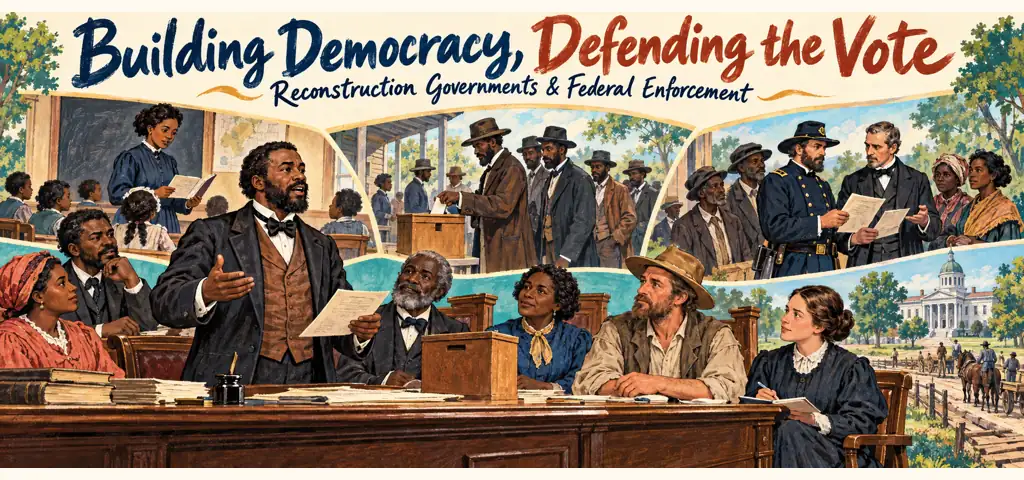
Chapter 1 of the CLEP History of the United States II study guide on Effortless Math covers Reconstruction Governments, Black Officeholding, and Federal Enforcement: the key terms, the core ideas, and worked examples showing how this topic is tested on the exam.
CLEP History of the United States II, Chapter 1
A new electorate enters government
Beginning in 1867, Black men registered, voted, served on juries and conventions, and held office on an unprecedented scale. Roughly two thousand served in local, state, or federal posts during Reconstruction. Voters did not yet elect senators directly; state legislatures did so until the Seventeenth Amendment took effect. Mississippi's Reconstruction legislature chose Hiram Revels in 1870 to finish an unexpired term and Blanche K. Bruce in 1874 for the full term beginning in 1875. Joseph Rainey of South Carolina became the first Black House member. Most Black officeholders served locally, where schools, taxes, roads, and courts shaped daily life. Their work refutes the claim that freedpeople passively received Reconstruction policy.
Who made the Republican coalitions?
Southern Republican governments rested on a coalition. Freedmen formed its largest and most loyal bloc. White Southern Republicans, derided by opponents as "scalawags," included former Unionists, small farmers, and modernizers with varied motives. Northern-born migrants labeled "carpetbaggers" included teachers, veterans, businesspeople, Bureau workers, and political adventurers. The insults imply that every white Republican was corrupt or alien, but labels used by enemies cannot substitute for analysis. Coalition members disagreed over spending, patronage, land, and race, yet they shared enough support for Unionism and the Republican program to govern for a time.
What Reconstruction governments built
New state constitutions expanded public responsibility. Reconstruction governments established or enlarged tax-supported public-school systems, broadened social services, rebuilt transportation, revised property and criminal law, and sometimes protected civil rights. Many constitutions eliminated property qualifications for officeholding and made government more democratic for white citizens as well. Schools were usually segregated, funding was unequal, and land redistribution remained limited. Rising taxes provoked opposition, though war damage and the cost of new services help explain them. Corruption existed, as it did nationally during the Gilded Age, but the stereotype of uniquely corrupt "Black rule" was a political weapon that erased real institution building.
Black political priorities and internal diversity
Black delegates and officeholders pressed for public education, equal civil status, fair courts, infrastructure, and protection from violence. They did not constitute a single class or ideology. Some had been free before the war; many had been enslaved. Ministers, skilled workers, teachers, farmers, and veterans brought different local networks. Most high offices still went to white Republicans. No Reconstruction state had Black majorities in both legislative chambers; South Carolina's lower house, however, had a Black majority for roughly 1868-1874. Political participation brought concrete gains but also made voters and leaders targets of economic retaliation and terror.
Organized violence attacks democracy
The Ku Klux Klan emerged in Tennessee in 1866 and became part of a wider counterrevolutionary campaign. Klansmen and related groups used night rides, whippings, murders, sexual violence, and economic threats against Black voters, teachers, officeholders, and white Republicans. Their goal was political, not merely personal prejudice: destroy Republican organization, suppress turnout, and restore Democratic white control. The 1873 Colfax Massacre in Louisiana and 1876 Hamburg Massacre in South Carolina show that armed attacks could occur openly. Calling such violence random "race riots" conceals the asymmetry and the effort to overturn election results and citizenship rights.
Congress creates enforcement machinery
Congress responded with the Enforcement Acts of 1870 and 1871. They made interference with voting rights a federal offense, authorized federal supervision of elections, and strengthened prosecution of conspiracies. The Ku Klux Klan Act of 1871 allowed the president in defined circumstances to suspend habeas corpus and use federal force. Grant's administration deployed marshals, troops, and federal prosecutors, especially in South Carolina, and temporarily broke the Klan's organized power. The Department of Justice, created in 1870, helped coordinate enforcement. These measures show national capacity working: constitutional rights became more effective when statutes, institutions, money, prosecutors, and executive willingness aligned.
measure success at the right scale
Suppose a table shows high Black turnout and Republican victories in 1868, a decline after terror in 1870, and recovery after federal prosecutions in 1872.
Achievement, dependency, and retreat
Reconstruction democracy was both genuine and vulnerable. Black political organization produced officeholding, constitutional reform, and public institutions. Federal enforcement showed that white terror was not irresistible. Yet local governments often depended on national recognition and troops when opponents refused to accept legitimate election outcomes. Northern fatigue, economic crisis, racism, intraparty division, and court decisions weakened that support during the 1870s. A common misconception describes federal troops as continuously occupying every Southern community. In reality their numbers were limited, and their effect varied. The deeper lesson is institutional: rights survive not through constitutional text alone but through organized citizens and repeated enforcement.
Watch the history in motion
This short lesson adds voices, images, and chronology to the ideas you just studied.
Video: RECONSTRUCTION [APUSH Review Unit 5 Topic 10] Period 5: 1844-1877, Heimler's History.
Try four CLEP-style questions
- Which achievement was characteristic of Reconstruction state governments?
- Creation or expansion of tax-supported public schools
- Replacement of local taxation with permanent federal school grants
- Transfer of most former plantations to the families who worked them
- Establishment of integrated schooling as a uniform condition of readmission
- Elimination of property and criminal-law differences among all states
- Why is Reconstruction-era Klan violence best understood as political violence?
- It arose chiefly from isolated labor disputes without coordination across communities.
- It concentrated on federal tax collectors while generally avoiding elections and party organizers.
- It attacked officeholders of both parties in equal numbers to protest corruption rather than citizenship.
- It targeted voters and officeholders to destroy Republican organization and restore white Democratic control.
- It sought to change crop contracts but not turnout, officeholding, or party control.
- What did Black officeholding and the Enforcement Acts have in common?
- Both translated constitutional change into institutional action, one through participation and the other through national protection.
- Both operated through state governments without national constitutional authority.
- Both depended on Supreme Court orders issued before congressional legislation.
- Both ended when the Fifteenth Amendment was ratified because their separate institutional purposes had already been completed nationwide.
- Both substituted military appointment for elections in reconstructed states.
- A federal prosecutor in 1871 charges conspirators with intimidating citizens who attempted to vote. The prosecution most directly relied on
- the Civil Rights Act of 1866, which chiefly defined contractual and property rights
- the Posse Comitatus Act, which later restricted domestic use of the Army
- the Reconstruction Act of 1867, which prescribed state readmission procedures
- the Tenure of Office Act, which restricted removal of federal officers
- the Reconstruction enforcement legislation, including the Ku Klux Klan Act
Check your answers and reasoning
Independent preparation. CLEP is a registered trademark of the College Board, which does not endorse this lesson.

Related to This Article
More math articles
- Perimeter for 4th Grade
- How Math Skills Give Players a Competitive Edge in Various Online Games
- How to Build Linear Functions from Tables, Graphs, and Points? (+FREE Worksheet!)
- How to Help Your 4th Grade Student Prepare for the District of Columbia DC CAPE Math Test
- Executive agreements
- 4th Grade PEAKS Math Worksheets: FREE & Printable
- 8th Grade NYSE Math FREE Sample Practice Questions
- From Equations To Innovation: Math Careers That Quietly Run The World
- Free Grade 7 English Worksheets for Louisiana Students
- Trigonometric Integrals: A Thorough Guide On Everything You Need To Know



















What people say about "Reconstruction Governments and Black Officeholding"?
No one replied yet.