White Counterrevolution, Judicial Retreat, and the Compromise of 1877
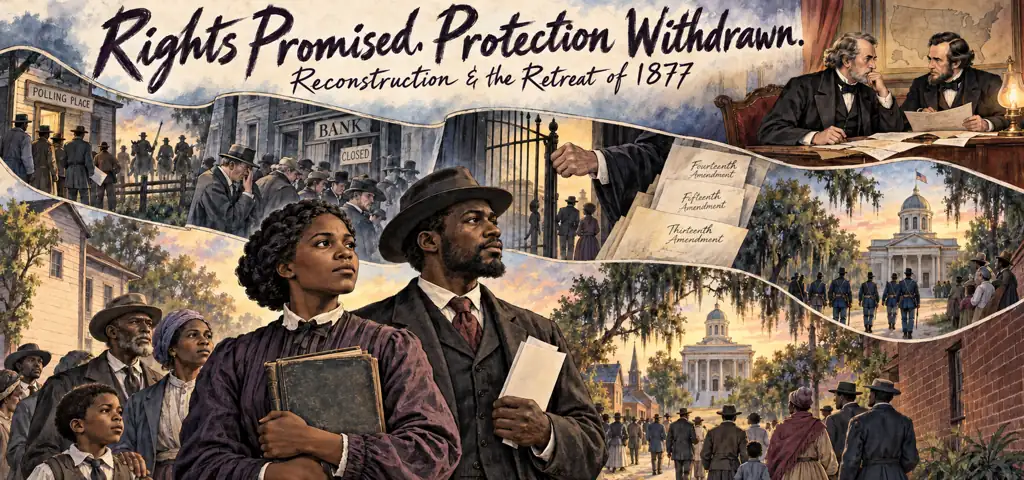
Chapter 1 of the CLEP History of the United States II study guide on Effortless Math covers White Counterrevolution, Judicial Retreat, and the Compromise of 1877: the key terms, the core ideas, and worked examples showing how this topic is tested on the exam.
CLEP History of the United States II, Chapter 1
The battle shifts after federal enforcement
The Grant administration's prosecutions weakened the first Ku Klux Klan, but they did not end armed opposition to Reconstruction. During the 1870s, white Democratic organizations often called Redeemers sought to "redeem" Southern states from Republican rule. Paramilitary groups such as the White League in Louisiana and Red Shirts in Mississippi and South Carolina operated more openly than the early Klan. They attacked officials, broke Republican meetings, intimidated voters, and seized disputed local power. Their campaign mixed violence with election fraud and appeals to lower taxes, home rule, racial hierarchy, and disgust with corruption. The result was a counterrevolution aimed at reversing biracial democracy.
Why northern commitment weakened
Several forces converged. Liberal Republicans backed Horace Greeley in 1872 and called for civil-service reform, general amnesty, local self-government, and an end to federal intervention in the South. Their platform deliberately left the tariff dispute to the voters and Congress rather than adopting a lower-tariff plank. Congress then passed the Amnesty Act, removing Section 3 disabilities from most former Confederates. The Panic of 1873 redirected northern attention toward unemployment, debt, and currency. Republican scandals weakened the party's moral claims, while racist assumptions and fatigue with military enforcement spread among white northerners. Democrats captured the House in 1874 and blocked new enforcement laws. Congress soon turned to coin redemption through the Specie Resumption Act. These shifts raised the political cost of intervention just as Southern violence made protection more urgent.
The Supreme Court narrows federal tools
The postwar cases did not all point in one direction. In Ex parte Milligan (1866), the Court barred military trials of civilians where ordinary civil courts remained open. Later decisions narrowed federal rights tools. The Slaughter-House Cases (1873) confined the Fourteenth Amendment's Privileges or Immunities Clause to a small set of national rights. In United States v. Reese (1876), the Court invalidated parts of voting-enforcement law whose wording reached beyond discrimination expressly based on race. In United States v. Cruikshank (1876), arising from the Colfax Massacre, it reversed federal convictions and limited national prosecution of private violence.
What the cases did-and did not do
The decisions did not repeal the Reconstruction Amendments. They narrowed particular constitutional pathways and statutes, shifted burdens back toward state protection, and demanded more precise federal legislation. That mattered enormously where state officials were unwilling or unable to protect Black citizens. A frequent error says Cruikshank created segregation or Slaughter-House upheld the Black Codes. Neither is accurate. The important relationship is institutional: constitutional rights were broad promises, but Court interpretations could restrict who could sue, which government could act, and what a prosecutor had to prove. Judicial retreat and political retreat reinforced one another.
The disputed election of 1876
Republican Rutherford B. Hayes and Democrat Samuel J. Tilden contested the presidential election. Tilden won the national popular vote and held 184 undisputed electoral votes, one short of a majority; Hayes held 165. Rival returns came from Florida, Louisiana, and South Carolina, and one Oregon elector was disputed, involving twenty electoral votes. Congress created a fifteen-member Electoral Commission. By 8-7 votes along party lines, it awarded the disputed votes to Hayes, giving him a 185-184 victory. The crisis unfolded while Republican state governments in Louisiana and South Carolina survived only amid competing claims and federal troop protection.
The Compromise of 1877 as an informal settlement
Democratic leaders accepted Hayes's inauguration, and Republicans withdrew remaining federal troops from protecting the Louisiana and South Carolina statehouses. Hayes also signaled support for Southern internal improvements and appointed a Southern Democrat to his cabinet. Historians debate whether there was one explicit, fully documented bargain; "Compromise of 1877" is best understood as a set of negotiations and understandings that resolved the electoral crisis. Troops had already left most of the South, so withdrawal was not a single nationwide evacuation. Its significance was political: the federal executive stopped sustaining the last Republican state governments.
avoid the single-cause story
Why did Reconstruction end?
Consequences and historical judgment
Redeemer governments cut some public spending, protected white political control, and prepared the way for formal disfranchisement and Jim Crow segregation in later decades. Black communities continued to vote where possible, build churches, schools, businesses, and mutual-aid institutions, migrate, litigate, and organize. Reconstruction therefore did not simply vanish in 1877, nor did every later restriction appear at once. The period left the Thirteenth, Fourteenth, and Fifteenth Amendments and a record of interracial democracy; it also left land inequality, violent impunity, and constitutional promises without sustained enforcement. The best historical judgment holds achievement and defeat together instead of labeling Reconstruction only a failure or an uncomplicated success.
Watch the history in motion
This short lesson adds voices, images, and chronology to the ideas you just studied.
Video: Why RECONSTRUCTION Failed [APUSH Review], Heimler's History.
Try four CLEP-style questions
- The term Redeemers referred chiefly to
- Southern Democrats seeking to end Republican Reconstruction governments and restore white political control
- Southern white Republicans who supported congressional Reconstruction governments
- paramilitary members alone, excluding Democratic candidates and civilian organizers
- Radical Republicans who sought continued federal enforcement of Black voting rights
- Liberal Republicans who paired civil-service reform with reconciliation in the election of 1872
- Which causal chain best connects the Panic of 1873 to Reconstruction's retreat?
- Bank failures produced a new Radical majority committed to expanding military enforcement and federal civil-rights intervention throughout the South.
- Railroad failures deprived white Democratic organizations of support and revived Republican state governments.
- Unemployment and monetary conflict weakened the governing party and redirected northern attention from sustained intervention in the South.
- Currency conflict displaced economic concerns and made Reconstruction the North's dominant electoral issue.
- The crisis led Democrats to exchange support for renewed southern enforcement for a national policy of currency inflation.
- How did Cruikshank and the settlement of 1877 differently weaken Reconstruction?
- The decision removed Black suffrage from the Constitution, while the settlement repealed the Enforcement Acts.
- The decision narrowed federal remedies against private violence, while the settlement ended executive support for the last Republican state governments.
- The decision ended all federal authority over state action and voting-rights cases, while the settlement invalidated the Fourteenth Amendment.
- The decision transferred disputed electoral votes to Tilden, while the settlement restored the Freedmen's Bureau.
- The decision ended military Reconstruction in 1867, while the settlement created the election commission in 1876.
- Which sequence best traces Reconstruction's retreat?
- Judicial narrowing in 1876; Panic of 1873; troop withdrawal in 1877; disputed election of 1876
- Disputed election of 1876; Panic of 1873; judicial narrowing in 1876; troop withdrawal in 1877
- Panic of 1873; disputed election of 1876; Enforcement Acts; judicial narrowing in 1876
- Panic of 1873; judicial narrowing in 1876; disputed election of 1876; troop withdrawal in 1877
- Panic of 1873; troop withdrawal in 1877; judicial narrowing in 1876; disputed election of 1876
Check your answers and reasoning
Independent preparation. CLEP is a registered trademark of the College Board, which does not endorse this lesson.

Related to This Article
More math articles
- Best Tips for Math Success
- Chapter 20: Freedom of Speech and Press
- For a price taker, price equals marginal revenue
- Near Synonyms and Commonly Confused Words
- How to Prepare for the SAT Math Test?
- How to Use Models to Multiply Two Fractions?
- Surface Area and Cell Size
- How to Graph Absolute Value Inequalities?
- Free Kansas Grade 2 Math Worksheets
- 5 Best Praxis Core Math Study Guides




















What people say about "White Counterrevolution and the Compromise of 1877"?
No one replied yet.