Homesteads, Railroads, and the National Market
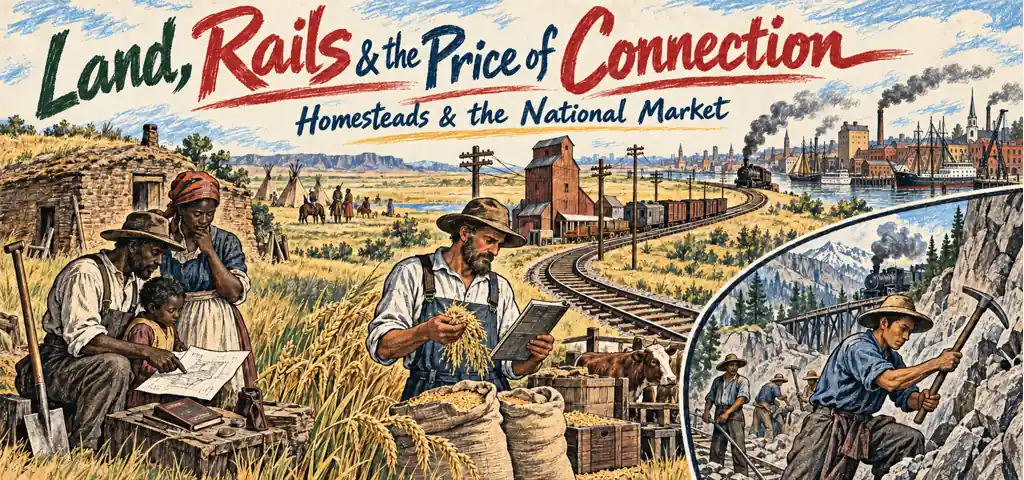
Chapter 2 of the CLEP History of the United States II study guide on Effortless Math covers Homesteads, Railroads, and the National Market: the key terms, the core ideas, and worked examples showing how this topic is tested on the exam.
CLEP History of the United States II, Chapter 2
A federal promise measured in acres
A homestead claimant did not receive a finished farm. The government offered a legal opportunity on surveyed land it declared available, often after displacing Native peoples. The Homestead Act of 1862 offered 160 acres to an adult citizen or intended citizen who paid modest fees, lived on the claim, and improved it for five years. Claimants could purchase sooner. The Southern Homestead Act of 1866 used the same model on federal land in five former Confederate states. During its first six months, freedpeople and loyal white applicants received priority. The law joined the free-labor ideal to wartime Republican policy, but legal access, agricultural success, and rightful possession remained separate questions.
Who moved and why
Homesteaders included U.S.-born families, European immigrants, single women who could qualify in their own names, and African American migrants. After 1877, thousands of Black Southerners known as Exodusters moved especially to Kansas, seeking land and distance from racial violence. Railroad companies and states advertised abroad and in the East because settlers created freight and land customers. Migration involved both push and pull: discrimination, scarce eastern land, and farm tenancy pushed, while federal acres, railroad promotion, family letters, and commodity opportunities pulled. The popular image of only white male pioneers therefore misses a diverse movement and the powerful institutions that directed it.
Why 160 acres could fail
In humid farming regions, 160 acres might support a household; across much of the Great Plains, rainfall was unreliable and such a parcel could be too small for grazing or dry farming. Claimants needed seed, tools, animals, fencing, transportation, and credit before a harvest produced income. Drought, grasshoppers, isolation, and volatile crop prices defeated many. Fraudulent entries and land-company manipulation diverted acreage, although millions of claims eventually became patented farms. Later laws offered larger parcels or supported irrigation, acknowledging that the original formula did not fit every environment. The decisive distinction is between widespread land transfer and universal small-farm prosperity: the first occurred, the second did not.
The railroad state
The Pacific Railway Acts of 1862 and 1864 supplied federal bonds and land grants. Companies mortgaged or sold acreage, raising money and attracting future freight customers. The Union Pacific built west from Omaha; the Central Pacific built east from Sacramento. Irish immigrants supplied much Union Pacific labor, while Chinese crews performed dangerous Sierra work. In 1867 Chinese workers struck for equal pay, a ten-hour day, and shorter tunnel shifts. Managers cut food deliveries, and the crews returned after eight days without their main demands. The lines met at Promontory Summit in 1869. Private managers built them, but federal credit, land, surveys, military protection, and treaty coercion created the corridor.
From local exchange to national market
Rail lines reduced travel time and freight costs, connected western farms and mines to eastern cities and ports, and made distant buyers relevant to local decisions. Grain elevators graded and mixed wheat; refrigerated cars expanded meat and produce shipment; telegraph lines carried price information; and wholesalers distributed manufactured goods. Railroad companies helped standardize time zones in 1883 because printed schedules could not operate efficiently by local solar time. A farmer could now buy a machine made in the Midwest, borrow against an expected harvest, and sell grain at a price shaped in Chicago or Liverpool. Integration widened opportunity while also transmitting distant downturns and price changes.
Corporate power and unequal bargaining
Railroad rates, land sales, and routes could determine whether a town prospered. Carriers offered rebates to large shippers, charged small customers more, and made short hauls costlier per mile than competitive long hauls. Overbuilding and speculation fed financial crises. Jay Cooke and Company marketed Northern Pacific bonds for track laid ahead of traffic. When investors stopped buying, Cooke suspended payment in September 1873, helping trigger the Panic. Farmers and merchants wanted connection, but they objected to dependence on a carrier with better information and bargaining power. Granger laws and federal regulation grew from that imbalance. Networks made the market national; they did not make competition fair.
read a railroad map
Imagine a map showing new tracks crossing Kansas between 1870 and 1890, towns clustered along the routes, and wheat acreage rising nearby.
A linked chronology and a hidden cost
Congress passed the Homestead and Pacific Railway Acts in 1862; the first transcontinental line was completed in 1869; rail mileage and Plains settlement accelerated in the 1870s and 1880s; standard time followed in 1883. These policies did not open an empty land. Federal officials had acquired territory through war, unequal treaties, reservation confinement, and allotment, while railroads helped hunters and troops penetrate Native homelands. A common misconception describes the West as settled by rugged individuals beyond government. In fact, individual labor mattered inside a structure built by national law, corporate finance, and coercive territorial power.
Watch the history in motion
This short lesson adds voices, images, and chronology to the ideas you just studied.
Video: Westward Expansion: Crash Course US History #24, CrashCourse.
Try four CLEP-style questions
- Under the five-year route created by the Homestead Act of 1862, how did an eligible claimant ordinarily obtain title?
- By purchasing a parcel from a railroad at its advertised land-office price
- By irrigating desert land under a later federal entry law
- By filing a preemption claim based only on settlement before a public auction
- By planting the acreage required under the separate Timber Culture Act
- By residing on and improving a 160-acre federal claim
- How did federal land grants help railroad companies finance construction most directly?
- Companies mortgaged grant acreage as security or sold sections to settlers and investors for cash.
- Settlers paid federal homestead fees into construction accounts controlled by the railroads.
- The grants entitled companies to federal bonds equal to the assessed value of each acre.
- The Treasury purchased granted acreage from each company at a fixed federal price.
- States collected lease payments on granted land and transferred the receipts to the railroads.
- Which comparison best distinguishes the Homestead Act from federal railroad land grants?
- Both transferred completed farms directly to corporations that operated rail lines.
- Homesteaders pursued individual title through residence and improvement, while railroad companies received sections they could sell or mortgage to finance construction.
- Homestead claims could be mortgaged only by federally chartered railroads, while company grant lands could be claimed only by resident farmers who completed five years of improvement.
- Both policies required settlers to buy land from a railroad before filing a federal claim.
- Railroad grants provided only rights-of-way, whereas homesteads supplied companies with saleable acreage.
- A map shows towns and wheat acreage expanding beside new western rail lines from 1870 to 1890. Which conclusion is best supported?
- The map proves that farms beside the tracks earned higher profits than farms elsewhere.
- The tracks alone account for the entire pattern of settlement shown.
- Wheat cultivation must have caused every railroad to choose its route.
- Rail access likely encouraged concentrated settlement and market farming, although the map cannot isolate railroads from land policy, rainfall, or prices.
- The association demonstrates that subsistence production displaced commercial crop sales near the lines and that railroad access reduced rather than expanded farmers' dependence on distant markets.
Check your answers and reasoning
Independent preparation. CLEP is a registered trademark of the College Board, which does not endorse this lesson.

Related to This Article
More math articles
- The Best Grade 6 ELA Practice Tests for California Students
- Unlock the Answers: “GED Math for Beginners” Solution Manual
- CLEP U.S. History I 011: Puritans, Covenant Communities, and Massachusetts
- Electoral College compromise
- The Best Grade 4 ELA Practice Tests for South Dakota Students
- Cooley’s Looking-Glass Self
- Best Calculators for Electrical Engineering Students In 2026
- 3rd Grade Georgia Milestones Assessment System Math Worksheets: FREE & Printable
- How Is the TSI Test Scored?
- Grade 3 Math: Multiplying by 10s and 100s





















What people say about "Homesteads, Railroads, and the National Market"?
No one replied yet.