Plains Warfare, Reservations, and the Destruction of the Buffalo
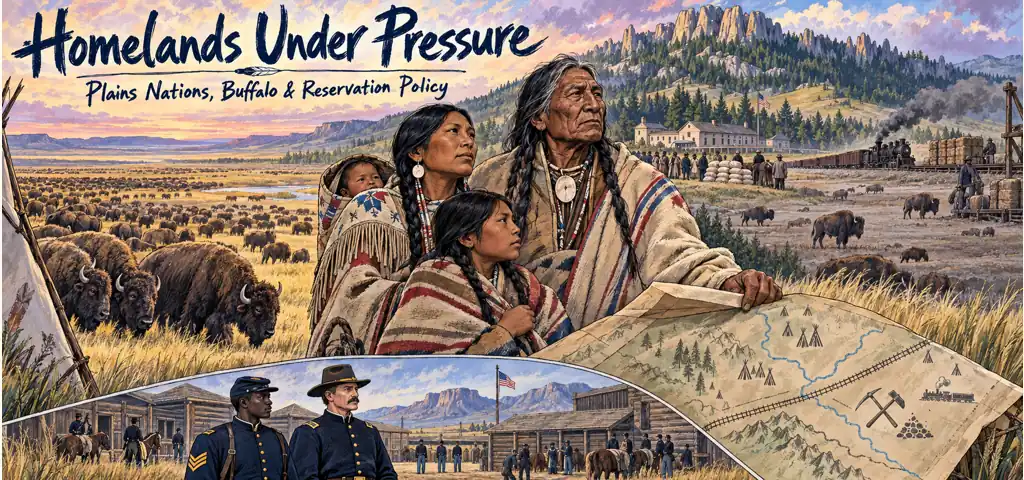
Chapter 2 of the CLEP History of the United States II study guide on Effortless Math covers Plains Warfare, Reservations, and the Destruction of the Buffalo: the key terms, the core ideas, and worked examples showing how this topic is tested on the exam.
CLEP History of the United States II, Chapter 2
Homelands rather than an empty frontier
The Great Plains contained distinct Native nations with their own political systems, trade networks, rivalries, and relationships to the buffalo. Lakota, Cheyenne, Arapaho, Comanche, Kiowa, and many others responded differently to migrants, soldiers, traders, and treaty agents. Horses had transformed mobility and hunting before the great postwar influx. U.S. maps might label territory public land or an Indian reservation, but those categories expressed federal claims, not consent from every community using the land. Warfare after the Civil War grew from collisions over sovereignty, migration routes, military posts, resources, and broken agreements rather than from an inevitable contest between undifferentiated "settlers" and "Indians".
Treaties create and contract boundaries
The Fort Laramie Treaty of 1851 attempted to define tribal territories and secure passage along western routes. Migration and federal noncompliance soon destabilized it. After Red Cloud's War closed the Bozeman Trail forts, the Fort Laramie Treaty of 1868 created the Great Sioux Reservation, including the Black Hills, and recognized a large area as unceded hunting territory. The agreement shows Native bargaining power: Lakota and allied resistance forced the United States to abandon posts. It also shows the weakness of treaty settlements when U.S. political and economic demand changed. Treaty lines meant little without a government willing to restrain its own citizens and honor negotiated obligations.
Sand Creek and the logic of retaliation
In November 1864, Colorado militia under Colonel John Chivington attacked a Cheyenne and Arapaho village at Sand Creek whose inhabitants included many women and children. The killings occurred despite efforts by leaders such as Black Kettle to signal peace. Federal investigations condemned the massacre, but punishment was minimal. Sand Creek intensified mistrust and retaliation across the central Plains. Calling it a straightforward battle hides the vulnerability of the encampment and the role of territorial militia. It also reveals a causal pattern repeated elsewhere: violence justified as protection could produce wider conflict, which officials then cited as grounds for more military force and confinement.
Gold, the Black Hills, and the Great Sioux War
An expedition led by George A. Custer confirmed gold in the Black Hills in 1874. Prospectors entered despite the 1868 treaty, and the federal government failed to keep them out. When Lakota and Northern Cheyenne bands outside the reservation did not meet a government deadline to report to agencies, the Army launched a campaign. At the Little Bighorn in June 1876, forces led by Sitting Bull and Crazy Horse defeated Custer's detachment. The Native victory did not decide the war. Additional troops and relentless pressure forced most bands to surrender, and Congress took the Black Hills in 1877. Tactical victory thus preceded strategic dispossession.
The buffalo economy is destroyed
Plains peoples used buffalo for food, clothing, shelter, tools, trade, and ceremony. Commercial hunters killed millions for hides and bones in the 1870s and early 1880s; railroads moved hunters in and products out, divided herds, and carried tourists who shot animals. Drought and competition from livestock also mattered. Army officers sometimes welcomed slaughter as a means of forcing Native dependence, even without one congressional extermination statute directing the whole campaign. By the 1880s, the vast herds had been reduced to remnants. Ecological destruction became political coercion: removing the economic foundation of mobile life made reservation confinement harder to resist.
Reservation policy and the end of treaty making
Reservations restricted Native nations to bounded areas often remote from traditional hunting grounds. Agents distributed rations, managed supplies, and pressured communities toward farming, while corruption and delayed deliveries produced hunger. The Indian Appropriations Act of 1871 ended the practice of treating Native nations as independent powers for new treaty making, though existing treaty obligations were not formally erased. Congress increasingly governed through statutes and administrative orders. Reservations were not protected spaces outside federal power; they were instruments of territorial control. Native people nevertheless maintained kinship, ceremony, trade, negotiation, and resistance within and across imposed boundaries.
Black regulars in the western army
The 1866 army reorganization created six Black regular regiments: the Ninth and Tenth Cavalry and the Thirty-Eighth through Forty-First Infantry. In 1869, the Army consolidated only the four infantry units into the Twenty-Fourth and Twenty-Fifth; both cavalry regiments continued unchanged. Known as Buffalo Soldiers, these troops spent decades at western posts. Under white officers, they escorted mail and surveys, guarded routes, and campaigned against Native nations. Army service offered pay and rations unavailable to many Black men in the postwar South, yet soldiers faced discrimination on and off their posts. Their service complicates a two-sided story: one federal institution could expand Black opportunity while helping conquer Native homelands.
order event and consequence
Consider four facts: the 1868 treaty recognizes the Black Hills; gold is confirmed there in 1874; Custer is defeated in 1876; Congress takes the Black Hills in 1877.
From Ghost Dance to Wounded Knee
By 1890, military defeat, confinement, hunger, land pressure, and cultural attack had produced profound crisis. The Ghost Dance religion promised renewal and the restoration of a devastated world; officials often interpreted it as a military threat. Police killed Sitting Bull during an attempted arrest. On December 29, 1890, the Seventh Cavalry surrounded a Lakota camp near Wounded Knee Creek. During an effort to disarm the group, shooting began, and soldiers killed large numbers of Lakota men, women, and children. Wounded Knee is often treated as the end of the armed Plains wars. It was not the end of Native history, political action, or survival.
Watch the history in motion
This short lesson adds voices, images, and chronology to the ideas you just studied.
Video: The Indian Wars, NBC News Learn.
Try four CLEP-style questions
- Under the Fort Laramie Treaty of 1868, what was the status of the Black Hills?
- They were reserved for federally supervised mineral exploration outside tribal jurisdiction.
- They lay beyond both the reservation boundary and the unceded hunting territory.
- They were exchanged for the Army's permanent use of the Bozeman Trail forts.
- They became part of Colorado Territory under a joint territorial commission.
- They lay within the Great Sioux Reservation recognized by the treaty.
- How did destruction of the buffalo herds strengthen the coercive power of reservation policy?
- It made reservation agriculture productive enough to reduce reliance on federal supplies during the transition.
- It removed a central economic and cultural resource, increasing dependence on agency supplies.
- It transferred control of the hide trade from railroads to elected tribal governments.
- It restored hunting access beyond reservation boundaries as compensation for commercial losses.
- It supplied the legal basis for Congress's earlier decision to end new treaty making in 1871.
- Which comparison of Little Bighorn and Wounded Knee is most accurate?
- Both occurred after the Ghost Dance had been interpreted as an armed rebellion.
- Both were attacks on villages carried out by Colorado territorial militia.
- Little Bighorn ended federal efforts to confine Lakota bands, whereas Wounded Knee restored their treaty lands.
- Little Bighorn was a Native military victory during a war, whereas Wounded Knee involved the killing of a largely surrounded Lakota camp during coerced disarmament.
- Little Bighorn directly produced the Fort Laramie settlement of 1868, whereas Wounded Knee prompted Congress to seize the Black Hills in 1877 and reopen unrestricted Lakota hunting territory.
- Which ordering correctly traces changing forms of Native dispossession and conflict on the Plains?
- End of new treaty making; Sand Creek; buffalo herds reduced to remnants; Wounded Knee
- Sand Creek; buffalo herds reduced to remnants; end of new treaty making; Wounded Knee
- Sand Creek; end of new treaty making; Wounded Knee; buffalo herds reduced to remnants
- Sand Creek; end of new treaty making; buffalo herds reduced to remnants; Wounded Knee
- Buffalo herds reduced to remnants; Sand Creek; end of new treaty making; Wounded Knee
Check your answers and reasoning
Independent preparation. CLEP is a registered trademark of the College Board, which does not endorse this lesson.

Related to This Article
More math articles
- What Kind of Math Is on the TSI Test?
- The Best Grade 3 ELA Practice Tests for Illinois Students
- 5 Best Laptops For Teachers
- Choose the quantity at the margin
- Nebraska NSCAS Grade 7 Math Worksheets: 95 Free Printable PDFs for Homework Review
- Full-Length 6th Grade ACT Aspire Math Practice Test-Answers and Explanations
- The Rules of Integral: Complex Subject Made Easy
- How to Support Grade 6 Reading at Home: 12 Smart Strategies That Build Independence
- The Best Grade 3 Math Book for Georgia Students
- How to Find x- and y-intercepts in the Standard Form of Equation?





















What people say about "Plains Warfare, Reservations and the Buffalo"?
No one replied yet.