Assimilation, Carlisle, and the Dawes Severalty Act
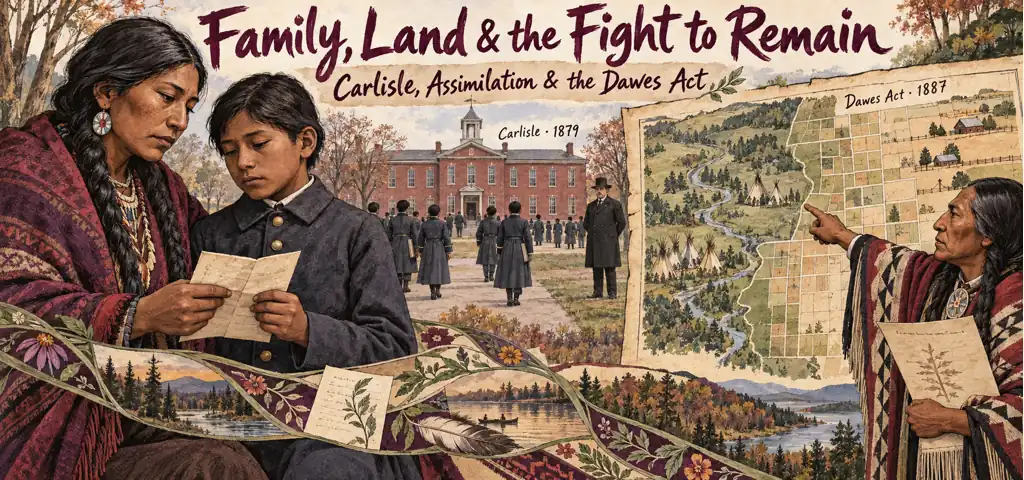
Chapter 2 of the CLEP History of the United States II study guide on Effortless Math covers Assimilation, Carlisle, and the Dawes Severalty Act: the key terms, the core ideas, and worked examples showing how this topic is tested on the exam.
CLEP History of the United States II, Chapter 2
A policy changes its method, not its objective
By the late nineteenth century, many federal reformers argued that reservations and warfare should give way to assimilation: the forced absorption of Native people into dominant white language, religion, gender roles, schooling, property law, and market labor. Some reformers criticized corruption and military violence, but they commonly treated tribal sovereignty and communal life as obstacles to progress. The objective remained control of Native land and political autonomy, even as the language shifted from conquest to civilization. Assimilation was not a neutral invitation to participate in U.S. society. It used compulsory institutions and legal pressure to suppress Native identities and governments in favor of individualized citizenship on federal terms.
Carlisle turns children into policy targets
Captain Richard Henry Pratt founded the Carlisle Indian Industrial School in Pennsylvania in 1879. It became the best-known off-reservation boarding school and a model for others. Officials removed children, sometimes through coercion or threats to family rations, cut their hair, replaced Native clothing, assigned English names, imposed Christian worship, and punished Native-language use. Students received military-style discipline and vocational training shaped by racial and gender assumptions. The distance from home was deliberate: policy makers believed separation would weaken cultural transmission. Photographs of students "before" and "after" were used as propaganda to present transformation as achievement.
Schooling produced loss, survival, and adaptation
Boarding-school experiences varied, but disease, loneliness, harsh punishment, unpaid or underpaid labor, and physical or sexual abuse harmed many students. Some died far from home. Students also formed friendships across tribal lines, learned English literacy, acquired skills, resisted rules, ran away, and later used their education in Native communities and political organizations. Recognizing agency does not excuse coercion. The accurate interpretation holds both facts: children and families found ways to survive and repurpose education, while a compulsory system sought to sever languages, kinship, spirituality, and identity. Assimilation policy could fail at cultural erasure yet still inflict lasting damage.
The Dawes Act individualizes land
The General Allotment Act of 1887, commonly called the Dawes Severalty Act, authorized the president to divide many reservations into individual household parcels. Allotments generally entered a federal trust period intended to prevent immediate sale; allottees were promised U.S. citizenship under the act's terms. After allotment, land declared "surplus" could be sold to non-Native settlers and corporations. Reformers claimed private property would turn Native people into self-sufficient farmers. In practice, the policy broke up communal land bases, opened valuable acreage to outsiders, and placed allottees under extensive federal supervision. Severalty means individual rather than collective holding.
Why land loss accelerated
Allotment parcels were often too small, arid, or poorly located for profitable farming. Trust rules, leasing, fraud, taxes after fee patents, and sales transferred additional land out of Native hands. Federal agents decided eligibility and surveyed boundaries without respecting all community practices. Between 1887 and 1934, the Native land base fell from roughly 138 million acres to about 48 million, a loss of about 90 million acres. The Curtis Act of 1898 extended allotment pressure and weakened the governments of the Five Tribes in Indian Territory. The numbers reveal the policy's central consequence: proclaimed household ownership accompanied massive collective dispossession.
Citizenship did not equal sovereignty
The Dawes Act linked allotment to citizenship, but citizenship was administered unevenly and did not automatically protect land or political equality. The Indian Citizenship Act of 1924 later recognized U.S. citizenship for all Native people born in the United States, yet some states continued obstructing Native voting. Tribal citizenship and sovereignty also did not disappear merely because U.S. citizenship expanded. This distinction defeats two common errors: allotment did not immediately make every Native person a citizen with fully protected rights, and U.S. citizenship did not logically require the destruction of tribal nationhood. Assimilationists fused those ideas because they wanted tribal political identity to vanish.
interrogate a before-and-after photograph
A Carlisle promotional pair shows a student in Native clothing upon arrival and later in a uniform with cut hair.
Chronology, resistance, and reversal
Carlisle opened in 1879, the Dawes Act followed in 1887, and the Curtis Act expanded allotment pressure in 1898. Native parents petitioned, hid children, moved camps, challenged agents, preserved ceremonies, and used courts and organizations to defend communities. In the twentieth century, evidence of boarding-school abuse and allotment failure helped discredit the policy. The 1928 Meriam Report documented severe conditions, and the Indian Reorganization Act of 1934 ended further allotment under Dawes and encouraged a measure of tribal self-government. The reversal did not restore all land or repair every injury, but it confirms that assimilation's claimed humanitarian logic had produced measurable dispossession.
Watch the history in motion
This short lesson adds voices, images, and chronology to the ideas you just studied.
Video: The History of America’s Indian Boarding Schools: Ep 12 of Crash Course Native American History, CrashCourse.
Try four CLEP-style questions
- Which change was the Dawes Severalty Act of 1887 designed to make?
- Restore nation-to-nation treaty making in place of congressional statutes
- Move Native children from reservations into off-reservation schools
- Extend United States citizenship at once to every Native person regardless of allotment status
- End allotment and restore communal landholding through tribal governments
- Divide many reservation lands into individual allotments and open land labeled surplus to outsiders
- Why did sales of land classified as "surplus" under allotment undermine Native communities?
- They inserted outside ownership and fragmented territory needed for community life and government.
- They paid collective royalties that strengthened tribal control of the remaining reservation.
- They created protected buffer zones between household allotments and non-Native settlement.
- They allowed landless tribal members to enlarge the communal land base.
- They transferred allotted parcels from federal trust into corporate ownership by tribal governments.
- What did Carlisle School policy and the Dawes Act share?
- Carlisle reorganized reservation ownership, while Dawes regulated school language and uniforms.
- Both preserved communal land and used bilingual schooling to strengthen tribal government.
- Carlisle targeted children and culture while Dawes targeted landholding, but both tried to weaken tribal continuity in the name of assimilation.
- Both ended federal supervision by transferring decisions to Native families and councils.
- Both treated United States citizenship as compatible with unchanged federal recognition of tribal sovereignty, communal landholding, Native-language education, and autonomous reservation government.
- A school administrator displays paired photographs of a Native student on arrival and later in uniform. Which interpretation best respects both the source's purpose and its limits?
- The pair measures the student's academic gains because institutional clothing, posture, and grooming provide reliable evidence of classroom learning and voluntary cultural change.
- The pair advertises outward conformity as successful assimilation but cannot by itself prove consent, learning, or cultural erasure.
- The pair demonstrates that every boarding school imposed identical rules and produced identical results.
- The pair establishes that the student and family voluntarily chose every aspect of the program.
- The pair is a private family record and therefore reveals little about the school's institutional goals.
Check your answers and reasoning
Independent preparation. CLEP is a registered trademark of the College Board, which does not endorse this lesson.

Related to This Article
More math articles
- The law of demand is a ceteris paribus claim
- The Best Algebra 1 Book for South Carolina Students
- The Ultimate 4th Grade STAAR Math Course (+FREE Worksheets)
- Reading Tables, Percentages, and Graphs
- Demography, Population Size, Composition, and Distribution
- Free Printable Grade 2 Math Worksheets for Idaho
- How to Solve Two-variable Linear Equations Word Problems
- Free Grade 7 English Worksheets for Wisconsin Students
- Checks between branches
- SAT Math Practice Test Questions

















What people say about "Assimilation, Carlisle, and the Dawes Act"?
No one replied yet.