Cattle, Mining, Water, and the Frontier Thesis
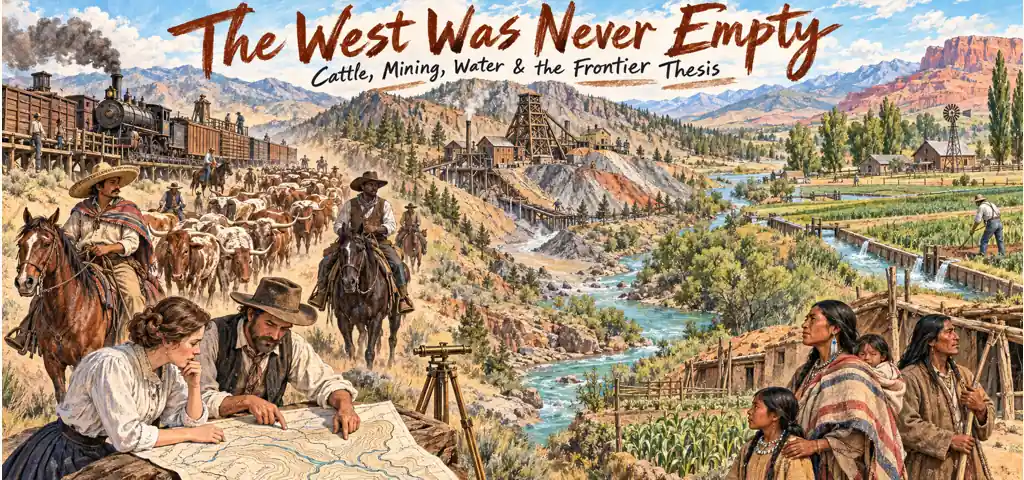
Chapter 2 of the CLEP History of the United States II study guide on Effortless Math covers Cattle, Mining, Water, and the Frontier Thesis: the key terms, the core ideas, and worked examples showing how this topic is tested on the exam.
CLEP History of the United States II, Chapter 2
The West as an extractive economy
A cattle drive, a silver shaft, and an irrigation ditch look like separate stories, yet each connected a western resource to distant capital and consumers. Ranchers converted grass into beef, mining companies converted ore into industrial metals, and farmers converted scarce water into crops. Railroads linked all three to national markets. This economy generated towns, wage work, fortunes, and public revenue, but it also encouraged boom-and-bust cycles, concentrated ownership, dangerous labor, and environmental change. The western economy was not outside industrial America. It was one of the places where corporations, federal land policy, technology, and natural limits most visibly met.
The cattle kingdom and its boundaries
After the Civil War, ranchers drove Texas longhorns north along routes such as the Chisholm Trail to railheads including Abilene, Kansas. From there, cattle traveled to eastern slaughterhouses and consumers. Cowboys included Mexican vaqueros, African Americans, Native people, and white migrants; the later all-white screen image is inaccurate. The open range relied on access to unfenced grass and water, but it did not last unchanged. Rail expansion, homesteader fences, corporate ranches, and barbed wire reduced open movement. Overstocking and the brutal winter of 1886-1887 killed herds and accelerated the shift toward fenced, managed ranching.
Mining rushes become industrial operations
Discoveries such as Nevada's Comstock Lode drew prospectors, merchants, workers, and speculators. The General Mining Act of 1872 let citizens mine valuable hard-rock deposits on public land without a federal royalty and patent claims at low prices. Individuals or small groups could work early placer deposits. Deep shafts, however, required pumps, machinery, engineers, and major investment, so large companies increasingly dominated. Boomtowns rose quickly and could collapse when ore prices fell or deposits failed. Chinese, Mexican, European, Black, and U.S.-born workers filled dangerous jobs under unequal wages and discrimination. Mining's movement from individual rush to corporate control mirrored the wider late-nineteenth-century economy.
Environmental costs travel downstream
Mining released tailings, sediment, and toxic materials into waterways, while hydraulic methods transformed hillsides and damaged farms downstream. Ranching altered grasslands and competed with buffalo and wildlife. Timbering supplied mines and towns. These effects were not merely local accidents; market demand rewarded rapid extraction while legal systems often allowed users to shift damage onto others. The 1884 decision in Woodruff v. North Bloomfield Gravel Mining Company restricted hydraulic mining that harmed California agriculture, showing conflict between resource users. Environmental history asks who received the profit, who absorbed the damage, and how law valued one use of land or water over another.
Water law in an arid region
Eastern riparian doctrine generally tied water use to land beside a stream. Western mining camps and states developed prior appropriation: the first person to put water to a beneficial use gained a priority claim, often summarized as "first in time, first in right". This rule allowed water to be diverted away from the stream and favored users who could establish and maintain early claims. Ditches, dams, and irrigation companies made settlement possible but also concentrated control. Water scarcity encouraged public engineering; the federal Reclamation Act of 1902 later financed irrigation projects. Law did not overcome aridity. It allocated a limited resource and created winners and losers.
Powell reads the environment differently
Explorer and scientist John Wesley Powell argued in his 1878 report on the arid lands that western settlement should respect watersheds and limited rainfall. He favored larger, cooperatively organized units shaped by access to water rather than imposing the humid East's rectangular small-farm assumptions everywhere. Policy makers mostly retained familiar land-disposal rules and local speculation. Powell's proposal matters because it shows that environmental limits were understood at the time; later water conflict was not simply the result of ignorance. His analysis challenges the idea that more settlement and engineering could make all western land behave like the Midwest.
Turner makes the frontier an interpretation
In 1893, historian Frederick Jackson Turner presented "The Significance of the Frontier in American History" after the 1890 census announced that a continuous frontier line could no longer be drawn. Turner argued that repeated movement into a zone of settlement had fostered American democracy, individualism, mobility, and practical innovation. The frontier thesis influenced generations of historians and popular culture. It is an interpretation, not a government policy or a neutral census fact. Turner tried to explain national character through a recurring process, making the West central rather than peripheral to U.S. history.
test a thesis against omitted evidence
Place Turner's claim beside evidence of federal land grants, Army campaigns, Chinese railroad labor, Native dispossession, corporate mines, and prior-appropriation law.
Distinguish myth, experience, and structure
Cowboys, prospectors, and pioneers became symbols of independence, but most worked inside markets and hierarchies. Cowboys earned wages, miners often served corporations, and irrigators depended on law and shared infrastructure. Buffalo Bill Cody's touring Wild West, launched in 1883, turned conquest into entertainment. Its staged attacks cast settlers as defenders and Native people as aggressors, reversing who had entered whose homeland. The 1890 census statement did not mean every western acre was occupied or conflict had ended. Turner's 1893 essay interpreted that statement; it did not prove its own thesis. The myth of western individualism grew alongside stronger corporate and governmental organization.
Watch the history in motion
This short lesson adds voices, images, and chronology to the ideas you just studied.
Video: Westward Expansion: Economic Development [APUSH Review Unit 6 Topic 2] Period 6: 1865-1898, Heimler's History.
Try four CLEP-style questions
- Which combination most directly accelerated the decline of the open-range cattle system?
- Refrigerated railcars, which sharply reduced eastern demand for western beef
- Railhead expansion, which removed the need for grazing land between Texas and Kansas
- Barbed wire, expanding settlement, overstocking, and the winter of 1886-1887
- Federal grazing permits, imposed across the open range during the cattle-drive era
- Early adoption of rotational grazing by ranchers, which made trail drives unnecessary
- Why could hydraulic-mining profits coexist with heavy losses on downstream farms?
- State mining law charged sediment damage to shareholders as part of each mine's production cost.
- A federal debris commission collected advance assessments that fully covered farm losses downstream.
- Prior-appropriation law made downstream farmers co-owners of mining claims within the same watershed.
- The Woodruff decision protected hydraulic mining while assigning debris control to downstream counties.
- Mining companies captured the ore's value while shifting much of the debris and flooding cost onto other land users.
- How did John Wesley Powell's analysis differ from Frederick Jackson Turner's thesis?
- Powell defended rectangular 160-acre surveys, while Turner proposed cooperative watershed districts.
- Both derived settlement policy from the census announcement that the frontier line had disappeared.
- Powell expected railroads and capital to remove the limits of rainfall, while Turner made aridity the source of national character.
- Powell emphasized aridity and watershed-based planning, while Turner emphasized the frontier's influence on national character.
- Powell interpreted western democracy, while Turner designed land units around scarce water.
- A historian cites federal land grants, Army campaigns, and Native land claims to criticize Turner's phrase "free land". What is the historian's main point?
- The census frontier line converted unsettled acreage beyond it into unclaimed federal public domain.
- Federal subsidies made western settlement principally a private market process rather than a public project.
- The phrase obscures prior Native possession and the governmental power that enabled settler access.
- Corporate investment mattered more than household migration in establishing lawful access to western land.
- Treaty cessions made public land policy, rather than conquest, the main source of western title.
Check your answers and reasoning
Independent preparation. CLEP is a registered trademark of the College Board, which does not endorse this lesson.

Related to This Article
More math articles
- 4 Reasons To Fall In Love With Math
- Preparing For SAT Math? DON’T Make These Big Mistakes!
- Tone, Mood, and Word Choice
- The Ultimate 6th Grade ILEARN Math Course (+FREE Worksheets)
- CLEP U.S. History I 033: State Constitutions and Republican Experiments
- Electricity, Magnetism, and Nuclear Science
- Education
- Earmarks
- Slot Volatility Math: Standard Deviation in Plain English
- Reaction Types and Redox: Recognizing What Changes





















What people say about "Cattle, Mining, Water, and the Frontier Thesis"?
No one replied yet.