CLEP U.S. History I 023: War, Debt, and the Proclamation of 1763
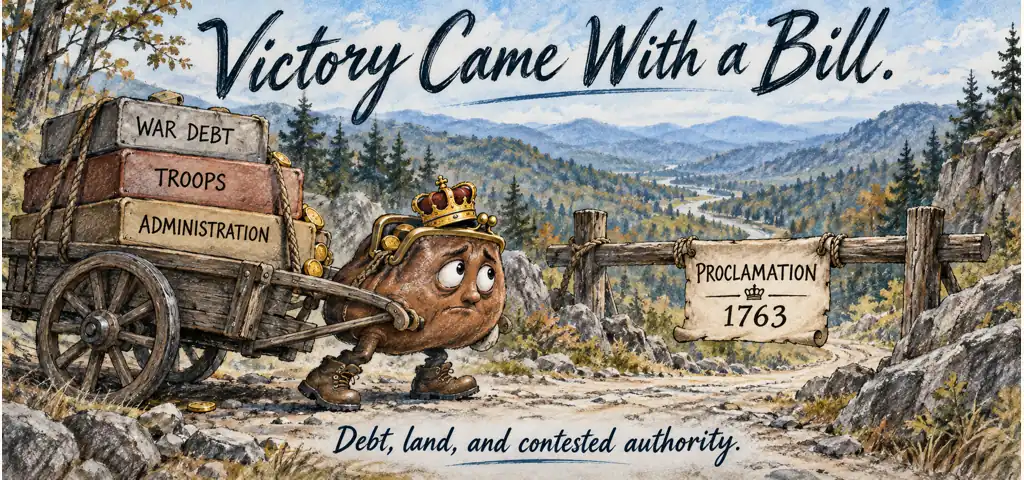
Lesson 5.2 of Chapter 5 of the U.S. History to 1877 study guide on Effortless Math covers CLEP U.S. History I 023: War, Debt, and the Proclamation of 1763: the key terms, the core ideas, and worked examples showing how this topic is tested on the exam.
U.S. History to 1877 | Chapter 5 | Lesson 5.2
The 1763 Treaty of Paris transferred Canada and much French territory east of the Mississippi to Britain. Victory enlarged Britain’s obligations. Maintaining troops, administering new lands, and servicing war debt cost money. British taxpayers already paid substantial taxes, so ministers looked to the colonies for revenue. From London, this appeared to be rational burden sharing. From colonial assemblies, it looked like an assertion of unfamiliar power.
Western conflict made administration urgent. Pontiac’s War captured British forts and challenged settlement. The Royal Proclamation of 1763 drew a boundary along the Appalachians beyond which colonial governors were not to authorize settlement. Officials hoped to reduce warfare and regulate future land purchases. The line acknowledged, without fully respecting, Native territorial realities because the crown still claimed ultimate authority.
Many colonists resented the restriction. Veterans expected western land, speculators held claims, and settlers had already crossed the mountains. Enforcement was incomplete, and westward movement continued. The proclamation was not designed chiefly to punish colonists for the war, though they often experienced it as a denial of victory’s rewards.
Debt did not mechanically cause revolution. Britain had choices about spending and taxation, and colonists had choices about response. Still, the war altered incentives. Ministers wanted systematic enforcement where earlier governance had been flexible. Colonists had fought as British subjects but also gained military experience and confidence. A shared victory therefore exposed different understandings of who controlled revenue and western land.
Watch, then test the claim
Watch this account from Schooled by Mr Chaffin with one question in mind: which evidence makes the lesson's strongest claim hold up?
Video: French and Indian War_Proclamation of 1763 – Video Lesson, Schooled by Mr Chaffin.
Check your understanding
- British ministers sought colonial revenue after 1763 chiefly because of
- elimination of the customs service
- contraction of Britain’s North American holdings
- withdrawal of all troops from the continent
- recognition of colonial fiscal independence
- war debt and imperial administration
- The Proclamation line attempted to
- validate every private claim west of the Appalachians
- regulate western settlement and reduce conflict
- transfer western diplomacy to colonial land companies
- abandon Britain’s new western territories
- authorize settlers to negotiate independently with Native nations
- Select all that apply. Colonists resisted the line because of
- land speculation
- loyalty to French rule
- existing settlement
- desire for western farms
- veteran expectations
- Compare London’s and colonists’ views of one postwar policy.
Write a brief response using a named fact from the lesson.
Open the answers and reasoning
Independent preparation. CLEP is a registered trademark of the College Board, which does not endorse this lesson.

Related to This Article
More math articles
- Missouri MAP Grade 8 Math Free Worksheets: Printable Practice for Every Eighth-Grade Math Topic
- Grade 7 ELA Tests: A Clear Parent Guide to Reading, Writing, and Test-Day Readiness
- Marginal revenue product combines productivity and output value
- Plate Boundaries: Pull Apart, Meet, or Slide Past
- The Best Grade 3 ELA Practice Tests for Ohio Students
- How to Pass the FSA / FAST Math Test (Florida): 2026 Parent & Student Guide
- The Role of Math in Developing Strategic Thinking for iGaming
- Turn a graph into an AP free-response answer
- Dividing Dollars: How to Navigate Money Division in Word Problems
- How to Add and Subtract Integers? (+FREE Worksheet!)













What people say about "War, Debt and the Proclamation of 1763"?
No one replied yet.