Sit-Ins, SNCC, Freedom Rides, and Birmingham
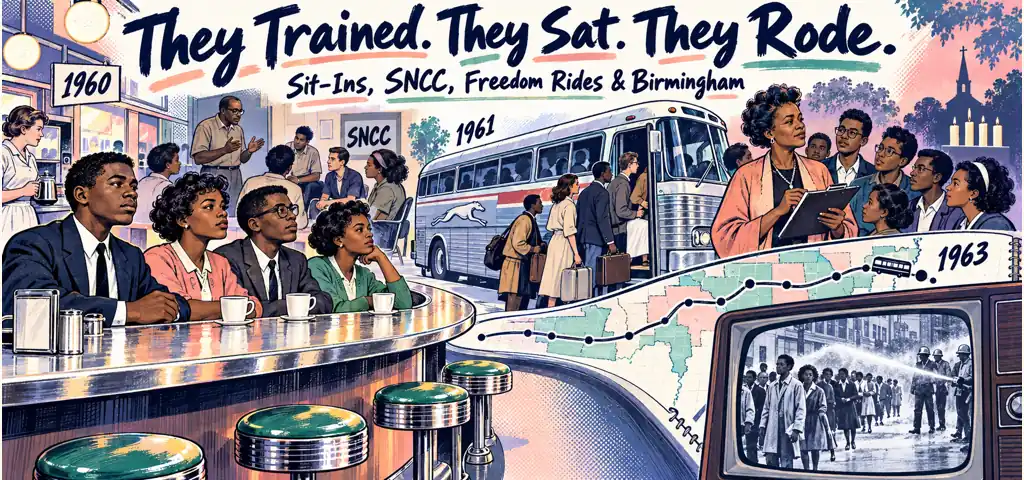
Chapter 13 of the CLEP History of the United States II study guide on Effortless Math covers Sit-Ins, SNCC, Freedom Rides, and Birmingham: the key terms, the core ideas, and worked examples showing how this topic is tested on the exam.
CLEP History of the United States II, Chapter 13
Students made an ordinary commercial transaction politically costly
On February 1, 1960, four students from North Carolina A&T sat at a Woolworth lunch counter in Greensboro and requested service. The protest spread across the South. Because national chains guarded reputations and sales beyond a single town, local sit-ins could draw sympathy pickets and headquarters pressure elsewhere. The students' discipline made the contrast visible: they asked to purchase the same food while managers and crowds enforced racial exclusion.
Nashville organizers trained before they occupied counters
Students from Fisk, Tennessee A&I, Meharry, and a Baptist seminary attended workshops led by James Lawson. They practiced enduring insults, smoke, food, and blows without striking back, while keeping the campaign's objective clear. Nashville therefore corrects the idea that sit-ins were improvised acts of courage alone. Courage was joined to rehearsal, role-playing, communication, bail strategy, and economic pressure. Preparation helped students continue when arrests and violence arrived.
SNCC gave the sit-in generation an organization of its own
Ella Baker invited student leaders to Shaw University in April 1960, where they formed the Student Nonviolent Coordinating Committee. Baker urged them to preserve independent leadership rather than become a youth branch of SCLC. SNCC emphasized local organizing, group-centered leadership, and the capacities of ordinary people. Its members would move from counters to voter-registration work, especially in rural counties where a brief national demonstration could not alter entrenched power.
CORE supplied an older tradition of nonviolent direct action
The Congress of Racial Equality formed in Chicago in 1942 among activists influenced by Gandhian methods and the Fellowship of Reconciliation. CORE used sit-ins and other direct action while the NAACP concentrated more heavily on federal litigation. In 1947 CORE and FOR organized the Journey of Reconciliation through the upper South to test a ruling against interstate bus segregation. The 1961 Freedom Rides pushed farther into the Deep South and faced much greater mob violence.
Freedom Riders tested enforcement, not merely public opinion
Federal decisions had barred segregation in interstate travel, but southern terminals still separated waiting rooms, restrooms, and lunch counters. Riders traveled in interracial groups to see whether those rules operated on the ground. A bus was burned near Anniston, riders were beaten in Birmingham and Montgomery, and many were jailed in Mississippi. Continued rides pushed the Interstate Commerce Commission to issue and enforce a stronger desegregation order for interstate facilities.
Albany taught organizers the value of a clear institutional target
The 1961-1962 Albany campaign challenged segregation across an entire Georgia city. Police chief Laurie Pritchett avoided televised brutality, dispersed prisoners among distant jails, and denied organizers a single dramatic confrontation. Few concrete concessions followed. The lesson was not that nonviolence had failed everywhere. A campaign needed a target whose response could create pressure and demands that an outside audience could understand.
Birmingham was chosen with Albany in mind
In 1963 SCLC targeted downtown desegregation and fair hiring in Birmingham, where public-safety commissioner Eugene "Bull" Connor was likely to answer demonstrations aggressively. When adult arrests depleted the campaign, young people joined. Television carried images of police dogs and high-pressure fire hoses. Business leaders negotiated, while the national crisis strengthened pressure for civil-rights legislation. The strategy was ethically costly: organizers deliberately entered a setting where official violence was foreseeable, though they did not cause that violence.
Terror continued after negotiated concessions
On September 15, 1963, a bomb planted at Birmingham's Sixteenth Street Baptist Church killed Addie Mae Collins, Denise McNair, Carole Robertson, and Cynthia Wesley during Sunday school. The church had served as a campaign center. The attack hardened national opinion and demonstrated that an agreement with merchants did not remove white-supremacist violence. In Mississippi that June, NAACP field secretary Medgar Evers had been murdered outside his home after years of organizing against exclusion and violence.
Cambridge joined public accommodations to broader material demands
Gloria Richardson's Cambridge movement in Maryland pressed employment, housing, health, and school issues rather than treating lunch-counter access as sufficient. Richardson accepted armed self-defense even while demonstrations used direct action. The campaign shows that movement goals differed by local condition and that nonviolent protest did not make every participant a pacifist. A narrow accommodations victory could leave work, care, housing, and police power unchanged.
Movement experience generated internal criticism
At a 1964 SNCC retreat, Casey Hayden and Mary King circulated a paper comparing women's subordinate treatment inside the organization with patterns of racial hierarchy. Women had canvassed, taught, organized offices, and faced danger, yet men often received authority and attention. The paper mattered because movement skills and an analysis of unequal power traveled into emerging women's liberation. Civil-rights organizations challenged hierarchy while also reproducing some of it.
Orangeburg showed that accommodations conflict remained lethal in 1968
Students in Orangeburg, South Carolina, protested a bowling alley that refused Black customers. On February 8 highway patrolmen fired into a crowd near South Carolina State College, killing Samuel Hammond, Henry Smith, and Delano Middleton and wounding many others. The episode received far less national attention than some earlier confrontations. Its setting and date warn against treating the 1964 accommodations law as self-enforcing or the movement as completed.
match tactic to the institution being pressured
A student action occurs at a bus terminal, another at a lunch counter, and a third at a county courthouse.
Watch the history in motion
This short lesson adds voices, images, and chronology to the ideas you just studied.
Video: The Freedom Riders History, Smithsonian Magazine.
Try four CLEP-style questions
- Why did the 1961 Freedom Riders continue traveling after federal courts had already ruled against interstate segregation?
- They tested segregation on intrastate routes outside federal jurisdiction.
- They sought a federal statute because courts had not addressed interstate travel.
- They sought to test whether rulings were being obeyed in terminals and buses.
- They asked southern utility commissions to replace federal transit rules.
- They sought damage awards without changing terminal practices.
- What best explains why Birmingham produced more national pressure than Albany?
- Birmingham officials quietly dispersed prisoners, while Albany used police dogs.
- Birmingham won a Supreme Court ruling, while Albany secured an ICC order.
- Birmingham centered on interstate terminals, while Albany centered on public schools.
- Birmingham avoided youth participation, while Albany depended on student marches.
- Birmingham combined a clear target with official violence visible to a national audience.
- How did CORE's early method differ from the NAACP's characteristic legal strategy?
- CORE organized nonviolent direct action; the NAACP built test cases in federal courts.
- CORE developed constitutional test cases; the NAACP organized chain-store sit-ins.
- CORE centered on rural literacy classes; the NAACP trained interstate riders.
- CORE negotiated with transit commissions; the NAACP organized interracial restaurant teams.
- CORE federated ministerial affiliates; the NAACP formed student chapters through the Shaw conference.
- Which event occurred last?
- Formation of SNCC at Shaw University
- CORE's Journey of Reconciliation
- The Freedom Rides through the Deep South
- The Orangeburg shootings
- The Birmingham church bombing
Check your answers and reasoning
Independent preparation. CLEP is a registered trademark of the College Board, which does not endorse this lesson.

Related to This Article
More math articles
- Mean, Median, Mode, and Range: A Plain-English Statistics Guide for 2026
- Full-Length 7th Grade FSA Math Practice Test-Answers and Explanations
- Top 10 ATI TEAS 7 Prep Books (Our 2023 Favorite Picks)
- Affirmative action
- The Best Algebra 1 Book for Montana Students
- How to Prepare for the SHSAT Math Test?
- Agenda setting
- 6th Grade WY-TOPP Math Worksheets: FREE & Printable
- Narrator and Point of View
- Measuring Length Change: Definite Integrals in Continuous Growth Analysis

















What people say about "Sit-Ins, SNCC, Freedom Rides, Birmingham"?
No one replied yet.