The March on Washington and the Civil Rights Act of 1964
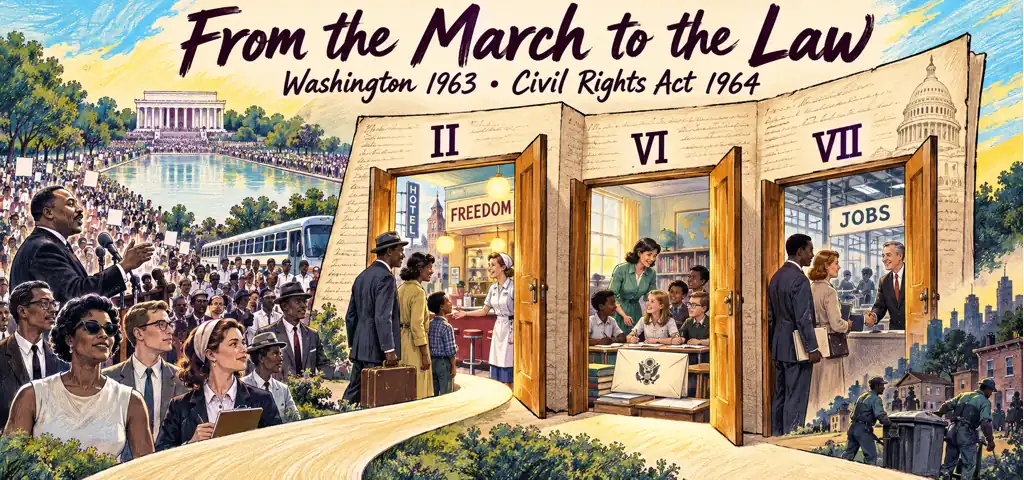
Chapter 13 of the CLEP History of the United States II study guide on Effortless Math covers The March on Washington and the Civil Rights Act of 1964: the key terms, the core ideas, and worked examples showing how this topic is tested on the exam.
CLEP History of the United States II, Chapter 13
The march joined civil rights to economic demands
On August 28, 1963, more than two hundred thousand people gathered at the Lincoln Memorial for the March on Washington for Jobs and Freedom. The title matters. Speakers demanded equal access to public life, but the program also called for decent work, a higher minimum wage, fair employment, and stronger federal protection. A. Philip Randolph had threatened a similar march in 1941 to pressure defense employers. Bayard Rustin managed the 1963 logistics, while a coalition of civil-rights, labor, and religious groups supplied buses, marshals, money, and participants.
The platform went beyond the speech remembered most often
Martin Luther King, Jr.'s "I Have a Dream" address became the best-known moment, yet the program contained several arguments. John Lewis of SNCC criticized federal delay. Randolph stressed work and economic security. Women such as Daisy Bates appeared, though male leaders dominated the formal speaking roles despite women's central movement work. The march strengthened the case for legislation, but it did not write a bill or ensure passage. Public demonstration, congressional bargaining, presidential pressure, and earlier local campaigns all contributed.
Title II attacked discrimination in public accommodations
The Civil Rights Act of 1964 prohibited racial discrimination in hotels, restaurants, theaters, and other covered public accommodations connected to interstate commerce. Congress relied mainly on the Commerce Clause because travelers, food, and business transactions crossed state lines. In Heart of Atlanta Motel v. United States, the Supreme Court upheld that basis. Title II did not create a general federal rule for every private association or solve discrimination in housing, voting, and employment through one section.
Title VI made federal money a source of enforcement
Title VI barred discrimination in programs receiving federal financial assistance. This changed the cost of resistance. A school district that ignored desegregation orders could risk federal education funds after new aid programs expanded Washington's financial role. The mechanism differed from sending troops or prosecuting an individual official. Agencies could investigate, negotiate compliance, and ultimately withhold money. Funding pressure became especially important after the Elementary and Secondary Education Act of 1965 sent large sums to local districts.
Title VII created an employment rule and an enforcement agency
Title VII prohibited employment discrimination based on race, color, religion, sex, or national origin. The statute created the Equal Employment Opportunity Commission to receive charges, investigate, and seek conciliation. Its early enforcement powers were limited, and later laws strengthened them. The inclusion of sex followed a floor amendment offered by Representative Howard Smith. Some supporters may have hoped the amendment would disrupt the bill, but women legislators and advocates also worked for its adoption. Treating the provision as a prank erases that political effort.
The act divided problems among different titles
A restaurant refusal belongs chiefly to Title II. A federally funded school program implicates Title VI. An employer's hiring rule falls under Title VII. Voting protections appeared in Title I but did not supply the strong registration machinery Congress added in 1965. This division explains why the Civil Rights Act and Voting Rights Act were complementary. A student who remembers only "the 1964 law ended discrimination" loses the institutional distinctions that make a hard item answerable.
Fair housing required another federal law
The Fair Housing Act of 1968 prohibited discrimination in the sale, rental, and financing of housing based on race, color, religion, or national origin. Later amendments added sex, disability, and familial status. Congress passed the law days after King's assassination, after years of failed proposals and sustained open-housing campaigns. The act addressed a field that Title II's public-accommodations rule did not cover. Enforcement remained difficult because sales, rentals, zoning, lending, and neighborhood intimidation involved many actors.
Memphis showed why employment power remained central
In 1968 Black sanitation workers in Memphis struck after Echol Cole and Robert Walker were crushed in a garbage truck. The workers sought union recognition, safer conditions, and fair pay. Their "I AM A MAN" signs made dignity at work inseparable from civil rights. King came to Memphis while planning a Poor People's Campaign focused on jobs and income. The strike reminds readers that access to a lunch counter did not settle public employment, workplace safety, bargaining power, or poverty.
Urban rebellion exposed limits that accommodations law could not reach
The Watts uprising began in Los Angeles in August 1965 after a traffic arrest escalated. It occurred outside the southern setting that dominated national civil-rights coverage and after Congress had enacted the 1964 law. Housing segregation, unemployment, policing, and unequal public services remained. The episode did not prove that the statute was useless. It showed that removing formal exclusion from covered accommodations left other institutions and economic conditions unresolved.
identify the institution before choosing the statute
A hotel refuses a Black traveler, a factory rejects women applicants, and a school district receives federal money while maintaining segregation.
The act was a turning point with bounded reach
The 1964 statute made federal law a direct force against discrimination in accommodations, employment, and federally funded programs. It also supplied no instant cure. Agencies needed staff, complainants needed protection, courts had to interpret new provisions, and resistant institutions learned to alter their methods. The strongest historical account holds both facts together: Congress changed the legal structure, while enforcement and later legislation determined how far that change traveled.
Watch the history in motion
This short lesson adds voices, images, and chronology to the ideas you just studied.
Video: The African American CIVIL RIGHTS Movement (1960s) [APUSH Review 8.10] Period 8: 1945-1980, Heimler's History.
Try four CLEP-style questions
- Which provision of the Civil Rights Act most directly threatened federal funds for a segregated school district?
- Title II's rule for covered public accommodations
- Title I's provisions governing voting-rights litigation
- Title VI's ban in federally assisted programs
- Title VII's prohibition of employment discrimination
- The EEOC's authority to investigate and conciliate
- What did the Memphis sanitation strike add to the civil-rights agenda?
- A demand that Congress transfer municipal services to private contractors
- A claim that school desegregation depended on residential zoning alone
- A test of whether Title II covered every city employee's grievance
- A demand for workplace safety, union recognition, fair pay, and dignity
- A campaign to replace collective bargaining with federal wage boards
- Which comparison between the 1964 act and the Voting Rights Act is most accurate?
- The 1964 act reached accommodations and employment, while the later law added stronger voting enforcement.
- The 1964 act governed housing sales, while the later law covered restaurants.
- The 1964 act abolished poll taxes in state elections, while the later law addressed employment.
- Both relied chiefly on voluntary local compliance without federal administrative tools.
- Both used the same federal-examiner system to register voters.
- A national chain restaurant changes its policy after local sit-ins and the prospect of federal legislation. Which interpretation best fits the evidence?
- Corporate headquarters lacked authority over service policies at local branches.
- Commercial pressure and public law could reinforce each other against exclusion.
- The sit-ins mattered only because courts had already ordered every restaurant integrated.
- Federal legislation removed the need for organized pressure before it took effect.
- The policy change shows that employment discrimination had already ended inside the chain.
Check your answers and reasoning
Independent preparation. CLEP is a registered trademark of the College Board, which does not endorse this lesson.

Related to This Article
More math articles
- Tip, Tax & Discount Math: Mental Shortcuts That Save Money
- Free Grade 8 English Worksheets for Michigan Students
- How to Use Area Models to Multiply One-Digit Numbers By Up to 4-digit Numbers
- The Best Grade 4 Math Book for New York Students
- Commerce Clause
- Middle School Math Worksheets: FREE & Printable
- Chapter 23: Privacy and Personal Liberty
- The Best Grade 4 ELA Practice Tests for Pennsylvania Students
- How to Find the Domain and Range of Quadratic Functions
- 3rd Grade STAAR Math Worksheets: FREE & Printable





















What people say about "March on Washington and the 1964 Act"?
No one replied yet.