AP Cybersecurity Network Segmentation: Explain the Security Benefit (2027 Prep)
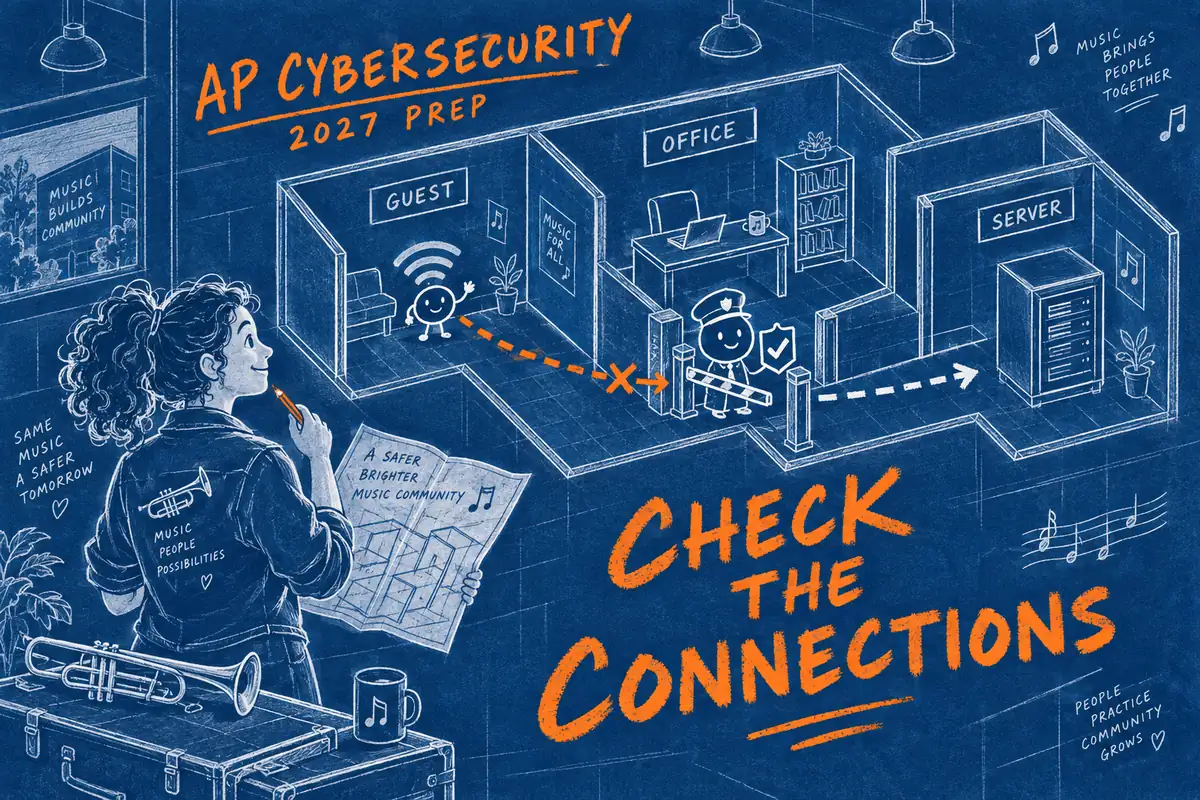
A visitor's laptop should reach a music center's approved internet service, while the staff booking server remains inaccessible from guest Wi-Fi. Putting those devices in differently named groups helps organize the network, but the security benefit depends on what traffic can actually cross between them.
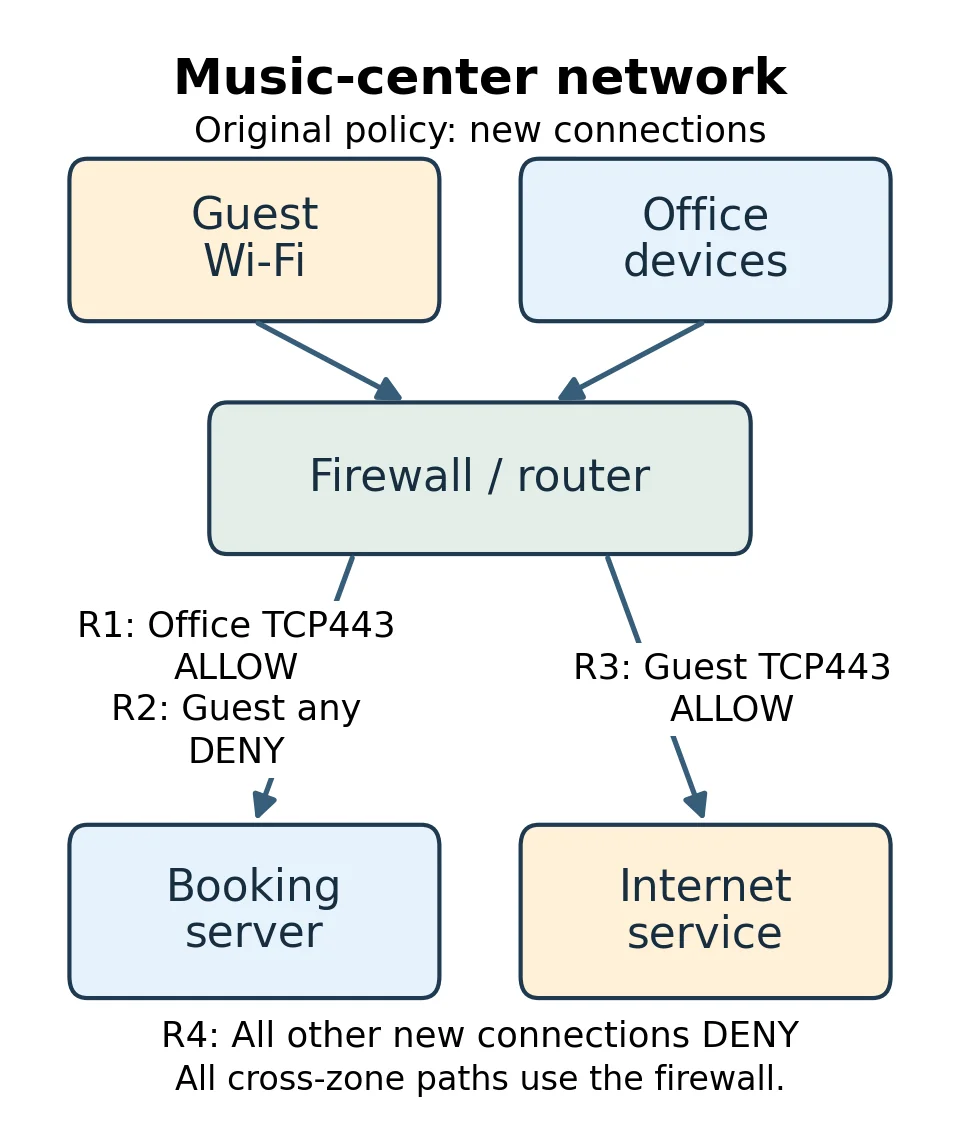
Follow one connection. In the original example below, the guest and office networks meet a firewall that permits selected traffic and denies the rest. You will trace the decisions, then see how one overly broad rule changes the result.
For AP Cybersecurity network segmentation, explain the boundary and its effect on access. Saying that the network has VLANs leaves out which unwanted path is restricted, which legitimate work remains possible and what risks are still present.
Connect the example to the current course
College Board's current AP Cybersecurity course and exam description covers segmentation techniques in Topic 3.3.A and their security benefits in Topic 3.3.B. Topic 3.4.B explains ordered access-control rules and the first matching rule, which this tutorial uses to test the intended boundaries in a small fictional network.
The model is deliberately limited. It illustrates policy for new connections, rather than supplying a complete production configuration or predicting a particular exam question. The groups, rules and modeled results are original.
Use the AP Cybersecurity Online Center for wider course review after working through the connections. Here, keep the diagram beside the rules so a label on a network cannot substitute for checking how traffic is handled.
Name the groups and their intended access
Our fictional music center has guest Wi-Fi, office devices and a private booking-server segment. A fourth destination zone, Internet, contains the approved external service used in this exercise and excludes all three internal groups.
The guest and office groups use separate VLANs and IP subnets. Each cross-zone connection in this model must pass through the same firewall/router, with no alternate routing path. The diagram simplifies physical links, preserving that policy boundary.
Office devices need the booking application on TCP destination port 443. Guests need the approved external service on TCP destination port 443, but no direct connection to the booking server. New connections outside those stated requirements are denied.
Scope matters here. We are not claiming that allowing TCP443 alone supports every form of internet use. Address resolution is assumed complete for the named test destinations, and dependencies such as DNS, device management and updates would need separate treatment in a real configuration.
The fictional firewall tracks connection state for return traffic. The rule traces below concern new connections, so an allowed request's legitimate reply is not evaluated as an unrelated new connection in the opposite direction.
Distinguish separation from traffic enforcement
VLANs create separate broadcast domains in a switching network. Communication between VLANs needs routing, and the controls applied along that route determine which cross-zone traffic is permitted.
Check the route. Creating two VLAN names does not by itself establish that guest traffic cannot reach a server through an available router. Our required route crosses the firewall and its rules.
IP subnets and VLANs describe related but different aspects of the design. The example uses one subnet per VLAN for clarity, without claiming that the terms are interchangeable or that an IP address label alone enforces a security policy.
NIST's firewall-policy guidance discusses allowing required traffic and denying other traffic by default. That principle helps explain the final rule in this teaching policy, while actual products and environments need their own tested configuration.
Read the original rules in their stated order
The first matching rule determines the decision. Reading from top to bottom, R1 allows Office to Booking server on TCP destination port 443, while R2 denies Guest to Booking server on any protocol or destination port.
Rule R3 allows Guest to Internet on TCP destination port 443. Rule R4 denies every other new connection. The source and destination names refer to the exact zones defined above, and any means every value for that field.
Use every field. Guest to Booking server on TCP443 does not match R1 because its source is Guest rather than Office. R2 denies it before the later Internet permission.
Office to Booking server on TCP443 matches R1 and is allowed. Office to Booking server on TCP22 fails R1's port condition, does not match the Guest rules, and reaches R4's deny. A destination server being accessible for one required service does not make every service accessible.
Trace a legitimate guest connection separately
Guest to Internet on TCP443 does not match R1's source or R2's destination. It reaches R3 and is allowed. This result preserves the particular guest service specified by the scenario while the server-directed guest connection remains denied.
The table records four worked traces. Download the worked connection traces (CSV) if you want to follow the matching rule for each connection and compare it with the changed policy below.
An allow decision has limits. It permits the modeled network path, without establishing that a remote service is healthy or that its application will accept a user's request. Network reachability and application authorization answer different questions.
| Source | Destination | TCP port | First match/result |
|---|---|---|---|
| Office | Booking server | 443 | R1 / Allow |
| Guest | Booking server | 443 | R2 / Deny |
| Guest | Internet | 443 | R3 / Allow |
| Office | Booking server | 22 | R4 / Deny |
Explain the benefit through a possible compromise
Suppose a guest device is compromised. Under the original policy and routing assumptions, its new direct connections to the booking server are denied by R2. That restricts its direct route to the server.
Keep the claim specific. The firewall has not removed malware from the guest device, and the diagram does not establish isolation between individual devices inside the Guest group. Within-zone communication and device safeguards need separate controls.
The Office-to-server TCP443 path is intentionally allowed. A compromised office device could still send traffic along that permitted path, so the booking application needs appropriate authentication, authorization, patching and other safeguards.
NIST's zero trust architecture guidance explains that network location alone does not grant implicit trust. Our segmentation example controls selected paths, while that broader principle helps explain why membership in Office is insufficient proof that an application request is authorized.
Find the rule that defeats the intended boundary
Now insert a new rule R0 above R1: allow Guest to any destination on TCP443. Leave all VLANs, subnets and the other rules unchanged.
Trace Guest to Booking server again. On TCP443 it now matches R0 first, so the model allows it and never reaches R2's deny. The topology still looks segmented, but this rule defeats the intended guest-to-server restriction for that port.
Check a different port too. Guest to Booking server on TCP22 does not match R0's port condition and still reaches R2's deny. The error therefore opens the specified TCP443 path, rather than proving that every protocol and port is now permitted.
For the stated teaching requirements, remove the accidental broad rule and retain the scoped Guest-to-Internet permission in R3. Then verify both the restored deny and the required allow, rather than checking only whether guests can still reach the external service.
Test the boundary and the useful service
An authorized test of the intended policy would include Guest-to-Booking TCP443 denied, Office-to-Booking TCP443 allowed and Guest-to-Internet TCP443 allowed. Add Office-to-Booking TCP22 denied to check the port restriction.
Inspect the evidence. Compare the observed connection result with the firewall decision and matched rule, while checking that the traffic took the intended path. A failed connection alone could also reflect a stopped service, an incorrect destination or a routing fault.
The blank connection-check record (CSV) separates expected result, matched rule, observed result and supporting evidence. Its empty fields are deliberate: the worked traces describe a model, while no live music-center network has been configured or tested.
Recheck after changes. A new route, moved device or broader permission can alter the boundary even when the diagram's group names stay the same. Keep necessary services working while checking the unwanted connection.
Write the explanation around the actual path
A clear explanation could read: Guest and Booking server are separate zones whose cross-zone traffic passes through the firewall. R2 denies new Guest-to-Booking connections, limiting the guest device's direct network access to that server, while R3 preserves the specified Guest-to-Internet TCP443 service.
Add the condition. This benefit depends on enforced rules without a bypass. It does not establish that guest devices are clean or that every request on an allowed path is safe.
Continue through the AP Cybersecurity Online Center when you are ready to connect segmentation with other controls and detection. For the next network you study, identify the source, destination, required service and enforcement point before describing its security benefit.
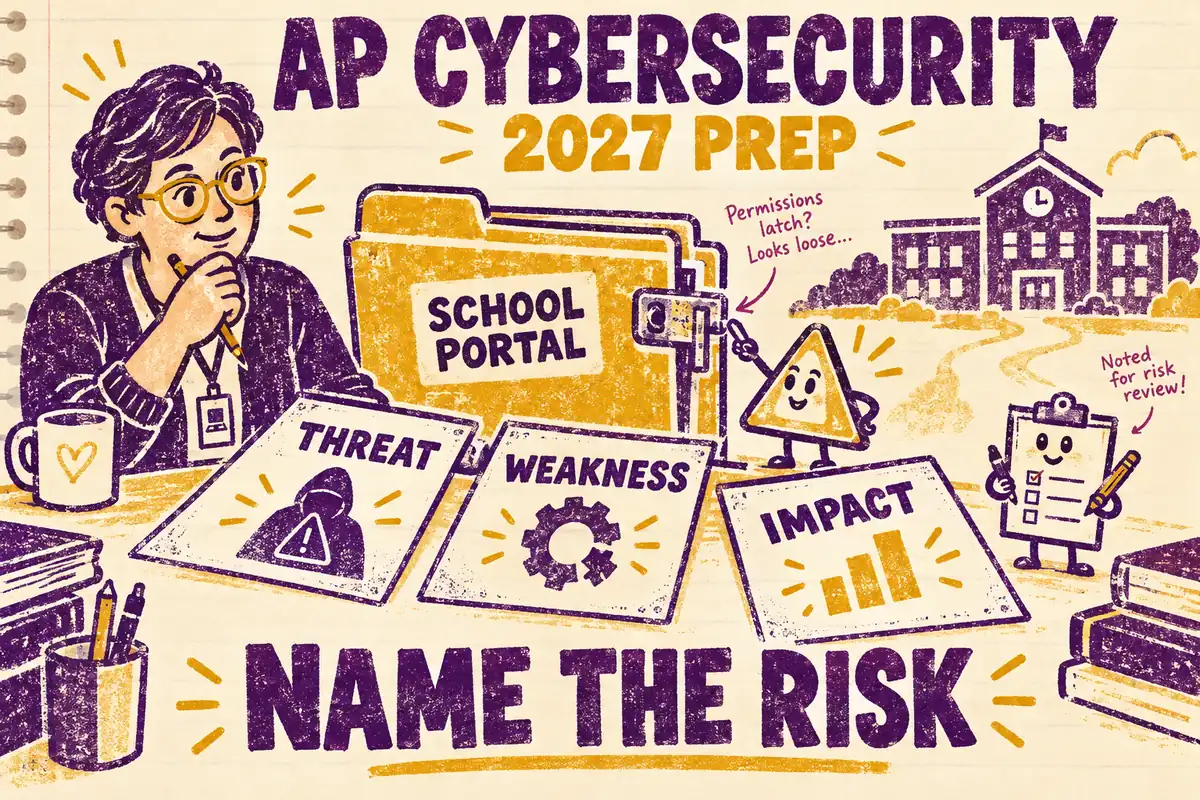
2027 preparation edition. Current College Board framework and NIST technical references checked October 11, 2026. Music center, network, rules, traces and diagram are original fictional teaching material, not a production configuration or official/recalled exam questions. No live network was tested. Cover architecture is conceptual artwork; the instructional diagram and exact rules define the model.

Related to This Article
More math articles
- Top 10 HiSET Math Prep Books (Our 2023 Favorite Picks)
- Stem –and–Leaf Plots
- Subject-Verb Agreement
- FREE 8th Grade PSSA Math Practice Test
- Grassroots lobbying
- 10 Most Common 4th Grade STAAR Math Questions
- The Best Grade 6 ELA Practice Tests for Arizona Students
- SSAT Math-Test Day Tips
- Mississippi MAAP Grade 6 Math Free Worksheets: 72 Free Skill-by-Skill PDFs with Answer Keys
- Best Calculators for Linear Algebra and Calculus














What people say about "AP Cybersecurity Network Segmentation: Explain the Security Benefit (2027 Prep)"?
No one replied yet.