Free Grade 7 English Worksheets for Alabama Students
Somewhere between the sixth-grade kid who could still get away with a one-line answer and the ninth grader expected to draft a real essay, Alabama puts seventh grade. It is the year a student is asked to stop summarizing what happened and start arguing about what it means. Teachers in Birmingham, Dothan, Decatur, and every district in between will say it the same way: the questions stop being recall and start being defend.
That shift is hard to feel from the outside. A parent flipping through a returned reading quiz might see three lines of writing where there used to be one and wonder why the score dropped. The reason is almost always the same, Grade 7 wants several pieces of evidence stitched together, not one quote dropped at the end. It wants the counterclaim acknowledged, not avoided. It wants the dangling modifier caught and fixed.
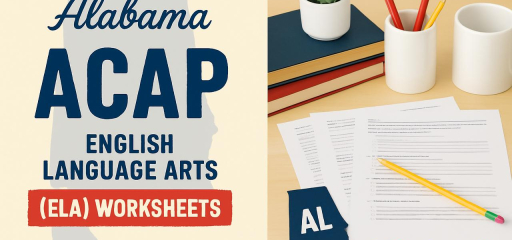
The worksheets on this page are built for exactly that gap. Forty-three single-skill PDFs, every one of them aligned to the Alabama Course of Study for English Language Arts at Grade 7, every one of them printable on the home printer with no login and no email collected at the door.
What’s on this page
Each PDF targets one standard. Page one is a short Quick Review your seventh grader can read without a parent translating. The practice items follow, and the final page is an answer key written for the student, explanations that say not just what the right answer is but why the wrong answers looked tempting.
Print whichever ones match what your child brought home this week. Stack the rest for later.
Reading: Literature
- Citing Several Pieces of Textual Evidence, [RL.7.1] stack two or three quotes so an inference is genuinely supported, not just decorated
- Theme and Its Development Over the Text, [RL.7.2] name the lesson the whole story teaches and trace how it grows scene by scene
- How Setting, Character, and Plot Interact, [RL.7.3] show how one story element pushes another into motion
- Word Choice, Figurative Language, and Tone, [RL.7.4] denotation, connotation, and the mood a single word can plant
- How Form Shapes Meaning in Drama and Poetry, [RL.7.5] line breaks, stanzas, and stage directions as part of what the text says
- Developing and Contrasting Points of View, [RL.7.6] analyze how a writer builds two perspectives that bump against each other
- Comparing a Story to Its Audio, Film, or Stage Version, [RL.7.7] what each medium can do that the others cannot
- Comparing Fictional and Historical Portrayals, [RL.7.9] sort the real history from the writer’s invention
Reading: Informational Text
- Citing Several Pieces of Evidence in Nonfiction, [RI.7.1] pull two or three article details that point to the same conclusion
- Two or More Central Ideas and Their Development, [RI.7.2] track an article that is teaching more than one thing at once
- How Individuals, Events, and Ideas Interact, [RI.7.3] how a person changes an idea and how an idea changes a person
- Word Meaning in Nonfiction: Figurative, Connotative, Technical, [RI.7.4] three different ways a single word can be doing work
- How Text Structure Develops the Author’s Ideas, [RI.7.5] problem-solution, compare-contrast, chronological, and why it matters
- Author’s Point of View and How They Distinguish It, [RI.7.6] locate the writer’s position and the moves that mark it as theirs
- Comparing a Text to Its Audio or Video Version, [RI.7.7] what the print version emphasizes vs. What the broadcast version emphasizes
- Evaluating an Argument: Reasoning and Evidence, [RI.7.8] sort strong evidence from filler and weigh the logic in between
- How Two Authors Shape Their Presentation of the Same Topic, [RI.7.9] same subject, different facts chosen, different angles emphasized
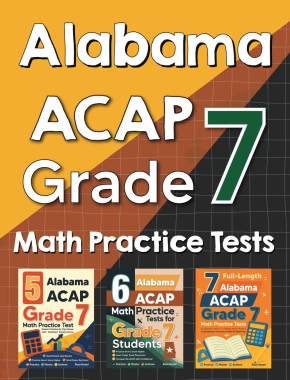
Working on Math Too? Try the Alabama ACAP Grade 7 Math Bundle
Many third graders are getting ready for the ACAP in both subjects. If your child also needs math practice that matches the same standards, this companion bundle is the shortest path, workbook, study guide, and full practice tests in one download.
Writing
- Argument Writing: Claims, Reasons, Evidence, and Counterclaims, [W.7.1] Grade 7 is the year the counterclaim becomes mandatory
- Informative and Explanatory Writing, [W.7.2] teach a reader something with a thesis, ordered sections, and clean transitions
- Narrative Writing, [W.7.3] pacing, dialogue, sensory description, and an ending that lands
- Coherent Writing for Task, Purpose, and Audience, [W.7.4] same idea written three different ways for three different readers
- Planning, Revising, and Editing, [W.7.5] sometimes the right revision is starting a paragraph over
- Short Research Projects: Question and Refocus, [W.7.7] let the early findings change the question
- Gathering, Evaluating, and Citing Sources, [W.7.8] author, date, publisher, and the basic citation a teacher actually expects
Speaking & Listening
- Collaborative Discussions, [SL.7.1] come prepared, listen first, and disagree without dismissing
- Analyzing Information in Diverse Media, [SL.7.2] read a chart, a video clip, and a photograph as part of one argument
- Evaluating a Speaker’s Argument, [SL.7.3] find the claim, the reasons, the evidence, and the soft spots
- Presenting Claims with Focus and Coherence, [SL.7.4] open with the point, preview the order, and stay in it
- Adapting Speech to Context, [SL.7.6] the words you use with friends are not the words you use in a presentation
Grammar
- Phrases and Clauses: Placement and Function, [L.7.1a] what each piece of a sentence is doing and where it belongs
- Sentence Structures: Simple, Compound, Complex, Compound-Complex, [L.7.1b] count the clauses, then name the structure
- Avoiding Dangling and Misplaced Modifiers, [L.7.1c] the sentence error that quietly makes a paragraph absurd
Conventions: Punctuation, Spelling
- Commas with Coordinate Adjectives, [L.7.2a] when two adjectives need a comma between them and when they do not
- Spelling Grade-Appropriate Words, [L.7.2b] homophones, doubled letters, and the words seventh graders miss most
Knowledge of Language and Style
- Precise and Concise Language, [L.7.3a] cut the filler and pick the exact word
Vocabulary and Word Study
- Using Context Clues, [L.7.4a] name the kind of clue, then use it on purpose
- Greek and Latin Roots and Affixes, [L.7.4b] the same root unlocks ten unrelated words
- Using Reference Materials Effectively, [L.7.4c] dictionary, thesaurus, glossary, pick the right tool for the question
- Verifying Word Meaning, [L.7.4d] confirm your guess instead of trusting it
- Allusions and Figures of Speech, [L.7.5a] Grade 7 starts asking for myth, Bible, and literary references on purpose
- Word Relationships: Synonyms, Antonyms, Analogies, [L.7.5b] name the relationship in plain words before picking an answer
- Connotation and Denotation, [L.7.5c] thin vs. Skinny vs. Slender, same fact, different feeling
- Academic and Domain-Specific Vocabulary, [L.7.6] words that travel across subjects and words tied to one field
How to use these worksheets at home
Most Alabama families do not have a clear hour to set aside for English homework. There is a sibling at the kitchen table, a tractor-pull on the radio, a load of laundry that needs flipping, and a coach’s text about Saturday’s drive to Tuscaloosa. The worksheets on this page are built around that reality.
Pick one PDF. Twelve focused minutes is enough. When something gets missed, ask your seventh grader to read the answer key aloud, the act of speaking the explanation does more for retention than any silent reread. Then move on. The next worksheet can wait until Thursday.
The skills here build slowly. Inference with several pieces of evidence is not a one-evening fix; counterclaim writing takes weeks before it stops feeling forced. Spacing the practice across short weeknight sessions is what builds the muscle. The standardized test in the spring is a small slice of a much larger arc, and steady drips are what fill the bucket.
A note about ACAP Summative ELA
The ACAP Summative ELA is Alabama’s spring state test, administered in a window that typically runs from late March through early May depending on the district’s calendar. The Grade 7 portion is aligned to the Alabama Course of Study for English Language Arts, which means the standards your child has been studying since the first week of August are exactly the ones the assessment is built on.
Expect reading passages that require pulling several pieces of evidence (RL.7.1 and RI.7.1), questions on theme development and central idea, vocabulary in context, and writing prompts that ask for either an argument with a counterclaim or an informative response built around a thesis. Nothing on this page is a cram tool. These worksheets work because they keep the everyday Course of Study skills warm so that by the time the test window opens, your child is rehearsing form, not learning it.
Want everything in one bundle?
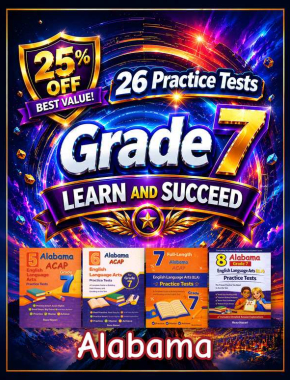
Some Alabama families would rather work from a single book than a long page of standalone PDFs. The Grade 7 ELA Preparation Bundle is built for exactly that. It collects full-length practice tests, answer keys with explanations, and the kind of structured rehearsal that turns isolated skills into test-day readiness.
Alabama Grade 7 ELA Preparation Bundle, four practice-test books, 26 unique full-length tests, complete answer keys with explanations.
A short closing
Seventh grade in Alabama is long. The school year stretches from the first hot week of August through the last warm week of May, and the reading work inside it should feel like a steady habit rather than a panic. Bookmark this page, pull a PDF on the slow nights, and let your seventh grader come back to it when a quiz makes them curious. One skill at a time is how Grade 7 readers actually grow.
Best Bundle to Ace the Alabama ACAP Grade 7 ELA
Looking for the best resource to help your kid ace the Alabama ACAP? Try this bundle, four full practice-test books (5 + 6 + 7 + 8 tests) covering the same Grade 7 reading, writing, and language skills your child is already learning. Instant PDF download, answer keys included.

Related to This Article
More math articles
- The firm’s demand reveals price-setting power
- Mastering the Midpoint & Distance on the Number Line
- GED Math FREE Sample Practice Questions
- Federal and State Powers in the United States
- Disclosure requirements
- The Best Grade 5 Math Book for California Students
- FREE 8th Grade MCAS Math Practice Test
- The Best Grade 5 Math Book for New Jersey Students
- 4th Grade K-PREP Math Worksheets: FREE & Printable
- Reading Scientific Data Tables





What people say about "Free Grade 7 English Worksheets for Alabama"?
No one replied yet.