Polynomial Division Calculator — Long & Synthetic (Free)
AlgebraFreeNo sign-up
A polynomial division calculator divides one polynomial by another and gives the quotient and remainder. For (x³ − 2x² − 4) ÷ (x − 3), write the missing x term as 0x, then divide, multiply, subtract and bring down: the quotient is x² + x + 3 and the remainder is 5, so the answer is x² + x + 3 + 5/(x − 3).
Dividing x³ − 2x² − 4 by x − 3 gives the quotient x² + x + 3 with remainder 5.
| x² | + x | + 3 | ||
| (x − 3) | x³ | − 2x² | + 0x | − 4 |
| − | x³ | − 3x² | ||
| x² | + 0x | |||
| − | x² | − 3x | ||
| 3x | − 4 | |||
| − | 3x | − 9 | ||
| 5 |
Show steps
- Write both polynomials in descending powers. The dividend becomes x³ − 2x² + 0x − 4 (0 placeholders keep the columns lined up) and the divisor is x − 3.
- Step 1: divide the leading term x³ by x to get x². Multiply: x² × (x − 3) = x³ − 3x². Subtract it: (x³ − 2x² − 4) − (x³ − 3x²) = x² − 4, then bring down the next term.
- Step 2: divide the leading term x² by x to get x. Multiply: x × (x − 3) = x² − 3x. Subtract it: (x² − 4) − (x² − 3x) = 3x − 4, then bring down the next term.
- Step 3: divide the leading term 3x by x to get 3. Multiply: 3 × (x − 3) = 3x − 9. Subtract it: (3x − 4) − (3x − 9) = 5.
- Stop when the remainder 5 has a lower degree (0) than the divisor (1).
- Result: quotient x² + x + 3, remainder 5, so the answer is x² + x + 3 + 5/(x − 3).
Check: divisor × quotient + remainder = (x − 3)(x² + x + 3) + 5 = x³ − 2x² − 4, the dividend ✓

How to use the polynomial division calculator
- Type the dividend and the divisor, for example x^3 – 2x^2 – 4 and x – 3. You can also switch to Coefficients and type 1, -2, 0, -4 and 1, -3 (highest power first, 0 for a missing power).
- Pick a method: Long division works for any divisor, Synthetic is the shortcut for a linear divisor such as x − 3 or 2x + 1, and Box method shows the area model.
- Read the quotient, the remainder and the answer written as quotient + remainder/divisor. For a linear divisor you also get the remainder theorem check.
- Follow the layout (the quotient sits on top, aligned with like powers) and open Show steps for every divide, multiply and subtract.
Dividend, divisor, quotient and remainder
Polynomial division works like number division. The polynomial being divided is the dividend P(x), the one you divide by is the divisor D(x), the result is the quotient Q(x), and what is left over is the remainder R(x). They always satisfy the division algorithm:
P(x) = D(x) · Q(x) + R(x), where the degree of R is less than the degree of D.
So the answer can be written as P(x)/D(x) = Q(x) + R(x)/D(x). If R(x) = 0, the divisor is a factor of the dividend.
Polynomial long division step by step
Write both polynomials in descending powers and put a 0 placeholder for every missing power. Then repeat four moves until the remainder has a lower degree than the divisor:
- Divide the leading term of what is left by the leading term of the divisor. Write the result on top.
- Multiply that term by the whole divisor.
- Subtract the product (change every sign, then add).
- Bring down the next term.
Example 1: (x³ − 2x² − 4) ÷ (x − 3)
Rewrite the dividend as x³ − 2x² + 0x − 4. First, x³ ÷ x = x²; multiply x²(x − 3) = x³ − 3x²; subtract to get x², and bring down 0x. Next, x² ÷ x = x; x(x − 3) = x² − 3x; subtract to get 3x, and bring down −4. Last, 3x ÷ x = 3; 3(x − 3) = 3x − 9; subtract to get 5. The quotient is x² + x + 3 and the remainder is 5.
Check: (x − 3)(x² + x + 3) + 5 = x³ − 2x² − 9 + 5 = x³ − 2x² − 4.
Example 2: dividing by a quadratic
(2x⁴ − 3x³ + 5x − 1) ÷ (x² + x − 2). The dividend needs a 0x² placeholder. Three rounds give the quotient 2x² − 5x + 9, and the remainder is −14x + 17, which has degree 1, less than the divisor’s degree 2. The answer is 2x² − 5x + 9 + (−14x + 17)/(x² + x − 2).
Synthetic division
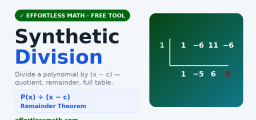
When the divisor is linear, x − r, synthetic division does the same work with numbers only. Write r in a box and the dividend’s coefficients beside it (0 for missing powers). Bring the first coefficient down, multiply it by r, add it to the next coefficient, and repeat. The last number is the remainder; the others are the quotient’s coefficients, one degree lower than the dividend.
Example 3: (x³ − 1) ÷ (x − 1)
Here r = 1 and the coefficients are 1, 0, 0, −1. The bottom row is 1, 1, 1, 0. The quotient is x² + x + 1 and the remainder is 0, so x − 1 is a factor: x³ − 1 = (x − 1)(x² + x + 1).
Example 4: a divisor like 2x − 1
For (6x³ + 5x² − 7) ÷ (2x − 1), use r = 1/2 because 2x − 1 = 0 when x = 1/2. Synthetic division on 6, 5, 0, −7 gives 6, 8, 4 and a remainder of −5. Since 2x − 1 = 2(x − 1/2), divide 6, 8, 4 by 2: the quotient is 3x² + 4x + 2 and the remainder stays −5. Many students forget this last division. The dedicated synthetic division calculator goes deeper into this method.
The box method
The box (area) method sets the divisor’s terms down the side of a grid and fills it so the cells add up to the dividend. For (x² + 5x + 6) ÷ (x + 2), the top-left cell must be x², so the first column heading is x² ÷ x = x; that column holds x² and 2x. The remaining 3x needs a second column headed 3, holding 3x and 6. The cells add to x² + 5x + 6 exactly, so the quotient is x + 3 with remainder 0.
Remainder theorem and factor theorem
When you divide P(x) by x − r, the remainder equals P(r). For P(x) = x² − 2x − 4 and divisor x − 3, P(3) = 9 − 6 − 4 = −1, which is exactly the remainder from long division. If P(r) = 0, the remainder is 0 and x − r is a factor. This is how synthetic division helps find roots and factor polynomials of degree 3 and higher.
Which division method should you use?
| Divisor | Best method | Why |
|---|---|---|
| x − r | Synthetic division | Fastest; numbers only |
| ax + b | Synthetic (then divide by a) or long division | Synthetic needs one extra step |
| Degree 2 or more | Long division or box method | Synthetic division does not apply |
| Any, to learn the idea | Box method | Shows why the answer works |
Common mistakes in polynomial division
- Skipping placeholders. x³ − 4 must be written x³ + 0x² + 0x − 4, or the columns slide out of line.
- Subtracting only the first term. Change the sign of every term in the product before adding.
- Using the wrong sign for r. Dividing by x + 2 means r = −2 in synthetic division.
- Stopping too early or too late. Stop exactly when the remainder’s degree is less than the divisor’s degree.
- Writing the remainder alone. The answer is Q(x) + R(x)/D(x), not “Q(x) R 5”, unless your teacher asks for that form.
Checking homework with the calculator
Divide by hand first, then enter the same polynomials here. If your quotient differs, compare your work with the layout row by row; the first row that does not match shows the mistake, usually a sign in a subtraction or a missing placeholder. Finally, multiply your divisor by your quotient and add the remainder to confirm you get the dividend back.
Polynomial division practice quiz: 10 questions
Test yourself with 10 multiple-choice questions. Choose an answer and press Submit to see if you are right and why. Your score appears at the end.
x² ÷ x = x; x(x + 2) = x² + 2x; subtracting leaves 5x + 10, and 5x + 10 = 5(x + 2). The quotient is x + 5 with remainder 0.
By the remainder theorem the remainder is P(1) = 1 + 3 + 1 = 5. Using P(−1) = −1 is the common sign error.
Every power from x⁴ down to the constant needs a coefficient, so x³ and x² get 0 placeholders.
Synthetic division with r = 2 on 1, 0, 0, −8 gives 1, 2, 4 and remainder 0, so the quotient is x² + 2x + 4.
4x² ÷ 2x = 2x; 2x(2x − 1) = 4x² − 2x; subtracting leaves 6x − 3 = 3(2x − 1). The quotient is 2x + 3. Forgetting to divide synthetic results by 2 gives 4x + 6.
Long division gives quotient x + 2. Then x³ + 2x² − x + 3 − (x + 2)(x² + 1) = −2x + 1, which has degree 1, less than 2.
By the factor theorem, a remainder of 0 means P(3) = 0 and x − 3 divides P(x) exactly.
Synthetic division with r = 2 on 2, −3, 0, 4 gives 2, 1, 2 and remainder 8. Using r = −2 by mistake gives the second distractor.
Quiz complete
Frequently asked questions
What is polynomial division?
It splits one polynomial by another into a quotient and a remainder, just like dividing numbers. For example, (x² − 2x − 4) ÷ (x − 3) gives the quotient x + 1 and the remainder −1.
How do you do polynomial long division?
Repeat divide, multiply, subtract and bring down. For (x² − 2x − 4) ÷ (x − 3): x² ÷ x = x, x(x − 3) = x² − 3x, subtracting leaves x − 4; then x ÷ x = 1, 1(x − 3) = x − 3, and subtracting leaves −1.
How do you do synthetic division?
Use r from the divisor x − r and the coefficients of the dividend, with zeros for missing terms. For (x³ − 1) ÷ (x − 1), r = 1 and 1, 0, 0, −1 give the quotient x² + x + 1 with remainder 0.
Can you divide polynomials on a calculator?
Only calculators with a computer algebra system can divide polynomials symbolically. This tool does it with exact fractions: entering the coefficients 2, 3, −5 and 1, −1 gives the quotient 2x + 5 and remainder 0.
What does the remainder tell you?
By the remainder theorem, dividing P(x) by x − r leaves P(r). For x² − 2x − 4 divided by x − 3, P(3) = −1, the same as the remainder. A remainder of 0 means the divisor is a factor.
What is the box method for dividing polynomials?
It is an area model: the divisor's terms label the rows, and you choose column headings so the cells add up to the dividend. For (x² + 5x + 6) ÷ (x + 2), the columns are x and 3, so the quotient is x + 3 with no remainder.
Related calculators
- Synthetic division calculator
- Long division calculator
- Partial fraction decomposition calculator
- Factoring calculator
- Quadratic equation solver
More algebra calculators

Related to This Article
More math articles
- The Best Grade 6 ELA Practice Tests for Wyoming Students
- 6th Grade MCAP Math Worksheets: FREE & Printable
- FREE 8th Grade MEAP Math Practice Test
- Top 10 Grade 3 Math Books: Inspiring Young Mathematicians to Explore
- Misinformation and political communication
- Labeling, Stigma, and Secondary Deviance
- Advanced Vocabulary Words: Magnitude to Opulent
- How to Determine the Missing Number when Multiplying Decimals by Powers of 10
- How to Simplify Variable Expressions? (+FREE Worksheet!)
- Density Calculator






What people say about "Polynomial Division Calculator: Long & Synthetic, Steps"?
No one replied yet.