Synthetic Division Calculator (Free, Step-by-Step)
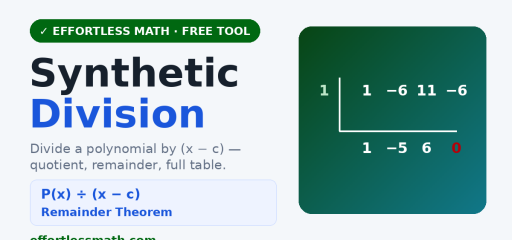
A synthetic division calculator divides a polynomial by x − c using only its coefficients. For (x³ − 6x² + 11x − 6) ÷ (x − 4), put 4 in the box, write 1, −6, 11, −6, bring down 1, then multiply by 4 and add: the bottom row is 1, −2, 3, 6. The quotient is x² − 2x + 3 and the remainder is 6, equal to P(4).
Lists every rational candidate ±p/q, tests them with synthetic division, divides out each root (repeating for double roots) and finishes the last quadratic with the quadratic formula.
Dividing x³ − 6x² + 11x − 6 by x − 4 with synthetic division (c = 4) gives the quotient x² − 2x + 3 and remainder 6.
| 4 | 1 | −6 | 11 | −6 |
| ↓ | 4 | −8 | 12 | |
| 1 | −2 | 3 | 6 | |
| x² | x | const | R |
Show steps
- Set the divisor equal to 0: x − 4 = 0 gives x = 4. Write 4 in the box on the left.
- Write the coefficients of P(x) from the highest power down, with 0 for every missing power: 1, −6, 11, −6.
- Bring down the first coefficient, 1, to the bottom row.
- Repeat “multiply by 4, then add” for each column: multiply 1 × 4 = 4, add −6 + 4 = −2; multiply −2 × 4 = −8, add 11 + (−8) = 3; multiply 3 × 4 = 12, add −6 + 12 = 6.
- The last number, 6, is the remainder. The other bottom numbers (1, −2, 3) are the quotient coefficients, starting one power lower than P(x).
- So the quotient is x² − 2x + 3.
- Remainder theorem check: P(4) = 6, the same as the remainder.
Check: (x − 4)(x² − 2x + 3) + 6 = x³ − 6x² + 11x − 6 = P(x) ✓
How to use the synthetic division calculator
- Type the polynomial, for example x^3 – 6x^2 + 11x – 6, or switch to Coefficients and type 1, -6, 11, -6 (highest power first, 0 for a missing power).
- Divide: enter the divisor as x − 4, 2x + 1, or simply the number c. You get the full tableau, the quotient, the remainder, the remainder theorem check and a factor check.
- Find all roots: the calculator lists the rational root candidates, tests them with synthetic division, divides out every root it finds and gives the factored form.
- Evaluate P(c): enter one or more values of c to evaluate the polynomial by synthetic substitution and see where it changes sign.
How synthetic division works
Synthetic division is a shortcut for dividing by a linear factor x − c. It keeps only the numbers and replaces long division’s “divide, multiply, subtract” with “multiply, add”.
- Find c by setting the divisor equal to 0. For x − 4, c = 4. For x + 2, c = −2.
- Write the coefficients of the dividend in order of descending powers. Put a 0 for every missing power.
- Bring down the first coefficient.
- Multiply it by c and write the product under the next coefficient.
- Add the column. Repeat steps 4 and 5 to the end.
- The last number is the remainder. The others are the quotient’s coefficients, starting one power lower than the dividend.
Here is the tableau for (x³ − 6x² + 11x − 6) ÷ (x − 4):
| c = 4 | x³ | x² | x | constant |
|---|---|---|---|---|
| coefficients | 1 | −6 | 11 | −6 |
| multiply by 4 | 4 | −8 | 12 | |
| add | 1 | −2 | 3 | 6 (remainder) |
Reading the bottom row: 1, −2, 3 give the quotient x² − 2x + 3 and 6 is the remainder, so x³ − 6x² + 11x − 6 = (x − 4)(x² − 2x + 3) + 6.
Missing terms need 0 placeholders
To divide x³ − 8 by x − 2, the x² and x terms are missing, so the coefficient list is 1, 0, 0, −8, not 1, −8. With c = 2 the bottom row is 1, 2, 4, 0. The quotient is x² + 2x + 4 and the remainder is 0, so x − 2 is a factor of x³ − 8.
Synthetic division by ax + b
When the divisor has a leading coefficient other than 1, such as 2x − 1, use c = 1/2 (the value that makes 2x − 1 = 0), then divide the quotient coefficients by 2 at the end. For (6x³ + 5x² + 0x − 7) ÷ (2x − 1), the bottom row with c = 1/2 is 6, 8, 4, −5. Dividing 6, 8, 4 by 2 gives the quotient 3x² + 4x + 2, and the remainder stays −5. The calculator adds this “÷ a” row to the tableau.
The remainder theorem and synthetic substitution
The remainder theorem says that when P(x) is divided by x − c, the remainder is P(c). So synthetic division is also a fast way to evaluate a polynomial. For P(x) = x³ − 6x² + 11x − 6 and c = −1, the bottom row is 1, −7, 18, −24, so P(−1) = −24. Direct substitution agrees: −1 − 6 − 11 − 6 = −24.
The Evaluate P(c) tab does this for a list of values. If P(c) changes sign between two values, a real root lies between them. For x³ − 2, P(1) = −1 and P(2) = 6, so a root lies between 1 and 2.
The factor theorem: checking a factor
If the remainder is 0, then x − c is a factor and c is a root. Dividing x³ − 6x² + 11x − 6 by x − 1 gives the bottom row 1, −5, 6, 0, so x³ − 6x² + 11x − 6 = (x − 1)(x² − 5x + 6) = (x − 1)(x − 2)(x − 3).
Finding all rational roots with repeated synthetic division
The rational root theorem limits the search: a rational root p/q of a polynomial with integer coefficients has p dividing the constant term and q dividing the leading coefficient. Test candidates with synthetic division, and each time the remainder is 0, keep going with the quotient (the depressed polynomial).
Example: 2x³ − 3x² − 11x + 6
The constant is 6 and the leading coefficient is 2, so the candidates are ±1, ±2, ±3, ±6, ±1/2 and ±3/2. Testing c = 1/2 gives the bottom row 2, −2, −12, 0, so x = 1/2 is a root and the depressed polynomial is 2x² − 2x − 12. Dividing that by x + 2 gives 2, −6, 0, leaving 2x − 6, so x = 3. The roots are −2, 1/2 and 3, and 2x³ − 3x² − 11x + 6 = (x + 2)(2x − 1)(x − 3).
Double roots
For x³ − 3x − 2, dividing by x + 1 leaves x² − x − 2, and dividing that by x + 1 again leaves x − 2 with remainder 0. So −1 is a double root: x³ − 3x − 2 = (x + 1)²(x − 2). The calculator repeats the division automatically and labels the multiplicity.
When only a quadratic with no rational roots is left, the quadratic formula finishes the job. For x³ − 2x² − 2x + 1 the root −1 leaves x² − 3x + 1, whose roots are (3 ± √5)/2.
Synthetic division vs long division
| Synthetic division | Long division | |
|---|---|---|
| Divisors | linear only: x − c or ax + b | any polynomial, such as x² + 1 |
| What you write | coefficients only | every term |
| Operations | multiply and add | divide, multiply, subtract, bring down |
| Best for | roots, P(c), factor checks | quadratic or higher divisors |
For a divisor of degree 2 or more, use the polynomial division calculator, which shows long division with aligned columns.
Common synthetic division mistakes
- Using the wrong sign for c. For x + 3, c is −3, not 3.
- Forgetting 0 placeholders for missing powers, which shifts every column.
- Subtracting instead of adding. Synthetic division always adds; the sign change is already built into c.
- Reading the quotient at the wrong degree. The quotient starts one power lower than the dividend.
- Not dividing by a when the divisor is ax + b.
Checking homework by hand
Work the tableau on paper first, then enter the same problem and compare the bottom rows. If they differ, the first column that disagrees shows the slip, usually a sign or a missing 0. Finish with a check: multiply the divisor by the quotient and add the remainder; you should get the dividend back.
Synthetic division practice quiz: 10 questions
Test yourself with 10 multiple-choice questions. Choose an answer and press Submit to see if you are right and why. Your score appears at the end.
Set the divisor to 0: x + 5 = 0 gives x = −5. Using 5 is the most common sign error.
Every power from x⁴ down to the constant needs a number, so x³ and x² get 0 placeholders.
The quotient starts one power lower than the dividend, and the last number (7) is the remainder, not part of the quotient.
By the remainder theorem the remainder is P(2) = 8 − 16 + 2 + 6 = 0, so x − 2 is a factor. Using P(−2) gives −20.
Bottom row with c = −2: 2, −1, 1, 3. The remainder 3 is P(−2). Check: −16 + 12 + 2 + 5 = 3. Using c = 2 gives P(2) = 31.
Use c = −1/2 on 4, 0, −2, 1 to get 4, −2, −1 | 3/2, then divide 4, −2, −1 by 2: 2x² − x − 1/2 (remainder 3/2). Forgetting to divide by 2 gives 4x² − 2x − 1.
Rational roots p/q need p to divide 2 and q to divide 3, so the candidates are ±1, ±2, ±1/3, ±2/3. 4 does not divide 2.
Factor theorem: remainder 0 means P(3) = 0, so 3 is a root and x − 3 divides P(x) exactly.
x = −2 is a double root, so two divisions by x + 2 leave remainder 0; the third would not.
Quiz complete
Frequently asked questions
How do you do synthetic division?
Write c from the divisor x − c, list the coefficients, bring down the first one, then multiply by c and add, column by column. For (x³ − 6x² + 11x − 6) ÷ (x − 1) the bottom row is 1, −5, 6, 0, so the quotient is x² − 5x + 6 and the remainder is 0.
Can you do synthetic division on a calculator?
Yes. Enter the coefficients and c, and the calculator does the multiply-and-add steps. Decimals are fine: dividing 2x⁴ − 5x² + x + 3 by x − 1.5 (coefficients 2, 0, −5, 1, 3) gives the bottom row 2, 3, −0.5, 0.25, 3.375, so the remainder is 3.375.
How do you do synthetic division on a graphing calculator?
Most graphing calculators have no synthetic division key, but you can store the polynomial as Y1 and evaluate Y1(c): by the remainder theorem that value is the remainder. For the quotient, repeat "multiply by c, add the next coefficient" on the home screen, or use an online tool like this one.
Can synthetic division be used for any polynomial?
Any polynomial can be the dividend, as long as you add 0 placeholders. For x³ − 8 ÷ (x − 2) use 1, 0, 0, −8; the bottom row 1, 2, 4, 0 gives x² + 2x + 4. The divisor, however, must be linear.
Does synthetic division work with complex numbers?
Yes, c can be complex. To divide x² + 1 by x − i, use coefficients 1, 0, 1: bring down 1; 1 × i = i and 0 + i = i; i × i = −1 and 1 + (−1) = 0. The quotient is x + i and the remainder is 0.
Related calculators

Related to This Article
More math articles
- 4th Grade SBAC Math FREE Sample Practice Questions
- Free Grade 3 Math Worksheet Library for Wyoming (WY-TOPP): 49 Printable Skill Pages
- Consistency: Avoiding Shifts in Person, Number, Tense, Voice, and Mood
- 3rd Grade MAP Math Practice Test Questions
- The Math Game Show: How to Find Probability of Simple and Opposite Events
- CBEST Math FREE Sample Practice Questions
- 5th Grade GMAS Math Worksheets: FREE & Printable
- Third-Grade Math in Delaware (DeSSA): 49 Free Printable Worksheets, One Concept Per Page
- The Best Grade 3 Math Book for New York Students
- FREE 7th Grade MCAS Math Practice Test




What people say about "Synthetic Division Calculator Step by Step: Roots, Remainder"?
No one replied yet.