World Price: Identify Imports, Exports and Gains from Trade
Compare the world price with the no-trade domestic equilibrium to identify imports or exports. A lower world price leads to imports in the basic small-country model; a higher world price leads to exports. Read domestic production and consumption separately, then calculate the trade gap.
The position of the world price determines whether a small country imports or exports.
International-trade questions become much easier when you separate three quantities: domestic production, domestic consumption, and trade. In the small-country model, the country can buy or sell at a world price, PW, that it cannot influence. Domestic demand and supply still determine how buyers and firms respond to that price.
Begin with the no-trade domestic equilibrium. Then draw a horizontal world-price line. If PW is below the domestic equilibrium price, domestic buyers demand more than domestic firms supply. The gap is imports. If PW is above the domestic equilibrium price, domestic firms supply more than domestic buyers demand. The gap is exports.
E0 marks the no-trade equilibrium and P0 its price. With the world price below P0, domestic consumption exceeds domestic production. Imports equal the horizontal gap.
Read production, consumption, and trade in order
- At PW, move to the domestic supply curve and read QS. That is domestic production.
- At the same price, move to the domestic demand curve and read QD. That is domestic consumption.
- Compare the two quantities. Imports equal QD − QS; exports equal QS − QD.
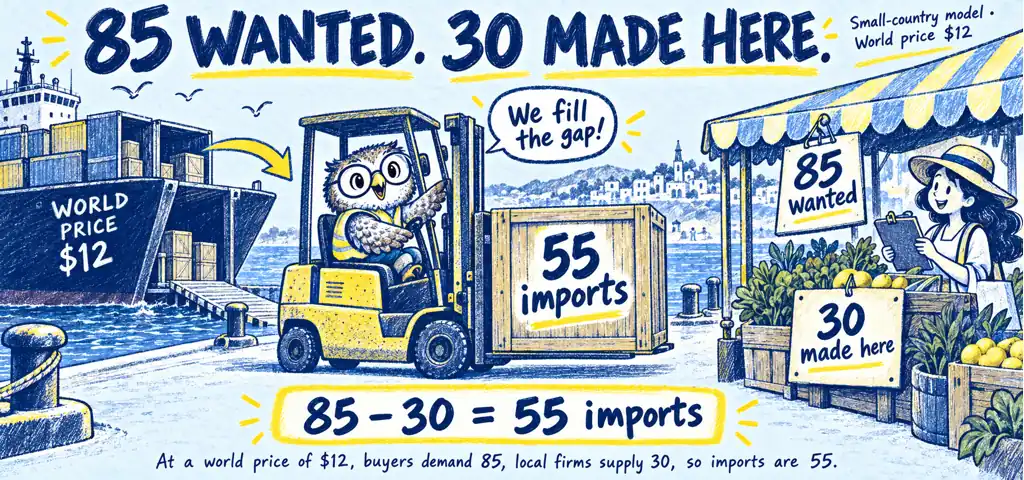
At a world price of $12, domestic firms supply 30 units and domestic buyers demand 85 units. Imports equal 85 − 30 = 55 units. The 85 units are total domestic consumption, not imports. The 30 units are domestic production, not exports.
Track surplus without claiming everyone wins
At an importing world price, consumers pay less and consume more, so consumer surplus rises. Domestic producers receive a lower price and produce less, so producer surplus falls. In the basic small-country model, the consumer gain exceeds the producer loss and total surplus rises. Trade replaces some higher-cost domestic production with lower-cost imports and permits additional purchases valued above the world resource cost.
At an exporting world price, the pattern reverses. Domestic producers receive a higher price and expand output, while domestic consumers pay more and buy less. Producer surplus rises by more than consumer surplus falls, so total domestic surplus rises in the basic model. The net gain does not mean every resident gains. AP questions often test this distinction between efficiency and distribution.
| World-price comparison | Trade direction | Quantity of trade | Domestic group that gains |
|---|---|---|---|
| PW below domestic equilibrium | Imports | QD − QS | Consumers |
| PW above domestic equilibrium | Exports | QS − QD | Producers |
Check Imports and Surplus
A country’s no-trade equilibrium price is $18. After opening to trade at a world price of $11, domestic supply is 40 units and domestic demand is 100 units. What happens?
Check your reasoning
Answer: The country imports 60 units. Consumer surplus rises, producer surplus falls, and total surplus rises in the basic small-country model.
Avoid the most common graph errors
The demand and supply curves are domestic. The horizontal world-price line does not replace either curve and does not shift them. It fixes the price at which domestic buyers and sellers make decisions. Do not label all consumption as imports, and do not decide the trade direction from memory. Compare the world price with the no-trade equilibrium first, then read both domestic quantities from the graph.
Build every trade graph in the same order: domestic demand and supply, no-trade equilibrium, world price, domestic production, domestic consumption, and finally the trade gap. That order turns a crowded diagram into a short series of economic decisions.
Check Equal Prices and Model Assumptions
If the world price equals the no-trade equilibrium price, domestic quantity demanded equals domestic quantity supplied, so the basic model predicts no net imports or exports. The price comparison has three possible outcomes, not just two.
The analysis assumes competitive domestic markets, a country too small to affect the world price, and no trade barriers or transport costs separating the domestic and world price. Its total-surplus result also leaves out externalities and adjustment costs. Use it to explain the model, not to claim that every worker or business benefits from trade.
Sources and Related Lessons
Read OpenStax on free trade and protectionism for the no-trade and trade comparisons. Continue with tariff effects on the import gap, or practise the labeling method in the AP graph-response guide.
This lesson follows the small-country trade model used in the AP Microeconomics course framework.
Watch the idea in action
A related lesson from Khan Academy. The article above covers the topic in full.
Open the video on YouTube · Educator lesson and source

Reza is an experienced Math instructor and a test-prep expert who has been tutoring students since 2008. He has helped many students raise their standardized test scores--and attend the colleges of their dreams. He works with students individually and in group settings, he tutors both live and online Math courses and the Math portion of standardized tests. He provides an individualized custom learning plan and the personalized attention that makes a difference in how students view math.
Related to This Article
More math articles
- Group Types, Boundaries, Dyads, and Triads
- CLEP College Math-Test Day
- How to Add and Subtract Functions? (+FREE Worksheet!)
- 4th Grade Math: The Complete Parent’s Guide for 2026
- Advanced Vocabulary Words: Kvetch to Ludic
- Top 5 Calculators for Geometry
- 7 Best Digital Pen Tablets for Online Math Teaching in 2026
- 6th Grade MEAP Math Practice Test Questions
- Incidence, Prevalence, and the Organization of Health Care
- How to Manage Your Time Effectively on the Praxis Core Math Test?












What people say about "World Price: Identify Imports, Exports and Gains from Trade"?
No one replied yet.