Linkage, Nondisjunction, and Pedigrees: Worked Examples
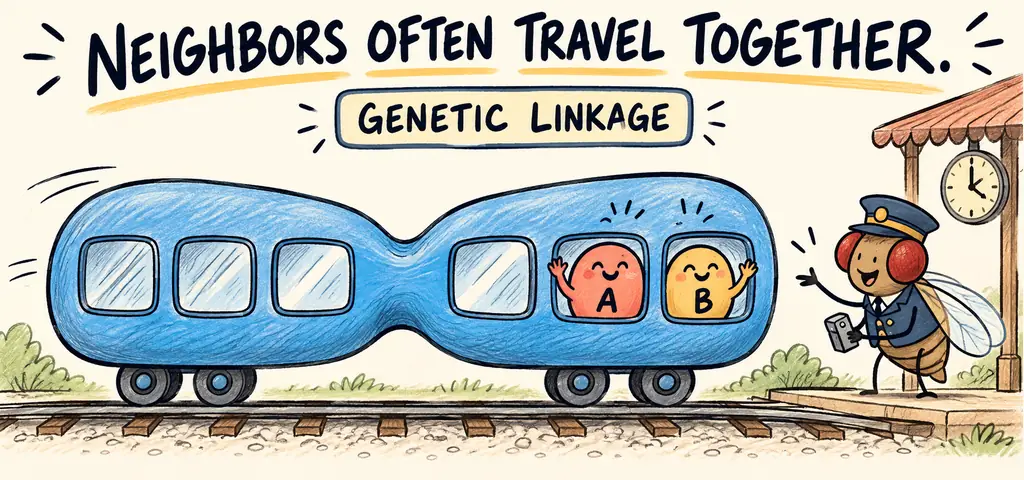
Linkage, nondisjunction, and pedigrees answer different questions. Linkage asks whether loci tend to be inherited together. Nondisjunction describes a chromosome-separation error. A pedigree helps compare inheritance models across a family. Work through the examples below to calculate recombinant frequency, distinguish meiosis I from meiosis II errors, and test pedigree assumptions.
Humans have roughly twenty thousand genes distributed across twenty-three chromosome pairs. Hundreds of genes therefore share each chromosome. During meiosis, nearby loci can travel together, so you should check the evidence before predicting independent assortment. Offspring counts can reveal linkage, an abnormal chromosome count can point to a separation error, and a pedigree can help test possible inheritance patterns.
Watch the process
Linked Genes
Independent orientation of different chromosome pairs generates independent assortment. Genes on the same chromosome are linked by physical location, but widely separated loci can show an approximately 50 percent recombinant fraction and behave as if they assort independently.
For close loci, parental allele combinations often exceed recombinant combinations in a test cross. Interpret this with known parental allele arrangement, accurate scoring, and comparable viability. An excess alone can also reflect selection or measurement bias.
Greater separation generally creates more opportunities for crossing over, but recombination rate varies along chromosomes. Multiple exchanges can restore a parental marker combination, so observed two-locus recombination can underestimate the number of exchanges. Genetic map distance is not a direct count of base pairs.
\[\text{recombination frequency} = \frac{\text{number of recombinant offspring}}{\text{total offspring}} \times 100\%\]
For short intervals, one percent recombination approximates one map unit, or centimorgan. The simple estimates here ignore undetected multiple crossovers. Under the standard unbiased two-locus model, the expected recombination fraction approaches a maximum of 50 percent for widely separated loci, making them indistinguishable from independently assorting loci by this measure. A finite observed sample can exceed 50 percent by chance or bias; do not silently relabel known parental classes. Two genes on the same chromosome that show approximately 50 percent recombination can be indistinguishable from unlinked genes in a two-locus test cross, and intermediate linked markers or physical DNA mapping can establish that they occupy the same chromosome. A genetic map assembled across several intervals can exceed 50 centimorgans.
Turning Offspring Counts Into a Map Distance
A test cross of a doubly heterozygous parent yields 500 offspring: 232 and 223 of the two parental phenotypes, and 27 and 18 of the two recombinant phenotypes. Estimate the genetic map distance, ignoring multiple crossovers.
Use the classes identified as recombinant in the prompt. With tight linkage and comparable viability, these are usually less frequent, but rarity alone is not a universal definition. Here they are the classes of 27 and 18. Both go in the numerator, so add them: \(27 + 18 = 45\) recombinant offspring out of 500. Then divide and convert to a percentage: \[\frac{45}{500} = 0.09, \qquad 0.09 \times 100\% = 9\%.\]
Answer
Approximately 9 map units. The parental classes are never counted in the numerator, and the total in the denominator is all 500 offspring, not just the recombinants.
Sorting a Linkage Data Set Into Parental and Recombinant
A female fruit fly heterozygous at two loci is test crossed. Assume accurate scoring, comparable viability, and negligible undetected multiple crossovers. The 1,000 offspring fall into four classes: 415 gray body with normal wings, 385 black body with vestigial wings, 108 gray body with vestigial wings, and 92 black body with normal wings. Determine whether the loci are linked, and if so, how far apart.
Step 1: use the test cross to your advantage. The recessive partner contributes only recessive alleles, so every offspring’s phenotype reports directly which combination of alleles the heterozygous parent put into that gamete. Under this complete-dominance, recessive-test-cross model, with accurately scored traits and comparable offspring viability, the offspring classes reveal the heterozygous parent’s gamete classes. A test cross therefore makes the inference simple; direct genotyping and other crosses can also measure linkage.
Step 2: identify parental classes by size. If the loci were unlinked, all four classes would be near 250. They are not. The two large classes, 415 and 385, are the allele combinations the heterozygous parent inherited intact and passed on without a crossover between the loci. The two small classes, 108 and 92, required a crossover. Under the assumptions here, the larger classes strongly suggest the parental arrangement. If viability differs or the arrangement is supplied independently, use that information rather than size alone.
Step 3: total the recombinants. \[108 + 92 = 200 \text{ recombinant offspring out of } 1{,}000.\]
Step 4: compute the frequency. \[\frac{200}{1{,}000} \times 100\% = 20\%.\]
Step 5: interpret. Twenty percent is well below the fifty percent that independent assortment predicts, supporting linkage under the stated assumptions. The simple two-point estimate is about 20 map units; unobserved multiple crossovers can make the true genetic distance larger.
Answer
The counts support linkage and give a simple estimate of about 20 map units under the stated approximation. Note that both recombinant classes go in the numerator, and the denominator is every offspring scored, not the parental total.
When Separation Fails
Nondisjunction is the failure of chromosomes to separate properly during division, including meiosis or mitosis. In the standard single-error model below, assume no later correction and one affected chromosome pair. If homologs fail to separate in anaphase I, all four gametes are abnormal: two carry an extra copy of that chromosome and two lack it entirely. If sister chromatids fail to separate in anaphase II, only that one secondary cell is affected, so two gametes are normal, one carries an extra copy, and one lacks the chromosome. Counting the abnormal gametes is how a stem asks you to identify which division failed.
Fertilization of an abnormal gamete by a normal one produces a zygote with an abnormal chromosome number, a condition called aneuploidy. Three copies of a chromosome is trisomy; one copy is monosomy. Trisomy 21 produces Down syndrome, and the sex chromosomes tolerate aneuploidy well enough that XXY and X0 karyotypes are viable. Autosomal monosomies and most other autosomal trisomies are not, which is why the surviving conditions cluster on the smallest autosomes and on the sex chromosomes.
A karyotype is a photograph of an individual’s chromosomes, arranged by size and banding pattern in numbered pairs. It is the standard way aneuploidy is detected, because an extra or missing chromosome is visible as a group of three or a group of one where a pair should be. A karyotype shows chromosome number and gross structure. A conventional karyotype does not resolve individual DNA bases or identify a typical point mutation; detecting such a change requires a suitable molecular test.
Nondisjunction is not the only chromosomal accident. A segment can be lost, doubled, turned around, or moved to a nonhomologous chromosome. Balanced inversions and reciprocal translocations can change arrangement without changing total DNA amount, which is why a carrier can be unaffected while still producing unbalanced gametes.
Pedigrees Are Evidence, Not Proof
A pedigree charts a phenotype through a family. Squares and circles record individuals, horizontal lines connect partners, vertical lines lead to offspring, and filled symbols mark individuals showing the trait. Reading one is an exercise in elimination. Assuming complete penetrance, no new mutation, and accurate parentage and phenotype records, two unaffected parents with an affected child rule out a simple dominant model, because a dominant allele cannot hide in an unaffected parent; the trait is recessive. If that affected child is female, X-linked recessive inheritance requires her father to be affected as well, so an unaffected father points to an autosomal locus. A trait that appears in every generation and always has an affected parent is consistent with dominance. An affected father whose sons are all unaffected while all his daughters are affected fits X-linked dominance.
Every one of those statements is an inference from a small sample. New mutations, incomplete penetrance, and families of three children can all mimic the wrong pattern. When an exam item asks which mode of inheritance a pedigree supports, look for the choice that no individual in the chart contradicts, rather than the choice that feels most familiar.
Eliminating Modes of Inheritance From a Pedigree
In a three-generation pedigree, an unaffected man and an unaffected woman in generation I have four children: two unaffected sons, one unaffected daughter, and one affected daughter. The affected daughter marries an unaffected man and has three unaffected children. Assume complete penetrance, no new mutations, and accurate parentage. Work through the four standard modes and decide which fit these assumptions.
Test autosomal dominant. A dominant allele shows in anyone who carries it, so an affected child requires an affected parent. Both generation I parents are unaffected. Eliminated.
Test X-linked dominant. Same argument. A dominant allele on the X still shows in whoever carries it, so an affected daughter would need an affected parent. Eliminated for the same reason.
Test X-linked recessive. An affected daughter is \(X^{a}X^{a}\), so she received a recessive allele from each parent. Her father gives her his only X, so his single X carries the recessive allele and he would be affected. He is not. Eliminated.
Test autosomal recessive. An affected daughter is \(aa\) and both parents are unaffected carriers, \(Aa\). Nothing in the chart contradicts that. Her three unaffected children fit as well: she is \(aa\) and transmits \(a\) to every child, so each unaffected child must be \(Aa\), and if her husband is \(AA\) every child is unaffected.
Three unaffected children leave the husband’s genotype unresolved. A homozygous dominant husband fits the pedigree, but a heterozygous husband would give each child a \(\tfrac{1}{2}\) chance of being unaffected. Three such outcomes have probability \(\tfrac{1}{8}\), so that small family would not be surprising under either possibility.
Answer
Autosomal recessive is the only mode no individual in the chart contradicts. The father’s phenotype is what eliminates X-linked recessive, and that single observation does more work than any other in the pedigree.
Linkage concerns inheritance of loci on the same chromosome. Nondisjunction concerns chromosome separation, while a pedigree records phenotypes across a family and helps test inheritance models.
Distance along a chromosome converts into a measurable frequency of recombination, so a genetics result becomes a genetic map; converting that distance to base pairs requires additional information.
Distinguish the model’s expected limit from a finite sample’s observed value. The expected fraction under the standard model is at most 50 percent. An observed value above that requires checking the sample size, parental arrangement, scoring, and model assumptions; it does not automatically mean the numerator is wrong.
Distinguish Linkage, X Linkage, and Nondisjunction
Linkage describes the relationship between loci; X linkage identifies a chromosome location. Linked genes are two genes on the same chromosome, any chromosome, and the evidence for linkage is an excess of parental offspring. An X-linked gene is one gene on the X chromosome, and its transmission pattern follows the X chromosome. Different trait frequencies between sexes alone do not prove X linkage. A question about two traits inherited together is asking about linkage. A trait appearing mostly in males may suggest an X-linked recessive model, but sex-influenced expression or environmental exposure are alternatives.
The number of abnormal gametes helps locate nondisjunction in meiosis I or II. An error in anaphase I happens before the cell has split in two, so both daughter cells inherit the imbalance and all four gametes are abnormal. An error in anaphase II happens in one of two already-separated cells, so two gametes are normal and two are not. Four abnormal means meiosis I; two abnormal and two normal means meiosis II.
Linkage, nondisjunction, and pedigrees
Practice question 1
A test cross produces 800 offspring, of which 96 show recombinant phenotypes. Ignoring multiple crossovers, the approximate genetic distance between the two loci is
-
6 map units
-
12 map units
-
24 map units
-
88 map units
Practice question 2
A single meiosis produces two chromosomally normal gametes, one gamete with an extra copy of chromosome 18, and one gamete missing chromosome 18. The most likely explanation is nondisjunction during
-
anaphase I, because homologous chromosomes failed to separate
-
anaphase II in one of the two cells, because sister chromatids failed to separate
-
anaphase II in both cells, because sister chromatids failed to separate twice
-
the S phase preceding meiosis, because chromosome 18 was replicated twice
Practice question 3
Assume complete penetrance and no new mutations. In a pedigree, two unaffected parents have an affected daughter. Her father is unaffected. The pattern is most consistent with
-
autosomal dominant
-
autosomal recessive
-
X-linked recessive
-
X-linked dominant
Practice answer key
1. B; 2. B; 3. B.
Practice answer explanations
-
Linkage, nondisjunction, and pedigrees, Question 1. Choice B is correct. Recombination frequency is recombinant offspring divided by total offspring, so \(96/800 = 0.12\), or 12 percent, giving an approximate short-interval distance of 12 map units. Choice A halves the correct value, a common slip from dividing recombinants between the two recombinant classes. Choice C doubles it. Choice D uses the parental offspring in the numerator instead of the recombinant ones.
-
Linkage, nondisjunction, and pedigrees, Question 2. Choice B is correct. Two normal gametes plus one extra-copy and one missing-copy gamete means only one of the two meiosis II cells was affected, which is the signature of a sister-chromatid failure in anaphase II. Choice A would leave all four gametes abnormal, since the error would occur before the cell divided in two. Choice C would leave no normal gamete at all, since a failure in each of the two cells makes all four products unbalanced. Choice D describes a replication error that would not produce a gamete lacking the chromosome.
-
Linkage, nondisjunction, and pedigrees, Question 3. Choice B is correct. Under the stated complete-penetrance and no-new-mutation assumptions, two unaffected parents producing an affected child rule out the simple dominant models, and an unaffected father rules out X-linked recessive inheritance, because an affected daughter would need a recessive allele on the X she receives from him. Choice A cannot hide the allele in an unaffected parent. Choice C is eliminated by the father’s phenotype. Choice D would require at least one affected parent.
Continue your review at the AP Biology study hub.

Related to This Article
More math articles
- Free GED Math Practice Tests, Worksheets & Review Tools
- Cross-cutting and reinforcing political cleavages
- A tariff raises the domestic price and reduces imports
- The Ultimate 7th Grade RICAS Math Course (+FREE Worksheets)
- Oscar’s Grind: Why a ‘Smart’ Progression Still Loses
- Divided government
- The Best Grade 8 ELA Practice Tests for Wyoming Students
- FREE CLEP College Algebra Practice Test
- The Best Grade 5 Math Book for Michigan Students
- Use of Technology in Math Class that Works



What people say about "Linkage, Nondisjunction & Pedigrees: Examples"?
No one replied yet.