Environmental Effects on Phenotype: Examples and Practice
Environmental conditions can change phenotype without changing DNA sequence. Nutrition, temperature and other conditions can affect how a genotype is expressed. Compare the same genotype across controlled environments to identify a plastic response, and distinguish that response from evidence of mutation.
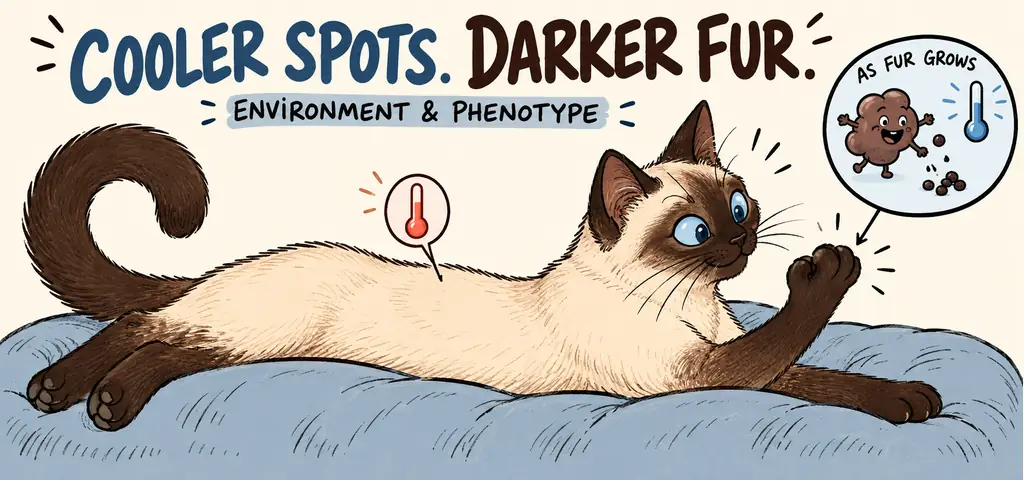
A Siamese cat usually has paler fur on warmer body regions and darker fur on cooler extremities. A temperature-sensitive variant of tyrosinase, an enzyme needed for pigment production, helps explain the pattern: pigment production is reduced at warmer temperatures and greater at cooler temperatures during hair growth.
Watch the process
LS3B – Variation of Traits
The inherited enzyme variant and the local environment both contribute. A different color does not require a new DNA mutation in each dark patch. This is a useful example of how the same genotype can yield different outcomes under different conditions.
Phenotypic plasticity is the capacity of one genotype to produce different phenotypes under different environmental conditions without requiring a DNA-sequence change. A plastic response can be adaptive, neutral, or harmful. Its effect depends on whether it improves survival or reproduction in the conditions being studied.
The Norm of Reaction
A plant reaches 30 centimeters at one light level, 22 centimeters at another, and 41 at a third, even though its genotype stays the same. Reporting only the first height leaves out those environmental effects. A norm of reaction describes the phenotypes a genotype produces across environments. The genotype constrains the response, and the conditions help determine which phenotype develops.
Norms of reaction differ in shape from trait to trait. ABO blood type is relatively stable across ordinary environmental conditions in the standard model; it should not be used to claim that antigen expression can never change under any condition. Height in humans has a broad one, since childhood nutrition shifts adult height by centimeters. A winter-white snowshoe hare, brown in summer and white in winter, has one with two separated outcomes triggered by day length. Evaluate genetic and environmental contributions using the evidence supplied.
Penetrance and Expressivity
Two words sharpen the same idea for single-gene traits. Penetrance is the fraction of individuals with a given genotype who show the associated phenotype at all. A dominant allele with 70 percent penetrance means 30 percent of the people carrying it look unaffected, which is why a dominant condition can appear to skip a generation in a pedigree. Expressivity is how strongly the phenotype is expressed in those who do show it. Two people with the same allele may have a barely visible patch of white hair or a large one. Penetrance is whether; expressivity is how much. Both are influenced by the environment and by other genes, and both are reasons a real pedigree misbehaves relative to a textbook prediction.
Two Plant Genotypes, Three Environments
A researcher takes cuttings from one yarrow plant, so every cutting is a clone with the same genotype, and plants them at three elevations. Mean mature height is 42 cm at sea level, 27 cm at mid elevation, and 15 cm at high elevation. A second clone, from a different original plant, gives 31 cm, 33 cm, and 12 cm at the same three sites. Interpret.
What the design controls. Within one clone the genotype is fixed by construction, so inherited differences between the starting cuttings are controlled. The sites differ in an environmental bundle that can include temperature, moisture, soil, and growing season. Replicated differences within a clone support environmental effects, but do not isolate elevation or one component as the cause. This is why clonal material is useful: it controls the starting genotype within each clone, while replication helps separate environmental effects from random variation.
Read clone one. Height falls steadily with elevation, \(42 \to 27 \to 15\). That is a norm of reaction with a simple downward slope, and it says the environment at high elevation limits growth in this genotype.
Read clone two. Height is 31, then 33, then 12. The first two reported means differ by 2 cm; without uncertainty estimates we cannot judge whether that difference is statistically meaningful, and the collapse comes only at the highest site. This genotype has a different norm of reaction, not merely a shifted one.
Read the two together. At mid elevation clone two is taller than clone one, 33 against 27; at sea level clone one is taller, 42 against 31. Height alone does not establish greater fitness. Which genotype produces the taller plant depends on the environment, and that dependence is exactly what a genotype-by-environment interaction means.
Interpreting the result
Both clones show environmental effects on phenotype, and their norms of reaction differ in shape, so no ranking of the genotypes holds across all environments. The experiment does not show that either genotype changed; the design began with matching genotypes within each clone, and there is no evidence here of sequence change.
Distinguishing an Environmental Effect From a Mutation
Two flats of genetically identical seedlings are grown side by side. One flat receives a nitrogen-poor soil mix and its plants develop yellowed leaves. Seeds collected from the yellowed plants are grown in normal soil and the resulting plants are green. What does the second generation tell you?
A nitrogen-related environmental effect predicts that supplying adequate nitrogen can restore normal leaf color in plants capable of responding. Green offspring in normal soil are consistent with that explanation.
However, this outcome does not rule out every mutation. A sequence change might be recessive, confined to nonreproductive tissue, or expressed only under low nitrogen. Offspring also need not be genetically identical to a parent. A stronger test would randomly assign replicated clones to low- and adequate-nitrogen treatments and test recovery after nitrogen is restored; sequence testing could address a specific mutation hypothesis.
Answer
The result supports an environmental contribution to yellowing. It does not, by itself, prove unchanged DNA or exclude all heritable and environment-dependent explanations.
A genotype specifies a range of possible phenotypes, and the environment selects from that range.
A plastic response does not require a DNA-sequence change; developmental conditions alter the phenotype produced.
Do not call an environmentally produced phenotype an acquired trait that will be inherited. An environmentally induced phenotype alone does not establish inheritance. Test offspring under controlled conditions to distinguish genetic transmission from environmental or parental effects.
Distinguish Phenotype Change from Mutation
A change in phenotype does not by itself demonstrate a DNA mutation. An environmental effect can alter phenotype without changing DNA sequence. Some developmental effects persist after the condition ends, so reversibility is not required. A mutation is a change in the DNA sequence itself. It can be transmitted if a germ-line cell carrying it contributes to an offspring. Reversibility alone is not a reliable way to classify a phenotype change. To investigate the alternatives, remove the environmental condition and see whether the phenotype returns to normal, and check whether the offspring show the trait in the original environment.
Phenotypic plasticity can depend on genotype. The Siamese pattern requires a specific allele; a functional, less temperature-sensitive enzyme variant can support pigment production over a wider temperature range, though other coat-color genes also matter. The environmental effect exists because of the genotype, not instead of it.
Environment and phenotype
Practice question 1
Cuttings from a single plant are grown at three elevations and reach three different mature heights. The result is best described as
-
evidence that the cuttings acquired different mutations at each site
-
a norm of reaction, since one genotype produced different phenotypes in different environments
-
evidence that height in this species is not influenced by genotype
-
an example of incomplete dominance among the three environments
Practice question 2
A dominant allele is described as having 60 percent penetrance. This means that
-
60 percent of the offspring of a heterozygote inherit the allele
-
individuals who show the trait express it at 60 percent of full severity
-
60 percent of individuals carrying the allele show the associated phenotype
-
the allele is dominant in 60 percent of genetic backgrounds and recessive in the rest
Practice question 3
Plants grown in nitrogen-poor soil develop yellow leaves, and their seeds grown in normal soil produce uniformly green plants. This outcome most directly supports the explanation that yellowing involved
-
a heritable mutation
-
an environmental effect
-
a case of epistasis
-
a result of nondisjunction
Practice answer key
1. B; 2. C; 3. B.
Practice answer explanations
-
Environment and phenotype, Question 1. Choice B is correct. Cuttings from one plant share a genotype, so the differences among sites support environmental effects, and the set of phenotypes one genotype produces across environments is its norm of reaction. Choice A asserts mutation without evidence rather than an established explanation of the site differences. Choice C overcorrects, since the genotype still sets the range within which the environment acts. Choice D applies an allele-interaction term to environments, which have no alleles.
-
Environment and phenotype, Question 2. Choice C is correct. Penetrance is the fraction of individuals carrying a genotype who show the associated phenotype at all. Choice A states the transmission probability from a heterozygote, which is a separate quantity. Choice B defines expressivity, the severity of the trait in those who show it. Choice D invents a switching of dominance that penetrance does not describe.
-
Environment and phenotype, Question 3. Choice B is correct. Green offspring grown with adequate nitrogen support an environmental contribution to the parental yellowing. This result alone does not exclude a recessive, tissue-limited, or environment-dependent mutation. Choice A asserts a sequence change without evidence, and C and D assert gene interaction or chromosome-separation mechanisms the experiment has not tested.
Continue your review at the AP Biology study hub.
Further reading
For a reference on the distinction between showing a trait and variation in its expression, see MedlinePlus Genetics: reduced penetrance and variable expressivity.

Related to This Article
More math articles
- TSI Math Formulas
- The Best Grade 6 ELA Practice Tests for Delaware Students
- How to Prepare for GED Math: 11 Steps and Free Resources
- Emergence of the Republican Party
- The Ultimate 6th Grade PEAKS Math Course (+FREE Worksheets)
- How To Calculate Outs In Poker
- Number Properties Puzzle -Critical Thinking 1
- How to Solve Prime Factorization with Exponents?
- Enzyme Kinetics: Km, Vmax and Inhibition
- Vectors Introduction







What people say about "Environmental Effects on Phenotype: Examples and Practice"?
No one replied yet.