How Evolution Shapes Animal Behavior and Survival
Animal behavior can be studied through both immediate causes and evolutionary explanations. This guide compares inherited tendencies, learning, communication, and cooperation, with examples that show how evidence supports a conclusion.
A honeybee returns to its hive and performs a waggle dance that communicates a food location. The dance has inherited components, but experience observing other dancers contributes to accurate performance. It is therefore a poor example of behavior that is wholly independent of learning.
Watch the process
Behavior and Natural Selection
A rat that improves over repeated maze trials shows a change with experience. For the rat or the dancing bee, compare behavior before and after the relevant experience. Controlled rearing and exposure experiments help separate inherited tendencies from learning.
A behavior is what an organism does, and like any other trait it has both a mechanism and a history. A proximate explanation names the immediate cause: the hormone, the stimulus, the neural circuit. An ultimate explanation addresses evolutionary history or how a behavior affects reproductive success. A proposed benefit is a hypothesis to test, not automatic proof of why a behavior evolved. A male bird sings because increasing daylength raised his testosterone, and he sings because singing males historically attracted more mates. The two statements address different explanatory levels.
Innate behavior appears in a functional form without prior experience of the relevant stimulus although its expression can vary with genotype, development, and environment. Learned behavior is modified by experience. Almost nothing is purely one or the other, and the useful question is how much of the variation in a behavior comes from experience, which is an experimental question rather than a definitional one.
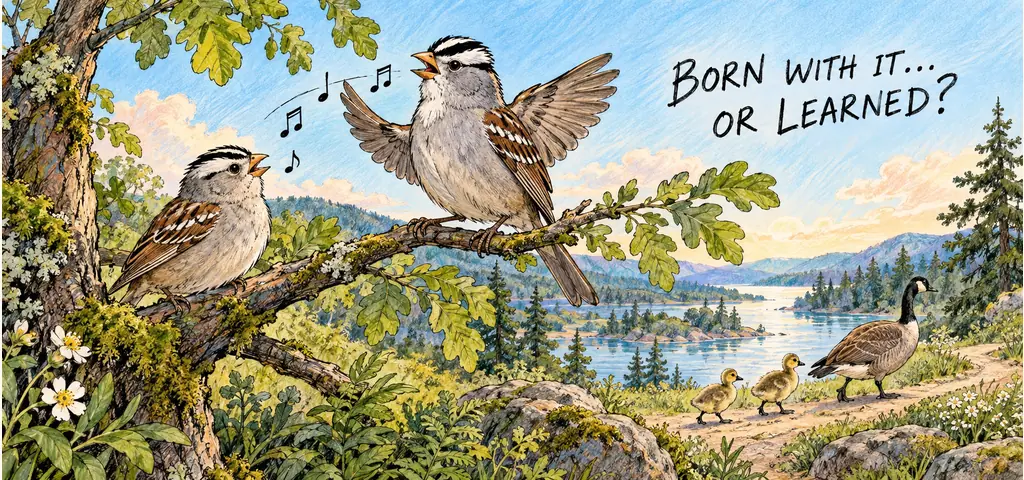
A behavior can combine inherited components and learning. Use experimental evidence to determine their contributions. The design that separates the two is deprivation: raise an animal without any opportunity to experience or practice the behavior, then test it. A white-crowned sparrow raised in silence still sings, so the impulse to sing is innate; but it sings an abnormal song, so the specific dialect is learned. The rearing conditions provide evidence about the role of experience. Compare isolated and exposed groups before deciding what was learned.
Proximate explanations describe mechanisms; ultimate explanations address evolutionary history and fitness significance. A proximate answer and an ultimate answer are not competing explanations of which only one can be right. They answer different questions about the same behavior. If a choice explains a behavior by naming a hormone, a receptor, or a stimulus, it is proximate. If it explains the behavior by naming survival or reproductive consequences over generations, it is ultimate. Read the stem for which question was asked.
The Named Categories, and What Each One Requires
Simple orientation behaviors come first. A taxis is directed movement toward or away from a stimulus, as in a moth showing positive phototaxis. A kinesis is a stimulus-dependent change in speed or turning rate without directed orientation. A pill bug that moves fast in dry air and slows in damp air accumulates in damp places without ever steering toward them. Taxis involves orientation toward or away from a stimulus; kinesis changes movement speed or turning rate without directed orientation.
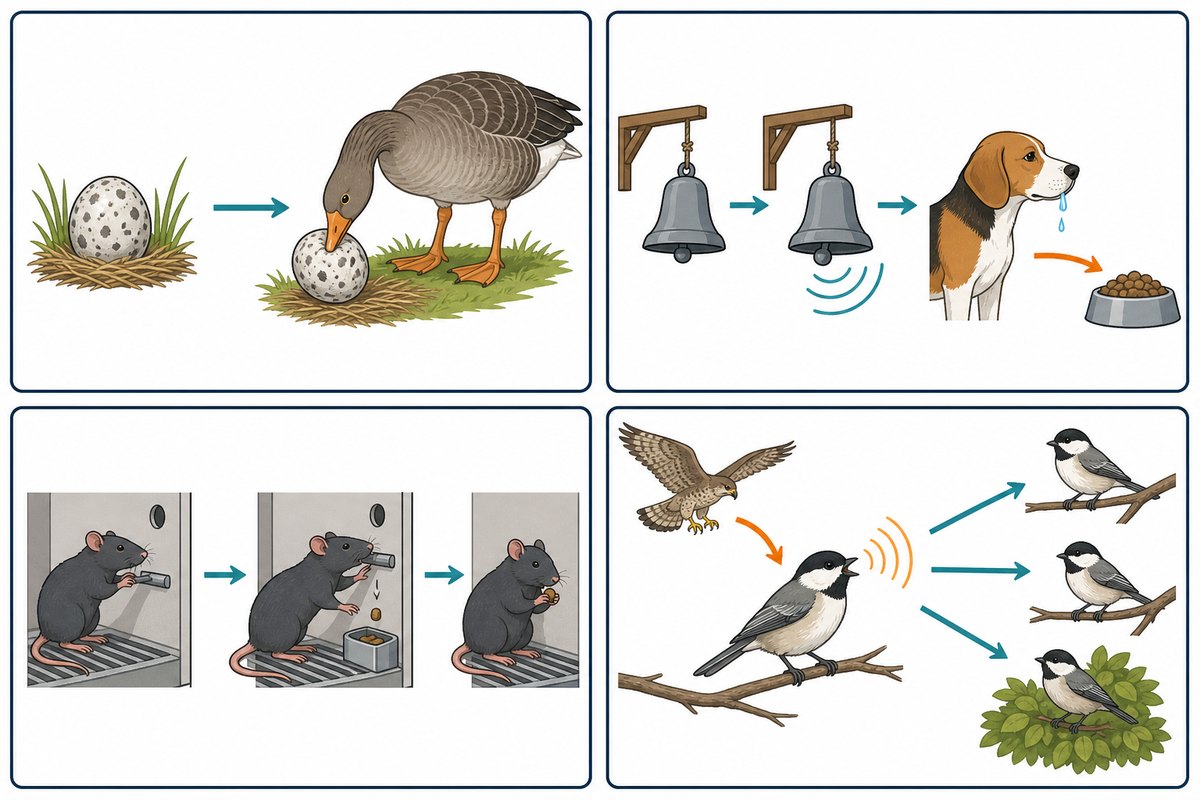
A fixed action pattern is a stereotyped sequence, triggered by a specific sign stimulus, that can continue after the triggering stimulus is removed in classic examples. A greylag goose that begins rolling an egg back toward the nest continues the rolling motion after the egg is taken away. The stereotyped sequence has a strong innate component; fixed action patterns can still show contextual variation.
Imprinting is learning concentrated in an early developmental window, called a sensitive period. The resulting preferences can be persistent; the timing and flexibility vary among species and forms of imprinting. A newly hatched gosling forms an attachment to a suitable moving object it follows during that window. Imprinting is the hybrid case: the capacity and its timing are innate, the content is learned.
Three further categories are learning proper. Habituation is a decrease in response to a repeated stimulus that carries no consequence, as when prairie dogs stop alarm-calling at footsteps that never precede an attack. Classical conditioning associates two stimuli, so a previously neutral stimulus comes to produce the response the meaningful one produced, while operant conditioning associates a behavior with its consequence, so a rewarded behavior becomes more frequent. Both are associative learning. Beyond these, cognitive learning covers spatial maps and problem solving. A digger wasp that memorizes the arrangement of pinecones around its burrow, and then flies to the wrong place when the researcher moves the cones, is demonstrating spatial learning: it stored a map of landmarks rather than a fixed direction. Social learning is learning by observing others, and it is the mechanism behind behavioral traditions that differ between neighboring populations of the same species even when genetic differences do not explain those traditions.
Foraging, Territory, and Mating as Cost-Benefit Problems
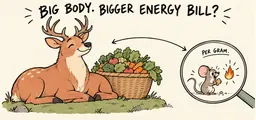
Foraging costs time and energy and may expose an animal to predators. Food supplies energy in return. Optimal foraging models predict behavior from the net energy gained per unit time under stated conditions. A crow dropping a whelk onto rock must climb high enough to break the shell reliably, but extra climbing spends energy. Compare the gain from the food with the costs of obtaining it.
Mate choice also involves costs and reproductive benefits. Sexual selection is differential reproductive success associated with competition for mates or mate choice. It can favor weapons and size in direct competition, or displays and ornaments that influence choice. A costly ornament may honestly signal condition when its costs differ with condition, but cost alone does not establish that explanation; other mechanisms can shape preferences.
Communication and Cooperation
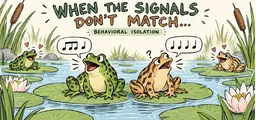
Behavior that involves other individuals requires signals. A signal is a trait or action involved in communication that affects a receiver; it differs from an incidental cue not evolved for that role, and signals may be visual, auditory, chemical, tactile, or electrical. Each channel has costs. A chemical pheromone persists, rounds obstacles, and works in the dark but may persist after the sender stops releasing it; signal properties vary among chemicals and environments. Sound is fast and works at night and advertises the signaler to predators. Visual displays carry much information at once but need light and a clear line of sight. When a question asks why a species uses a particular channel, answer from the physical environment.
Cooperative behavior raises an obvious problem. If selection favors whatever raises individual reproductive success, why does any animal pay a cost to help another? Altruism, biologically, means exactly that: a behavior that lowers the actor’s reproductive output and raises the recipient’s. The resolution is that alleles, not individuals, are what spread, and a relative carries copies of your alleles. Inclusive fitness combines direct reproductive effects with effects on relatives’ reproduction weighted by relatedness, and kin selection is selection acting through that second channel. As optional supporting mathematics, Hamilton’s rule gives a simplified condition; it is not on the AP Biology reference sheet and will be supplied if needed here: helping is favored when \(rB > C\). Read the three symbols before you use them. The coefficient of relatedness \(r\) measures expected genetic similarity by common descent relative to the population. In a simple pedigree with unrelated founders, it is \(0.5\) between full siblings or between parent and offspring, \(0.25\) between half siblings or between grandparent and grandchild, and \(0.125\) between first cousins. \(B\) is the extra offspring the recipient gains, and \(C\) is the offspring the actor gives up. So the rule says that a costly act spreads when the allele copies gained through the relative outweigh the copies lost through the actor.
Why Does a Ground Squirrel Call?
A Belding’s ground squirrel that spots a predator gives a loud alarm call. The call draws the predator’s attention and raises the caller’s own risk of being killed. Females call more often than males, and females are far more likely than males to live near close relatives. Explain the pattern.
Under the stated assumptions, start with the cost: calling raises the caller’s chance of death, which lowers direct fitness, so that survival effect is a direct cost; the observations do not measure every possible direct benefit. Now apply inclusive fitness. Nearby relatives share alleles with the caller, at \(r = 0.5\) for a full sibling or offspring and \(r = 0.25\) for a half sibling, so if the call saves several of them the allele copies preserved can exceed the copies lost to the caller’s added risk, \(rB\) exceeds \(C\), and inherited tendencies to call can be favored. The sex difference is consistent with that explanation: males disperse, potentially lowering the relatedness-weighted benefit of calling. Measuring recipient relatedness and reproductive effects would test the mechanism more directly.
Answer
Kin selection. The behavior is maintained by the reproductive success of relatives who carry the same alleles, a plausible explanation for greater calling where relatives are nearby. The association alone does not establish all fitness costs and benefits.
Kin selection does not cover every case of helping. Reciprocal altruism describes costly help that can be favored when later help or other delayed benefits compensate. Repeated encounters and reliable responses to previous interactions can support such cooperation; literal punishment or conscious accounting is not always required. Helping may also yield immediate direct benefits, so observing assistance does not by itself establish altruism.
Avoid explaining a behavior solely as “for the good of the species.” A complete evolutionary explanation identifies how inherited variants affect reproduction and persist, through direct benefits, relatedness-weighted benefits, or other demonstrated population structure. Benefits to a group alone do not establish that mechanism. Nor does a plausible adaptive story prove that every behavior is an adaptation.
Is the Song Innate, Learned, or Both? (Science Practice 6)
A researcher raises white-crowned sparrows under four conditions and records the adult song of each group. Group 1 is raised normally in the wild population. Group 2 is raised in acoustic isolation and hears no song at all. Group 3 is raised in isolation but hears recordings of its own species’ song between days 10 and 50 after hatching, then hears nothing until adulthood. Group 4 is raised in isolation and hears the same total duration of recordings, at the same volume, over days 100 to 140. Groups 1 and 3 produce normal adult song; Groups 2 and 4 produce an abnormal, simplified song. Make a claim about how the song develops.
Claim. The capacity and drive to sing are innate, the song’s specific structure is learned, and the learning is restricted to a sensitive period early in life.
Evidence. Group 2 sings without ever having heard a song, so singing itself does not require a model. Group 3, which heard the model only during days 10 to 50 and then nothing for weeks, sings normally, so the information was acquired during that window and stored. Group 4 heard the same recording, in the same isolation, and failed, so later exposure in the tested window did not produce normal song under these conditions. This does not identify an exact cutoff or establish that all later experience is ineffective.
Reasoning. Compare the pairs deliberately. Group 2 against Group 3 isolates the effect of exposure while holding rearing conditions constant, and it shows exposure matters. Group 3 against Group 4 isolates the effect of timing while holding total exposure constant, and it shows the timing matters. Neither comparison alone would support the claim; together they do. Note also what the design does not test. Nothing here tells you whether the sparrow could learn another species’ song, because no group was played one.
Interpreting the result
The result is a case of imprinting-like learning: an innate tendency, a learned content, and a developmental window during which the content must be acquired. Groups 3 and 4 are the comparison that carries the argument.
A behavior is a trait, and like any trait it has a mechanism that produces it and an evolutionary history that can be investigated.
Experience can alter learned behavior, while developmental conditions can also affect expression of innate tendencies; change the relatedness of the animals nearby and you change whether a costly helping behavior pays.
When evaluating an explanation, identify the mechanism that could preserve the behavior across generations. Also check whether the question asks for an immediate cause or an evolutionary explanation.
Behavior, learning, and kin selection
Practice question 1
Woodlice placed in a chamber with a dry half and a damp half move rapidly and turn frequently in dry air and slowly in damp air. Over time most end up on the damp side, though no individual ever moves directly toward it. This is best classified as
-
a taxis
-
a kinesis
-
imprinting
-
operant conditioning
Practice question 2
A dog that has repeatedly heard a bell just before being fed begins to salivate at the bell alone. This is
-
operant conditioning, because the dog’s behavior was rewarded
-
classical conditioning, because a neutral stimulus became associated with a meaningful one
-
habituation, because the response to the bell changed with repetition
-
a fixed action pattern released by a sign stimulus
Practice question 3
An alarm-calling behavior is costly to the caller and is given mainly when close relatives are nearby. The best evolutionary explanation is that
-
the behavior benefits the species as a whole, so selection preserves it at the species level
-
callers gain a direct survival advantage, because the predator turns toward a neighbor instead
-
copies of the caller’s alleles carried by relatives are preserved, so inclusive fitness rises even as direct fitness falls
-
the behavior is learned by imitation and therefore does not require an evolutionary explanation
Practice answer key
1. B; 2. B; 3. C.
Practice answer explanations
-
Behavior, learning, and kin selection, Question 1. Choice B is correct. The woodlice change the rate of undirected movement in response to humidity and never orient toward the damp side, which is the defining feature of a kinesis. Choice A requires directed movement along the stimulus gradient. Choice C requires a sensitive period early in development, which no part of the stem supplies. Choice D requires a consequence that reinforces a behavior, and none is described.
-
Behavior, learning, and kin selection, Question 2. Choice B is correct. A previously neutral stimulus, the bell, came to elicit the response the meaningful stimulus produced, which is stimulus-to-stimulus association. Choice A describes behavior-to-consequence association, but salivation was not a rewarded action the dog chose. Choice C reverses the direction of change, since habituation is a decrease in response. Choice D would require an unlearned stereotyped sequence, but the response here depended on prior pairing.
-
Behavior, learning, and kin selection, Question 3. Choice C is correct. Helping relatives can increase relatedness-weighted reproductive success enough to offset a direct cost, supporting kin selection as an explanation. A names a species benefit without a mechanism linking it to persistence of the behavior. B asserts an unmeasured direct benefit despite the stated cost. D supplies a possible learning mechanism but does not explain evolutionary persistence. Quantifying costs, benefits, and relatedness would strengthen the inference.
Continue your review at the AP Biology study hub.

Related to This Article
More math articles
- Transformation Using Matrices
- Can You Cheat on the ALEKS Test?
- The Best Grade 7 Math Book for Oregon Students
- Graph to Grid: How to Completing a Table Using Information from a Graph
- Prepositions, Conjunctions, and Interjections
- Primary elections
- 8th Grade FSA Math FREE Sample Practice Questions
- Top Calculators for the TASC 2026: Quick Review
- FREE 6th Grade NYSE Math Practice Test
- How to Graph Trigonometric Functions?


What people say about "How Evolution Shapes Animal Behavior and Survival"?
No one replied yet.