Tet, Vietnamization, Cambodia, and the Fall of Saigon
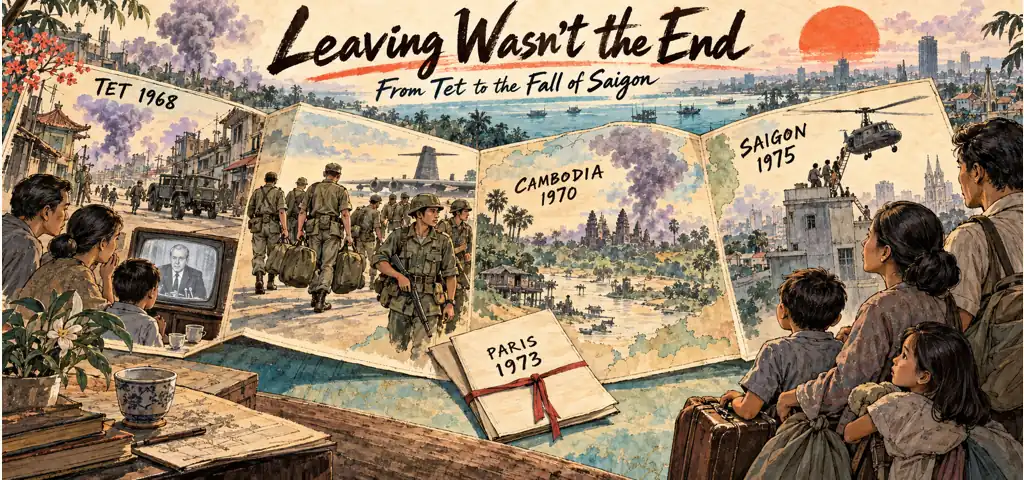
Chapter 14 of the CLEP History of the United States II study guide on Effortless Math covers Tet, Vietnamization, Cambodia, and the Fall of Saigon: the key terms, the core ideas, and worked examples showing how this topic is tested on the exam.
CLEP History of the United States II, Chapter 14
Tet was a military setback and a political shock
During the lunar new year in January 1968, North Vietnamese and Viet Cong forces attacked cities, bases, and provincial centers across South Vietnam. American and South Vietnamese forces retook the targets and inflicted severe losses. Yet the scale of the offensive contradicted repeated claims that communist capacity was nearing exhaustion. Tet's political effect came from the distance between official expectations and the enemy's demonstrated reach, not from a communist battlefield conquest.
The election of 1968 changed the war's management
After Tet, Johnson limited bombing and announced he would not seek reelection. Robert Kennedy's assassination and conflict at the Democratic convention deepened the year's crisis. Richard Nixon campaigned on achieving peace with honor while also appealing to voters who rejected disorder. Once elected, he inherited a war, negotiations in Paris, a divided public, and a South Vietnamese government whose survival depended heavily on American support.
Vietnamization shifted combat while preserving pressure
Nixon and Henry Kissinger withdrew American ground troops while expanding South Vietnamese forces and equipment. Vietnamization was not immediate disengagement. The administration continued bombing and sought a settlement that would allow withdrawal without an obvious collapse of South Vietnam. American casualties declined, but South Vietnamese dependence on air power, logistics, money, and political support remained substantial.
Cambodia widened the visible war
North Vietnamese forces used sanctuaries and supply routes in neutral Cambodia. Nixon secretly bombed Cambodian targets beginning in 1969, then announced an American and South Vietnamese ground incursion in April 1970. The administration described the action as protecting withdrawal by disrupting sanctuaries. Critics saw expansion of a war Nixon had promised to end. The invasion destabilized Cambodia and helped intensify domestic protest.
Kent State turned protest into a national crisis
After the Cambodia announcement, students protested at campuses across the country. On May 4, 1970, Ohio National Guard troops fired at Kent State University, killing four students and wounding nine. Two of those killed had not participated in the protest. Police killed two Black students at Jackson State in Mississippi eleven days later, an event that received less national attention. The contrast revealed how race shaped public visibility even within a shared protest crisis.
The Pentagon Papers deepened distrust
Daniel Ellsberg copied a classified Defense Department history and gave it to newspapers. The study documented years of official decisions, doubts, and widening commitments under several administrations. In New York Times Co. v. United States (1971), the Supreme Court rejected the Nixon administration's attempt to impose prior restraint because the government had not met the heavy burden required. The documents concerned past policy; the case concerned whether publication could be stopped in advance.
Congress tried to recover authority
Lawmakers repealed the Gulf of Tonkin Resolution in 1971 and restricted funding for combat in Indochina. The War Powers Resolution of 1973 required presidential reporting and generally contemplated withdrawal within sixty days, with a thirty-day period for removal, absent authorization. Nixon vetoed it; Congress overrode the veto. Presidents have disputed its constitutionality, but the law records a post-Vietnam effort to constrain unilateral war making.
The Paris agreement enabled withdrawal without settling the war
The January 1973 Paris Peace Accords provided a cease-fire, American withdrawal, prisoner exchange, and political arrangements for South Vietnam. North Vietnamese forces already in the South were not required to leave. Nixon privately promised support, but Watergate, congressional restrictions, and declining appropriations weakened the credibility of future intervention. The agreement ended direct American combat participation more clearly than it ended the Vietnamese civil and interstate war.
Saigon fell after American forces had departed
North Vietnam launched a major offensive in 1975. South Vietnamese defenses collapsed rapidly amid material shortages, poor command, and declining outside support. Saigon fell on April 30, and Vietnam was reunified under communist rule. The iconic evacuation from the American embassy area symbolized the end, but it occurred two years after the main American withdrawal. Cambodia and Laos also came under communist governments, with catastrophic Khmer Rouge rule beginning in Cambodia.
Memory remained politically contested
The Vietnam Veterans Memorial, dedicated in 1982 and designed by Maya Lin, lists the names of the American dead on polished black granite descending into the earth. Supporters valued its intimate focus on loss; critics initially called it too abstract or insufficiently heroic. Later films variously portrayed alienation, trauma, moral ambiguity, and battlefield loyalty. These works reveal how commemoration can separate mourning soldiers from agreement about the war.
Vietnam films centered fracture rather than wartime unity
The Deer Hunter, Coming Home, and Platoon, released from 1978 through 1986, focused on damaged veterans, divided communities, or American soldiers turning against one another. That emphasis differed from many combat films made during the Second World War, which pictured a socially mixed unit cooperating for an accepted national cause. The Vietnam films were not documentaries, and all included war or its consequences. Their distinctive feature was the damaged homecoming and contested purpose, not an absence of combat or commercial studio financing.
distinguish battlefield, political, and institutional outcomes
An offensive loses most of the positions it attacks but changes public belief about the war.
Watch the history in motion
This short lesson adds voices, images, and chronology to the ideas you just studied.
Video: Vietnamization and the Fall of Saigon | The Vietnam War, US HISTORY HELP.
Try four CLEP-style questions
- Why did the Tet Offensive damage the Johnson administration despite communist tactical losses?
- It produced an immediate peace agreement requiring all northern forces to withdraw.
- It forced Congress to recognize North Vietnam as the government of all Vietnam.
- It eliminated American air power and permanently closed every base in South Vietnam.
- It persuaded China to enter the war with conventional forces along the seventeenth parallel.
- It exposed a large enemy capacity that conflicted with official claims of steady progress.
- What best describes Vietnamization?
- A congressional plan to replace the South Vietnamese army with regional militias
- A transfer of combat responsibilities to South Vietnamese forces while American troops withdrew
- A return to French command financed by American military and economic assistance
- A prohibition on bombing combined with immediate recognition of a communist coalition government
- A United Nations administration of both Vietnamese states pending nationwide elections
- What did the Pentagon Papers case establish?
- Wartime classification supplied sufficient grounds to block publication of current military material without a particularized showing.
- The president alone could decide whether a war required congressional authorization.
- Congress could compel newspapers to reveal every confidential source used in an investigation.
- The documents proved that every military claim made after Tet was knowingly fabricated.
- The government had not met the heavy burden required to stop publication in advance.
- Why did the Paris Peace Accords fail to guarantee South Vietnam's survival?
- They required immediate American recognition of Ho Chi Minh as South Vietnam's president.
- They transferred all provincial administration to a neutral United Nations commission.
- They dissolved the South Vietnamese armed forces before prisoners were exchanged.
- They left northern forces in the South while American withdrawal reduced future military and bargaining influence.
- They committed China and the Soviet Union to defend the Saigon government jointly.
Check your answers and reasoning
Independent preparation. CLEP is a registered trademark of the College Board, which does not endorse this lesson.

Related to This Article
More math articles
- SSAT Upper Level Math Practice Test Questions
- 8th Grade PARCC Math FREE Sample Practice Questions
- 7th Grade IAR Math Practice Test Questions
- The Best Grade 7 Math Book for Arkansas Students
- The Ultimate Georgia Milestones Assessment Algebra 1 Course (+FREE Worksheets)
- Free Grade 7 English Worksheets for New Mexico Students
- Party Stalemate, Civil Service, and the Tariff
- Presidential action
- The Best SAT Math Book for Students Starting From the Basics
- How to Use Tables to Write Proportional Relationship Equations





















What people say about "Tet, Vietnamization, and the Fall of Saigon"?
No one replied yet.