The Antiwar Movement, the Draft, and the Crisis of 1968
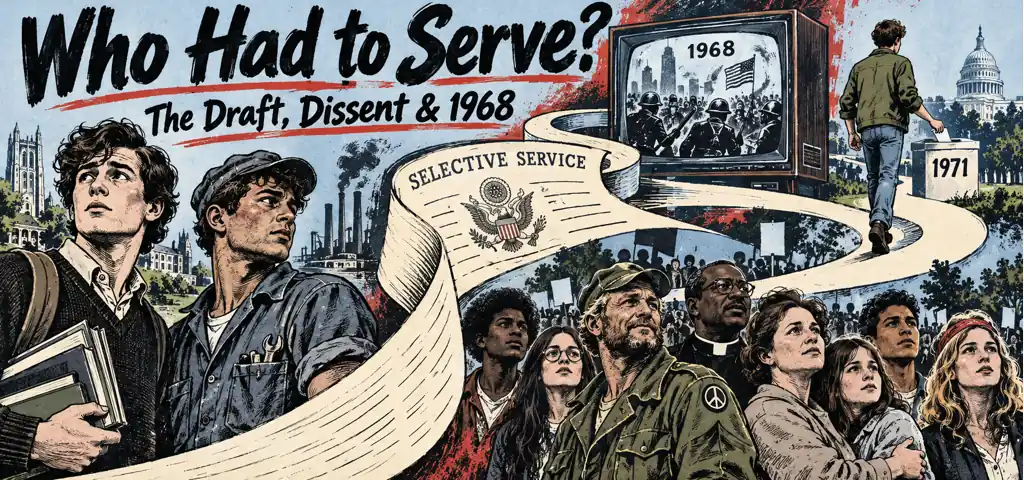
Chapter 14 of the CLEP History of the United States II study guide on Effortless Math covers The Antiwar Movement, the Draft, and the Crisis of 1968: the key terms, the core ideas, and worked examples showing how this topic is tested on the exam.
CLEP History of the United States II, Chapter 14
Opposition to the war was a coalition, not a single movement
Students for a Democratic Society, clergy, pacifists, veterans, civil-rights leaders, elected officials, parents, and draft resisters opposed the war for different reasons. Some considered it immoral; others believed it unwinnable, unconstitutional, too costly, or harmful to domestic reform. Tactics ranged from elections and marches to draft-card burning and raids on induction files. A question about the antiwar movement must identify which constituency, claim, and method it means.
The draft distributed risk unequally
Selective Service classifications gave local boards substantial authority. College, occupational, medical, family, and other deferments allowed many middle-class men to postpone or avoid induction. Poor and working-class men had fewer options, while African Americans were initially overrepresented in combat casualties. A lottery introduced in 1969 made the order of call more transparent, but it did not eliminate debate over who served and who decided.
Draft resistance took several legal and political forms
Some men sought conscientious-objector status based on opposition to war rooted in religious or moral belief; the law did not recognize mere objection to one particular war on political grounds. Others refused induction, left the country, burned draft cards, or returned them publicly. In United States v. O'Brien (1968), the Supreme Court upheld a law against destroying draft cards as a content-neutral regulation serving the government's administrative interest.
Muhammad Ali turned induction into a public argument
Heavyweight champion Muhammad Ali refused induction in 1967, citing his religious beliefs and opposition to the war. Boxing authorities stripped his title, and he was convicted of draft evasion. In 1971, the Supreme Court unanimously reversed the conviction because the appeal board had not explained which ground it used to deny his conscientious-objector claim. The ruling did not declare a general constitutional right to reject a particular war.
King connected Vietnam to domestic justice
At Riverside Church in April 1967, Martin Luther King Jr. condemned the war as destructive abroad and a drain on antipoverty priorities at home. Many civil-rights allies feared that the speech would divide supporters or alienate Johnson. SNCC had already opposed the war, while the NAACP was more cautious. The dispute showed that organizations sharing civil-rights goals could differ over whether racial justice required a foreign-policy position.
1968 moved dissent into electoral politics
Senator Eugene McCarthy challenged Johnson in the Democratic primaries, drawing antiwar volunteers. Robert Kennedy entered after McCarthy's strong New Hampshire showing. Johnson then withdrew from the race, and Vice President Hubert Humphrey entered without competing in most primaries. Kennedy was assassinated in June. The sequence made party rules, delegate selection, and the gap between primary voters and convention delegates visible.
Chicago fused a nomination struggle with street conflict
Humphrey won the nomination at the Democratic convention in Chicago while police confronted demonstrators outside. A later federal commission described the violence as a "police riot," although protesters also used confrontational tactics. Television brought beatings and chaos into homes. The convention did not prove that antiwar voters formed a majority, but it damaged party legitimacy and prompted the McGovern-Fraser reforms that expanded primary participation and made delegate selection more open.
The election combined war, rights, and order
Nixon narrowly defeated Humphrey and George Wallace. Wallace carried five Deep South states, mobilizing resistance to civil rights and federal power. Humphrey recovered many industrial and urban voters late in the campaign but could not fully separate himself from Johnson's war. Nixon's appeals to a "silent majority" linked dissatisfaction with protest and disorder to a promise of controlled withdrawal rather than immediate abandonment.
The Twenty-sixth Amendment followed a long age argument
The slogan "old enough to fight, old enough to vote" gained force during World War II and Vietnam. Congress lowered the voting age for federal elections in 1970, but the Supreme Court limited Congress's power over state elections in Oregon v. Mitchell. The Twenty-sixth Amendment, ratified in 1971, prohibited denial of the vote to citizens eighteen or older on account of age. It constitutionalized a national rule for federal, state, and local elections.
Veterans reshaped public memory
Vietnam Veterans Against the War used testimony, demonstrations, and symbolic return of medals to challenge official narratives. Later disputes over Maya Lin's Vietnam Veterans Memorial concerned whether an abstract wall of names honored sacrifice or communicated defeat. The final site included a representational soldiers' statue nearby. Commemoration allowed Americans to mourn service while continuing to disagree about the policy that sent troops.
The Chicano Moratorium joined war protest to inequality at home
Tens of thousands marched through East Los Angeles on August 29, 1970, to protest the disproportionate Vietnam casualty burden borne by Mexican American servicemen and their communities. The demonstration became chaotic after law enforcement intervened, and journalist Ruben Salazar was killed by a sheriff's tear-gas projectile. The Moratorium was not chiefly a protest against deportation, Native termination, school walkouts, or farm pesticides. It connected military sacrifice to unequal citizenship at home.
Vietnam and the Gulf War used the reserve components differently
Johnson relied heavily on the draft and avoided a broad call-up of the National Guard and reserves, partly to limit the war's political disruption. In 1990-1991, the Defense Department mobilized more than a quarter-million Guard and reserve members for the Gulf War. The later call-up carried the war directly into workplaces and towns whose local units deployed. This contrast concerns mobilization policy, not whether either conflict used any volunteers or reservists at all.
infer a coalition from disagreement
Three organizations support voting rights, but one endorses King's Riverside speech, one avoids foreign policy, and one already opposes the war.
Draft rules distributed risk unevenly
College deferments, occupational categories, local boards, medical standards, and unequal access to advice shaped who served. Reformers introduced a national lottery in 1969 to make sequence more visible and reduce some local discretion, but the lottery did not erase class differences or racial inequality. Volunteers, draftees, reservists, and National Guard members also faced different probabilities of deployment. Opposition to the draft could arise from moral objection, personal vulnerability, or criticism of unfair administration. These motives overlapped without being identical.
The antiwar coalition disagreed about both ends and means
Pacifists, clergy, students, veterans, civil-rights activists, liberal legislators, radicals, and concerned families did not share one program. Some demanded immediate withdrawal; others favored negotiation, congressional limits, or a change in bombing policy. Tactics ranged from petitions and electoral campaigns to civil disobedience, draft resistance, and occasional violence. Government officials often treated disruption as evidence against the movement, while activists debated whether disruption was necessary to make ordinary politics respond. The coalition's breadth increased visibility but made discipline and a single negotiating position difficult.
Rostker preserved male-only registration under the policy then in force
In Rostker v. Goldberg (1981), the Supreme Court upheld requiring men, but not women, to register for the draft. Federal law then excluded women from combat assignments, and the majority reasoned that men and women were not similarly situated for a system designed to supply combat troops. The decision rested on deference to Congress in military affairs, not on a claim that sex classifications always survive constitutional review.
Watch the history in motion
This short lesson adds voices, images, and chronology to the ideas you just studied.
Video: The VIETNAM WAR, Explained [APUSH Review], Heimler's History.
Try four CLEP-style questions
- Why did student deferments intensify criticism of the draft?
- They allowed universities to cancel an induction order after a student graduated.
- They required every college graduate to enter combat before other registrants.
- They eliminated the authority of local Selective Service boards over classifications.
- They made exposure to induction depend partly on access to higher education.
- They reserved noncombat assignments exclusively for men enrolled in private colleges.
- A protester burns his draft card to oppose the Vietnam War. Why did United States v. O'Brien permit punishment?
- Congress could regulate destruction of draft cards for a substantial administrative purpose.
- Burning a draft card was protected whenever it communicated opposition to one war.
- Local boards could deny conscientious-objector claims without identifying any legal ground.
- The president could induct eighteen-year-olds only after they received voting rights.
- Selective Service classifications violated equal protection because boards were locally appointed.
- Why did the 1968 Democratic convention prompt party reform?
- Humphrey lost the nomination despite winning every state presidential primary.
- The convention abolished all state delegations and substituted presidential appointees.
- The nomination highlighted delegate procedures poorly connected to primary participation.
- Police selected the nominee after removing antiwar delegates from the convention hall.
- Congress required both parties to use identical national primary-election rules.
- What did the Twenty-sixth Amendment accomplish?
- It guaranteed college students a federal exemption from Selective Service.
- It prohibited age-based denial of the vote to citizens eighteen or older.
- It lowered the military draft age from twenty-one to eighteen for the first time.
- It required states to count party-convention delegates by population.
- It created direct popular election of the president and vice president.
Check your answers and reasoning
Independent preparation. CLEP is a registered trademark of the College Board, which does not endorse this lesson.

Related to This Article
More math articles
- How to Discover the Key to Math Mastery: “TABE Math for Beginners” Solution Manual Unveiled
- The Lorenz curve plots cumulative shares
- How to Solve Problems Using Venn Diagrams
- How is the AFOQT Test Scored?
- Number Properties Puzzle – Challenge 1
- Chapter 16: Supreme Court Processes and Power
- Top 10 Tips You MUST Know to Retake the CLEP College Algebra
- Expansion of suffrage
- Conflict, White-Collar Crime, and Corporate Power
- Algebra 1 EOC Formula Sheet: What Is Given and What You Still Need to Know
















What people say about "The Antiwar Movement and 1968"?
No one replied yet.