The New Left, Counterculture, and Student Protest
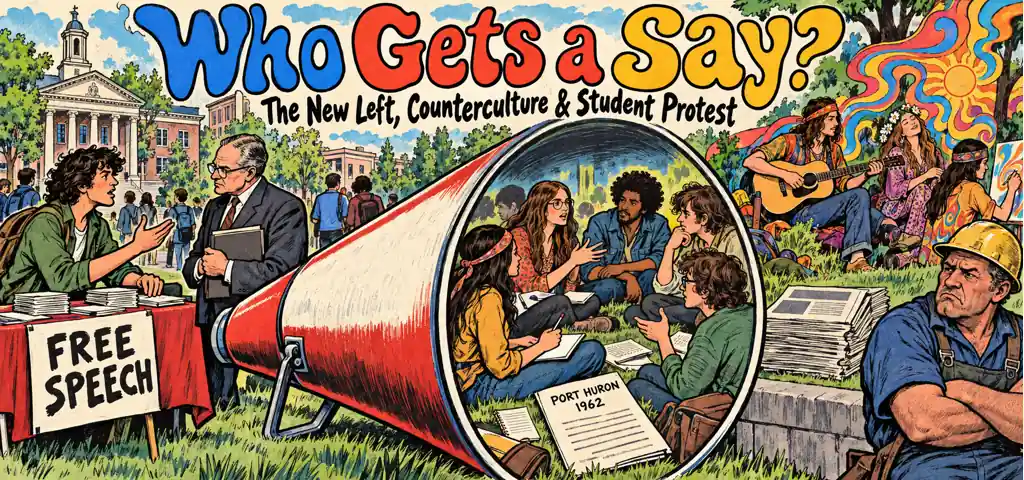
Chapter 14 of the CLEP History of the United States II study guide on Effortless Math covers The New Left, Counterculture, and Student Protest: the key terms, the core ideas, and worked examples showing how this topic is tested on the exam.
CLEP History of the United States II, Chapter 14
The Port Huron Statement criticized distant institutions
Students for a Democratic Society issued the Port Huron Statement in 1962. It condemned racial injustice, nuclear danger, Cold War rigidity, and large bureaucracies that left citizens feeling powerless. Its alternative, participatory democracy, meant that people affected by decisions should have a meaningful role in making them. The document grew from reformist hopes as well as alienation; it was not originally a call for armed revolution or withdrawal from all public institutions.
The New Left differed from the older Communist-centered left
Many young activists distrusted both corporate liberalism and Soviet authoritarianism. They organized around civil rights, universities, the draft, poverty, and Vietnam rather than a single industrial working-class party. This did not make class irrelevant, nor did it produce one ideology. The label New Left captured a generational style, decentralized organizing, and concern with power in everyday institutions.
Berkeley made university rules a civil-liberties issue
In 1964, the University of California at Berkeley restricted political advocacy and fundraising at a campus entrance. Students who had worked in civil-rights campaigns formed the Free Speech Movement. A sit-in and mass arrests followed. Mario Savio's Sproul Hall speech attacked a university treated like an impersonal machine. The immediate dispute was over political activity on campus, not a general demand to abolish academic standards.
Universities became targets because they were connected to public power
Students challenged classified research, military recruiting, racial inequality, rules governing residence and speech, and expansion into surrounding neighborhoods. At Columbia in 1968, protesters occupied buildings over a defense-research affiliation and a proposed gym in Morningside Park that Harlem residents criticized. Administrators called police, producing injuries and arrests. The case joined campus governance to the university's external relationships.
Counterculture and political protest overlapped without becoming identical
Young people experimented with communal living, sexual norms, psychedelic drugs, music, dress, and spiritual traditions. Some rejected electoral politics; others moved between cultural and political rebellion. The Haight-Ashbury district and Woodstock became symbols, but commercial media quickly packaged countercultural styles for sale. Buying a record or wearing a style did not establish membership in an antiwar organization.
Music carried arguments through different audiences
Folk singers, rock musicians, soul artists, and country performers addressed war, race, gender, patriotism, and generational conflict. Lyrics could mobilize protest or answer it. Popular music did not speak with one political voice: Merle Haggard's "Okie from Muskogee," for example, was heard as a rebuke to counterculture, while antiwar songs attacked the draft and official claims. The same medium carried competing positions.
The movement fractured over strategy and identity
By the late 1960s, SDS struggled with factional disputes. Some activists favored community organizing or mass protest; the Weather Underground embraced clandestine violence. Women and activists of color criticized male leadership and white-centered agendas. These conflicts helped generate autonomous feminist and ethnic-power organizations. Fragmentation came from repression and exhaustion, but also from unresolved questions about whose experience defined liberation.
The Hard Hat Riot revealed a politics of class and order
In May 1970, construction workers in New York attacked antiwar demonstrators after Kent State. Some marched in support of Nixon and later received administration attention. The episode did not prove that all workers backed the war or all students opposed it. It showed how patriotism, masculinity, union identity, resentment of elite students, and law-and-order politics could pull parts of the white working class away from the left.
The state monitored and disrupted dissent
The FBI's COINTELPRO operations targeted communists, civil-rights groups, Black nationalists, the New Left, and others through surveillance, informants, disinformation, and disruption. Local police intelligence units also monitored activists. Genuine violence by some groups did not make every target violent, and the existence of lawful protest did not prevent illegal government tactics. Evidence must identify the target, alleged threat, and method used.
distinguish institutional reform from cultural refusal
One source demands a student voice in university policy; another rejects conventional family life and consumer norms.
Underground newspapers connected local scenes without one command
Campus and community papers circulated reports, satire, art, legal advice, music criticism, and movement arguments outside mainstream editorial control. Syndication and shared reprints let a local dispute travel nationally, while differences among papers preserved regional voices. Police seizures, obscenity prosecutions, and advertiser pressure made publication itself a civil-liberties conflict. The medium did not guarantee factual accuracy or ideological unity. Its significance lay in lowering the cost of communication for movements whose participants distrusted established institutions and wanted to speak to one another directly.
Women's liberation grew partly from inequality inside reform movements
Women organized voter drives, researched policy, ran offices, and sustained campaigns, yet often encountered expectations that men would lead while women handled clerical or domestic work. Feminists translated those experiences into analysis of power in family, sexuality, employment, and organization. The phrase "the personal is political" did not mean every private disagreement required government control; it argued that apparently individual problems could reflect repeated social arrangements. Autonomous women's groups emerged from this critique while retaining connections to civil rights, labor, and antiwar activism.
Watch the history in motion
This short lesson adds voices, images, and chronology to the ideas you just studied.
Video: Youth and the COUNTERCULTURE of the 1960s [APUSH Review], Heimler's History.
Try four CLEP-style questions
- What did participatory democracy mean in the Port Huron Statement?
- Political parties should restrict nominations to experienced officeholders.
- Citizens affected by decisions should have a meaningful role in making them.
- Federal judges should replace elected legislatures whenever participation declined.
- Universities should prohibit political organizations to preserve academic neutrality.
- National economic planning should be assigned to expert administrators insulated from citizen participation.
- What was the immediate issue in Berkeley's Free Speech Movement?
- Whether students could conduct political advocacy and fundraising in campus space
- Whether California would eliminate tuition at every public university
- Whether the university would end all grading and degree requirements
- Whether federal courts would supervise local voter-registration offices
- Whether students could choose members of the state legislature directly
- Why is the counterculture not interchangeable with the organized antiwar movement?
- Countercultural lifestyles and political opposition overlapped, but neither required the other.
- Counterculture supported military escalation, while every antiwar group defended traditional family life.
- Only countercultural organizations used music, whereas political groups avoided popular media.
- Antiwar organizations were federal agencies, while counterculture existed only in universities.
- Countercultural participants all rejected public protest in favor of electoral campaigning.
- What did the Hard Hat Riot most clearly reveal?
- The administration ended the draft after consulting union leaders and student protesters.
- Every labor union formally endorsed Nixon and expelled members who opposed the war.
- Parts of the white working class could link patriotism and order to opposition toward student protest.
- Antiwar organizers abandoned campuses and transferred leadership to building-trades councils.
- Construction workers joined SDS to demand participatory control of university research.
Check your answers and reasoning
Independent preparation. CLEP is a registered trademark of the College Board, which does not endorse this lesson.

Related to This Article
More math articles
- Manage both timed sections without rushing
- Oral arguments
- Free Grade 7 English Worksheets for Arkansas Students
- Majority Rule and Minority Rights
- Social Darwinism, the Gospel of Wealth, and Their Critics
- Delegated, expressed, implied, inherent, reserved, and concurrent powers
- Half-Angle Identities
- Conflict Approaches
- How to Pass the HiSET Math Test: 2026 Strategy Guide
- 25 Ways You Use Math Every Day (Without Realizing It)















What people say about "The New Left, Counterculture, and Protest"?
No one replied yet.