Second-Wave Feminism, Family Change, the ERA, and Roe
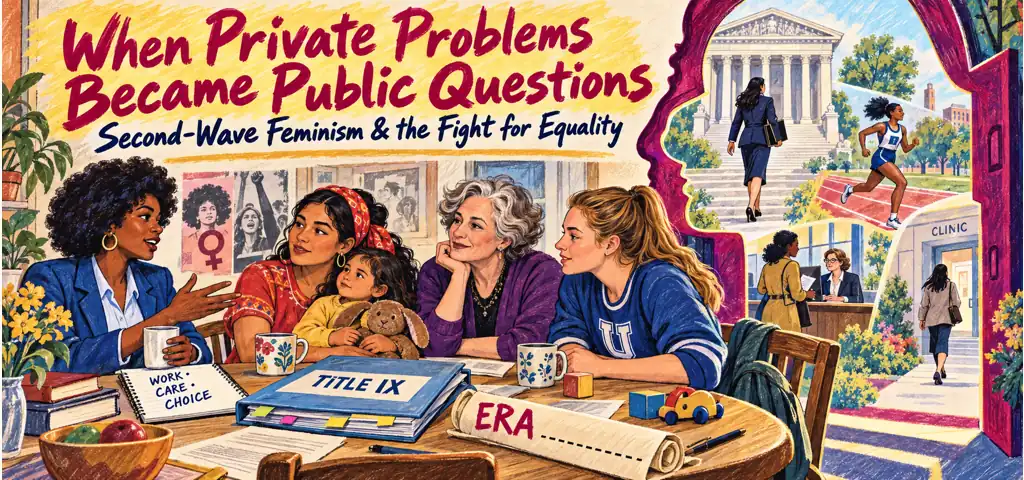
Chapter 14 of the CLEP History of the United States II study guide on Effortless Math covers Second-Wave Feminism, Family Change, the ERA, and Roe: the key terms, the core ideas, and worked examples showing how this topic is tested on the exam.
CLEP History of the United States II, Chapter 14
Postwar change exposed a gap between expectation and experience
More women entered paid work, pursued higher education, married later, and questioned the assumption that fulfillment required full-time domesticity. Betty Friedan's The Feminine Mystique described dissatisfaction among many educated suburban homemakers, but it did not represent every woman's circumstances. Black, Latina, working-class, and lesbian feminists often began from paid labor, racism, poverty, sterilization abuse, or exclusion within movements as well as from domestic confinement.
The President's Commission joined equality to practical policy
John F. Kennedy created the President's Commission on the Status of Women in 1961, chaired by Eleanor Roosevelt until her death. Its 1963 report documented inequality in employment, education, legal status, and public life while supporting childcare and maternity protections. The Equal Pay Act of 1963 targeted sex-based wage differences for substantially equal work. Title VII of the Civil Rights Act then prohibited employment discrimination based on sex as well as race, color, religion, and national origin.
NOW sought enforcement through established institutions
The National Organization for Women formed in 1966 after frustration with weak enforcement of Title VII. NOW pressed the EEOC, courts, legislatures, employers, and schools on work, education, reproductive freedom, and legal equality. Executive Order 11375 added sex to federal contractors' affirmative-action obligations in 1967. NOW used protest, litigation, lobbying, and administrative pressure rather than relying on consciousness-raising alone.
Consciousness-raising turned private patterns into public questions
Small groups compared experiences of marriage, sexuality, work, childcare, violence, and medical authority. The method treated repeated personal experiences as evidence of institutions and power, not merely isolated dissatisfaction. Radical feminists criticized male dominance more broadly than a program centered on equal access. The slogan "the personal is political" did not mean every private choice required government control; it challenged the claim that recurring inequality was purely individual.
The Women's Strike for Equality joined several demands
On August 26, 1970, the fiftieth anniversary of the Nineteenth Amendment, women marched and demonstrated for equal employment and educational opportunity, abortion rights, and childcare. The event showed that workplace equality, reproductive freedom, and care work were connected in the movement's program. Media attention sometimes emphasized spectacle, but organizers used the strike to make the economic structure of women's unpaid and paid labor visible.
Peace protest and pageant protest used different public symbols
Women Strike for Peace brought roughly fifty thousand women into demonstrations in November 1961 against atmospheric nuclear testing and radioactive fallout in children's milk. At the 1968 Miss America protest, activists crowned a sheep and deposited girdles, curlers, and magazines in a Freedom Trash Can; they did not burn bras. Both actions made private life politically visible, but one targeted nuclear danger while the other challenged commercial standards of femininity.
Title IX changed educational opportunity through a funding rule
Title IX of the Education Amendments of 1972 prohibited sex discrimination in federally funded education programs. It affected admissions, employment, treatment, and athletics. The statute did not command identical sports or identical spending on each team; enforcement examined whether institutions provided equitable opportunity. Women's athletic participation rose dramatically, though schools, courts, and agencies continued to dispute compliance.
The ERA divided equality strategies
Congress sent the Equal Rights Amendment to the states in 1972. Supporters argued that explicit constitutional equality would strengthen review of sex-based law. Some labor feminists had earlier feared that an ERA would invalidate protective legislation covering women workers without extending protections to men. Phyllis Schlafly later mobilized STOP ERA around claims that the amendment threatened sex-specific benefits, family roles, and legal distinctions. Congress extended the deadline, but ratification fell short.
The Hayden rider turned earlier ERA victories into defeats
The Senate approved an ERA in 1950 and 1953 only after adding Senator Carl Hayden's provision preserving existing laws that granted women special rights, benefits, or exemptions. ERA sponsors rejected that qualification because it could preserve the very sex-based legal distinctions they wanted the amendment to displace. The episode explains why a favorable roll-call tally did not count as victory for the amendment's own advocates.
The Court built sex-equality doctrine without the ERA
In Reed v. Reed (1971), the Supreme Court struck down an automatic preference for men as estate administrators. Frontiero v. Richardson (1973) invalidated unequal military-benefit rules, though no single rationale commanded a majority for strict scrutiny. Craig v. Boren (1976) articulated intermediate scrutiny: sex classifications must serve important government objectives and be substantially related to achieving them. This doctrine was more demanding than ordinary rational-basis review but less demanding than strict scrutiny.
Reproductive politics involved access as well as formal choice
Griswold v. Connecticut protected married couples' contraceptive privacy; Eisenstadt v. Baird extended contraceptive access to unmarried people through equal protection. Roe v. Wade (1973) recognized a constitutional abortion right under a trimester framework, while later cases modified the rule. Poor women and women of color also challenged involuntary sterilization and unequal access to care. A legal right without money, providers, information, or freedom from coercion could be incomplete.
Family and credit rules changed unevenly
No-fault divorce laws spread, making dissolution possible without proving traditional marital fault. Two-earner households became more common, while unpaid care remained unequally distributed. The Equal Credit Opportunity Act of 1974 prohibited creditors from discriminating on grounds including sex and marital status, challenging practices that discounted a married woman's income or required a husband's signature. Legal equality altered bargaining conditions without erasing wage gaps or care responsibilities.
Feminists challenged medicine, media, art, and religion
The Boston Women's Health Book Collective's Our Bodies, Ourselves translated medical information into accessible language and encouraged patients to question professional authority. Feminist artists exposed exclusion from museums and challenged ideals of representation. Women's studies programs made gender a field of academic inquiry. Churches divided over ordination, scriptural authority, and leadership. Kate Millett analyzed power in literature and sexuality, while the Combahee River Collective emphasized interlocking racial, gender, sexual, and class oppression.
Workplace rules, violence services, and art made structural claims concrete
Airlines dismissed many female cabin attendants when they married or reached their early thirties and enforced weight and appearance rules that male employees did not face. Feminists built rape crisis centers and shelters because police, courts, hospitals, and existing charities often failed survivors. In art, Womanhouse used a domestic setting and The Dinner Party used craft-associated media and women's names to challenge exclusion from cultural history. These campaigns targeted different institutions, but each turned a supposedly private problem into a public claim.
identify the legal instrument before choosing an answer
A student compares a wage law, an employment-discrimination law, and an education-funding rule.
Title VII became broader through enforcement and litigation
The 1964 Civil Rights Act prohibited sex discrimination in employment after sex was added to the bill. The Equal Employment Opportunity Commission initially enforced the provision cautiously, prompting activists to organize the National Organization for Women and pursue lawsuits. Courts and agencies then addressed hiring, promotion, pregnancy, harassment, and workplace rules. Statutory language opened a legal route, but employees still needed evidence, organizations, lawyers, and institutions willing to apply it. The history shows why enactment and practical enforcement should be dated separately.
Congress gave the employment commission litigation power in 1972
The EEOC as created in 1964 could investigate complaints and seek voluntary settlements but could not itself compel most employers to comply. The Equal Employment Opportunity Act of 1972 authorized the commission to sue employers in federal court and extended coverage to state and local governments and educational institutions. It did not give the agency a general power to impose fines or binding cease-and-desist orders on its own.
Black feminists named exclusions inside two movements
Founders of the National Black Feminist Organization in 1973 argued that much of the women's movement slighted race while many Black organizations slighted sex. Separate organization did not mean abandoning either antiracism or feminism. It created a place to analyze how race, sex, class, and sexuality interacted, a line of reasoning later developed by groups such as the Combahee River Collective.
Professional and military entry rose faster than earnings equality
By 1985-1986, women earned about 31 percent of medical degrees and close to two-fifths of law degrees, up from under one-tenth around 1970. Their share of active-duty military personnel also rose sharply after the draft ended and the services recruited for an all-volunteer force. Yet full-time, year-round median earnings stayed near 60 percent of men's through 1980 before narrowing appreciably afterward. Entry, representation, and pay therefore require separate measures.
Childcare exposed the difference between labor-force access and care policy
As more mothers entered paid work, families relied on relatives, private care, schools, and uneven public programs. Congress passed a broad child-development bill in 1971, but Nixon vetoed it, criticizing its expense and collective approach to family life. Feminists themselves differed over wages for housework, public childcare, workplace reform, and the value of full-time caregiving. Increased employment did not make care disappear; it redistributed time and cost. Family policy therefore became central to economic equality even when debate was framed as private choice.
Watch the history in motion
This short lesson adds voices, images, and chronology to the ideas you just studied.
Video: The Fight For Women's Rights | Flashback | NBC News, NBC News.
Try four CLEP-style questions
- Why did NOW initially focus attention on the EEOC?
- The agency administered Medicare benefits for women employed outside the home.
- The agency controlled admissions and athletic budgets at every public university.
- The agency alone possessed authority to ratify the Equal Rights Amendment.
- The agency supervised state divorce courts and issued national marriage licenses.
- The agency was failing to enforce Title VII's prohibition on sex discrimination vigorously.
- What made consciousness-raising a political method?
- Groups assigned every personal decision to a federal administrative agency.
- Participants assumed women across race and class had identical experiences.
- Participants rejected discussion of marriage, work, sexuality, and medical care.
- Groups replaced legal and workplace campaigns with private therapy sessions.
- Participants treated recurring private experiences as evidence of broader institutions and power.
- Which comparison of Reed and Craig is accurate?
- Reed upheld a male preference, while Craig required strict scrutiny for sex classifications.
- Reed concerned contraception, while Craig established the trimester framework.
- Reed struck an automatic male preference; Craig articulated intermediate scrutiny.
- Both cases held that the unratified ERA already bound every state government.
- Both cases concerned sex discrimination in federally funded intercollegiate athletics.
- Why did reproductive-rights activists address sterilization abuse as well as abortion restrictions?
- Title IX conditioned athletic participation on proof of a patient's reproductive history.
- Freedom required protection against coerced reproduction as well as access to voluntary choices.
- Federal law required sterilization before an unmarried woman could obtain contraception.
- The Equal Rights Amendment transferred all reproductive decisions to hospital boards.
- Sterilization abuse occurred only after Roe eliminated every state health regulation.
Check your answers and reasoning
Independent preparation. CLEP is a registered trademark of the College Board, which does not endorse this lesson.

Related to This Article
More math articles
- The Best Grade 8 ELA Practice Tests for Florida Students
- The Chain of Infection, Bioburden, and Biofilm
- Free Grade 3 English Worksheets for New York Students
- How to Solve Word Problems of Dividing Two-Digit Numbers By One-digit Numbers
- How to Solve Rational Numbers Word Problems
- How to Graphing the Floor Function
- 10 Most Common 5th Grade MCAS Math Questions
- Human Ecology and Urban Spatial Models
- Informal Work and Development Beyond Economic Growth
- Function Notation Worksheet with Answers



















What people say about "Second-Wave Feminism, the ERA, and Roe"?
No one replied yet.