CLEP U.S. History I 004: French and Dutch Colonization
Lesson 1.4 of Chapter 1 of the U.S. History to 1877 study guide on Effortless Math covers CLEP U.S. History I 004: French and Dutch Colonization: the key terms, the core ideas, and worked examples showing how this topic is tested on the exam.
U.S. History to 1877 | Chapter 1 | Lesson 1.4
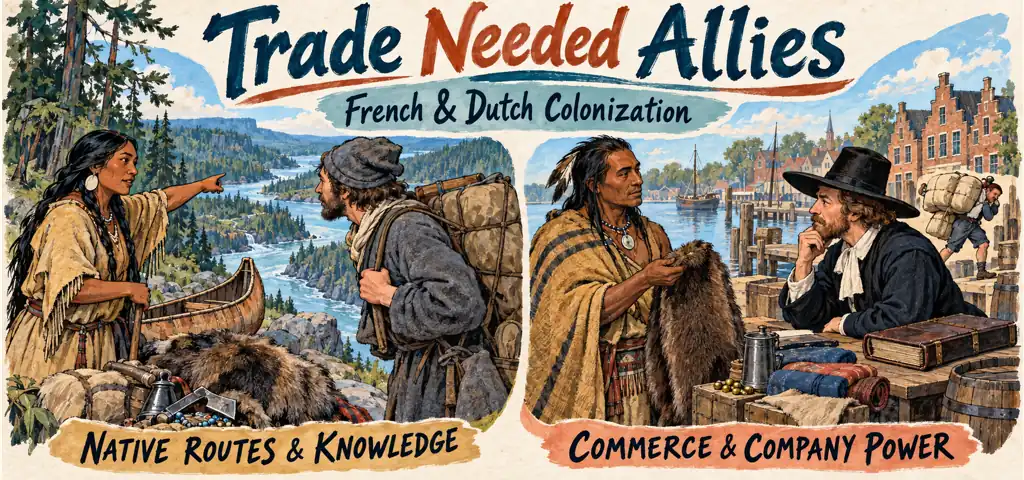
French and Dutch colonizers entered North America chiefly through commerce. French settlements along the St. Lawrence River and later through the Great Lakes and Mississippi system depended heavily on the fur trade. Because French populations remained comparatively small, traders and officials needed durable relationships with Native nations. Alliances with Huron-Wendat and Algonquian-speaking peoples brought furs and military partners, while also drawing the French into wars against the Haudenosaunee. Missionaries sought converts, but commercial and diplomatic survival often required cultural accommodation.
French traders known as coureurs de bois traveled far beyond compact settlements. Intermarriage connected families and trading networks, and Indigenous women frequently supplied agricultural knowledge, translated, negotiated, and processed goods. Native suppliers were not merely laborers in a European business. They determined routes, prices, and alliance choices, and used European goods for their own purposes. Firearms and metal tools could change regional power, sometimes intensifying competition and warfare.
The Dutch founded New Netherland as a commercial colony centered on the Hudson River and New Amsterdam. The Dutch West India Company expected profit, not a uniform religious society. This goal encouraged ethnic and religious diversity and the patroon system of large estates. Dutch traders built an important relationship with the Haudenosaunee, exchanging goods and weapons for furs. Yet commercial partnership did not prevent land conflict, and Dutch campaigns against nearby peoples could be brutally destructive.
Compared with Spanish colonies, French and Dutch settlements generally relied less on large Indigenous labor drafts and more on trade. That difference should not become a moral fable. All three empires claimed land and sought to redirect Native economies. French and Dutch influence could be violent, destabilizing, and expansionist. Their smaller settler populations, however, made negotiation unusually central. The structure of colonization shaped the balance between coercion and alliance.
Watch the topic in context
This Khan Academy lesson supplies a second explanation of the same period. Note where chronology, cause, and perspective connect.
Video: French and Dutch colonization | Period 2: 1607-1754 | AP US History | Khan Academy, Khan Academy.
Check your understanding
- Why was alliance diplomacy structurally important to France’s interior empire?
- Seigneurial farms supplied enough settlers to defend interior posts without allies.
- Licensed traders remained at Atlantic ports beyond Native diplomatic influence.
- Crown officials could treat Native strategic choices as politically irrelevant.
- Mission settlements made negotiated access to interior trade unnecessary.
- French posts relied on Native routes, suppliers, and military partners.
- Which aim most directly encouraged New Netherland to recruit residents of varied origins?
- building a religiously uniform, tightly covenanted Dutch Reformed settler community
- replacing Atlantic commerce with household-level subsistence production
- reserving commercial work for Netherlands-born Dutch migrants
- expanding commerce through a larger and more varied port workforce
- ending the Dutch West India Company’s governing authority
- Select all that apply. Which features were shared by both French and Dutch colonization?
- elected settler assemblies directing colonial government
- tobacco plantations anchoring overseas commerce
- fur commerce linking interior and Atlantic markets
- dense family-farm settlement across the interior
- Native alliances sustaining diplomacy and exchange
- Compare the role of negotiation in French or Dutch colonization with its role in Spanish colonization.
Write a brief response using a named fact from the lesson.
Open the answers and reasoning
Independent preparation. CLEP is a registered trademark of the College Board, which does not endorse this lesson.

Related to This Article
More math articles
- Utah RISE Grade 5 Math at Home — 49 Free Single-Skill PDF Worksheets with Friendly Keys
- The short-run supply curve is marginal cost above AVC
- How to Use Models to Divide Whole Numbers by Unit Fractions?
- Vetoes and veto overrides
- Boycotts
- Vector-Valued Functions: Fundamentals and Applications
- 5 Best Programmable Calculators
- Mean, Median, Mode & Range Practice — Free Drills
- 4 Perfect Tablets for Note-Taking in 2026
- The Best Grade 4 ELA Practice Tests for Florida Students






















What people say about "French and Dutch Colonization in North America"?
No one replied yet.