CLEP U.S. History I 005: Columbian Exchange and Demographic Catastrophe
Lesson 1.5 of Chapter 1 of the U.S. History to 1877 study guide on Effortless Math covers CLEP U.S. History I 005: Columbian Exchange and Demographic Catastrophe: the key terms, the core ideas, and worked examples showing how this topic is tested on the exam.
U.S. History to 1877 | Chapter 1 | Lesson 1.5
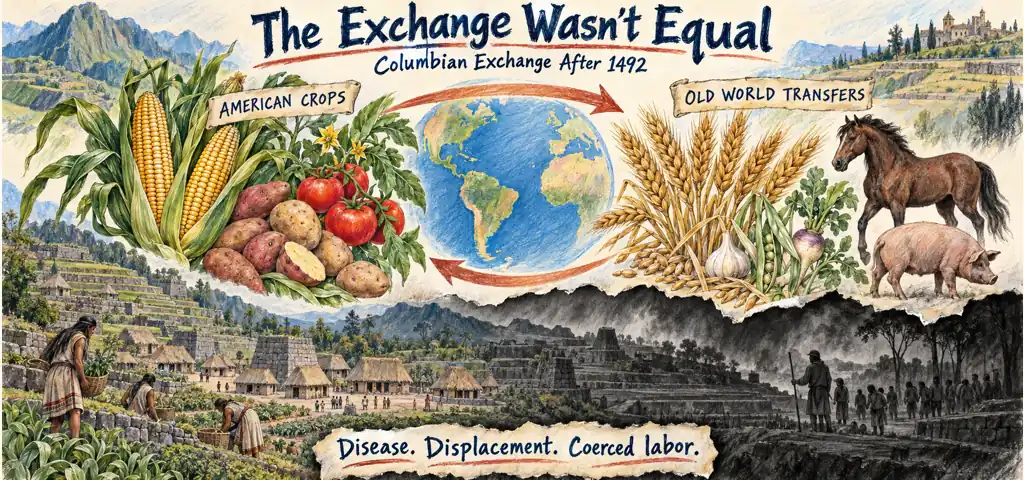
The Columbian Exchange names the movement of organisms, people, and pathogens between hemispheres after 1492. Europeans carried wheat, sugar, cattle, pigs, and horses westward. American crops including maize, potatoes, tomatoes, and cassava moved eastward and supported population growth in parts of Europe, Africa, and Asia. The exchange created new diets, landscapes, and economies. It was biological, but it was never separate from power.
Disease was the most devastating transfer. Smallpox, measles, influenza, and other infections struck populations without prior exposure. Mortality varied by place and episode, but repeated epidemics produced catastrophic decline. Disease could arrive before Europeans themselves through Native trade routes, weakening communities and political systems. Depopulation then made conquest and settlement easier. It also led colonizers to misread managed lands as untouched wilderness.
The catastrophe was not simply an accidental event for which human action is irrelevant. Europeans did not understand germ theory, but colonial warfare, forced relocation, hunger, and labor exploitation increased vulnerability. Spanish labor systems concentrated people and demanded exhausting work. Later English expansion disrupted food supplies and crowded survivors. A careful account distinguishes unintentional pathogen transmission from policies that magnified mortality.
Other transfers carried mixed effects. Horses expanded mobility and transformed the economies and warfare of many Plains peoples. Livestock damaged Indigenous crops and altered ecosystems. Sugar cultivation generated immense profit while accelerating the forced migration of Africans and the growth of racial slavery. Maize and cassava strengthened food supplies beyond the Americas, yet plantation export systems often enriched owners rather than workers. “Exchange” can therefore sound too balanced. Movement occurred in many directions, but benefits and losses were distributed unequally.
A focused video lesson
Heimler's History traces the people and chronology behind this lesson. Listen for the evidence that sharpens the written account, then try the questions below.
Video: The COLUMBIAN EXCHANGE, Spanish Exploration, and Conquest [APUSH Unit 1 Topic 4] 1.4, Heimler's History.
Check your understanding
- Which transfer most clearly carried an American food crop into diets across Europe and parts of Asia?
- Old World wheat entering colonial North American diets
- Asian rice entering the Carolina lowcountry economy
- Mediterranean sugarcane entering Caribbean plantation production
- European barley entering Spanish mission settlements
- Andean potatoes entering European and Asian diets
- Why do historians describe the Columbian Exchange as unequal?
- Conquest made biological exchange coincide with unequal mortality, dispossession, and coerced labor.
- Transferred crops and animals produced broadly comparable social effects in both hemispheres.
- Native communities generally refused introduced animals despite the choices they created.
- Epidemic loss and demographic recovery followed comparable paths across the Atlantic.
- Imperial labor systems developed separately from environmental and biological transfers.
- Select all that apply. Which conditions could magnify epidemic mortality?
- coerced labor reducing health and recovery
- warfare and forced displacement
- effective quarantine before local transmission
- malnutrition weakening resistance to infection
- recovery intervals restoring food supplies and births
- Explain one beneficial and one destructive result of the Columbian Exchange, identifying who experienced each.
Write a brief response using a named fact from the lesson.
Open the answers and reasoning
Independent preparation. CLEP is a registered trademark of the College Board, which does not endorse this lesson.

Related to This Article
More math articles
- Ratio, Proportion and Percentages Puzzle – Challenge 28
- Colorado CMAS Grade 6 Math Free Worksheets: Printable Grade 6 Math Practice with Full Solutions
- Dual Degree Programs: A Complete Guide
- Money and Decimals Relation: A Step-by-Step Guide
- Derivative Calculator — Differentiate Step by Step (Free)
- Wisconsin Grade 2 Math Worksheets — Free Printable PDFs
- Cabinet departments
- The Best Grade 3 ELA Practice Tests for Maryland Students
- How to Solve Word Problems of Calculating Profit
- 9th Grade Math Worksheets: FREE & Printable


















What people say about "The Columbian Exchange and Demographic Catastrophe"?
No one replied yet.