CLEP U.S. History I 089: Changing Work, Gender, and Household Economies
Lesson 16.5 of Chapter 16 of the U.S. History to 1877 study guide on Effortless Math covers CLEP U.S. History I 089: Changing Work, Gender, and Household Economies: the key terms, the core ideas, and worked examples showing how this topic is tested on the exam.
U.S. History to 1877 | Chapter 16 | Lesson 16.5
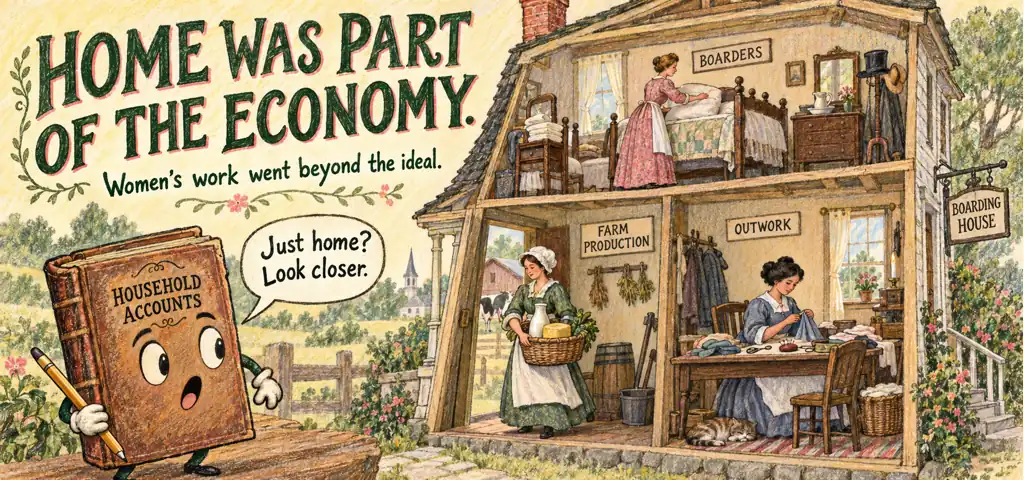
The ideal of separate spheres assigned men to market and political life and women to moral influence in the home. It was a prescriptive white middle-class ideal, not a complete description. Farm women produced food and textiles, managed dairies, and exchanged goods. Enslaved women performed coerced field and domestic labor while sustaining family and community under threat of sale. Working-class and immigrant women entered domestic service, outwork, mills, shops, and boardinghouse economies. Widows and single women often faced different legal and economic circumstances from married women under coverture.
Industrialization shifted some production out of households without making households economically unimportant. Families pooled wages, took boarders, cared for children, and managed irregular work. Employers classified jobs by gender and paid women less, often treating their earnings as temporary even when families depended on them.
Legal status shaped this work. Under coverture, a married woman’s legal identity and control of property or earnings were generally subordinated to her husband’s, although state rules and married-women’s property reforms varied. Enslavement denied women legal control of labor and exposed families to sale. A household account book, mill payroll, freedom petition, and conduct manual therefore answer different questions. Using all four prevents a middle-class prescription from standing in for every woman’s material conditions.
A focused video lesson
This Last Minute Lecture lesson supplies a second explanation of the same period. Note where chronology, cause, and perspective connect.
Video: The Market Revolution, 1800 to 1840 | Chapter 9 – Give Me Liberty! (Brief Volume 1, 5th Edition), Last Minute Lecture.
Check your understanding
- Separate-spheres ideology assigned middle-class women primary responsibility for
- independent wage earning as the household’s principal provider.
- domestic and moral life.
- formal party leadership and electoral representation.
- autonomous property management outside coverture.
- public policymaking as household political head.
- Which evidence would best test the claim that women did not participate in market production?
- A conduct manual defining respectable domestic behavior.
- A census table listing households by county.
- Patent records naming inventors of household tools.
- Payrolls and household accounts recording women’s paid work.
- A court calendar listing civil and criminal cases.
- Select all forms of women’s economic labor:
- farm production,
- mills,
- domestic service,
- outwork,
- taking boarders.
- Explain why an ideal can shape history even when many people do not live according to it.
Write a brief response using a named fact from the lesson.
Open the answers and reasoning
Independent preparation. CLEP is a registered trademark of the College Board, which does not endorse this lesson.

Related to This Article
More math articles
- Free Grade 4 English Worksheets for Nevada Students
- The Best Keyboards For Online Teaching
- Multiplication Models: Area Models and Partial Products
- How to Find Powers and Roots of Complex Numbers
- Congressional limits on the executive
- FREE 4th Grade PSSA Math Practice Test
- The Best Grade 4 ELA Practice Tests for Missouri Students
- Top 10 Tips to ACE the ISEE Math Test
- Crypto Casinos vs. Traditional Online Casinos: The Math Differences
- 7th Grade MEAP Math Practice Test Questions














What people say about "Changing Work, Gender and Household Economies"?
No one replied yet.