Fundamentalism, Modernism, the Scopes Trial, and Education
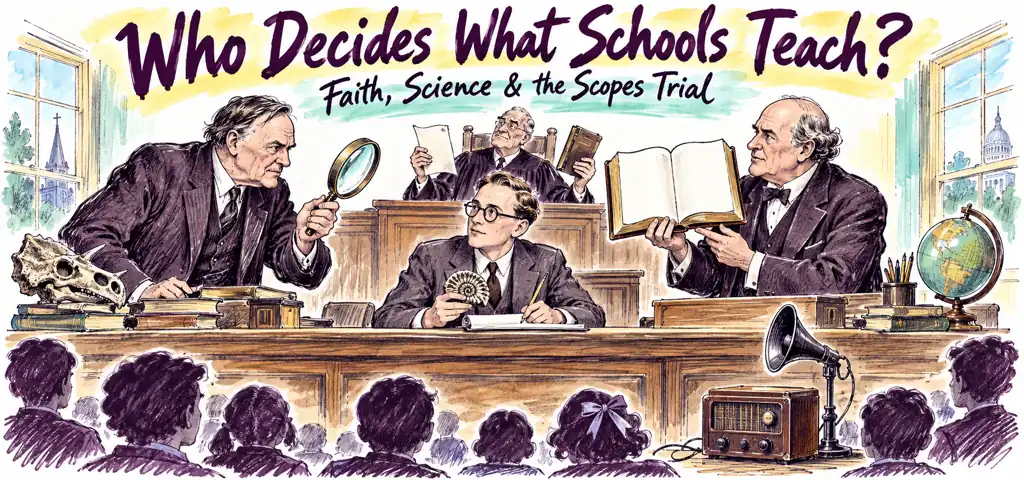
Chapter 8 of the CLEP History of the United States II study guide on Effortless Math covers Fundamentalism, Modernism, the Scopes Trial, and Education: the key terms, the core ideas, and worked examples showing how this topic is tested on the exam.
CLEP History of the United States II, Chapter 8
The Protestant conflict concerned authority and interpretation
During the late nineteenth and early twentieth centuries, biblical criticism, evolutionary science, urban pluralism, and new social thought challenged inherited Protestant assumptions. Modernists argued that Christianity could absorb historical study of scripture and scientific accounts of nature while emphasizing ethics and social service. Fundamentalists defended core doctrines, including biblical authority, Christ's divinity, and the reality of miracles. The conflict was not simply science against religion: religious thinkers stood on both sides and disagreed about how faith should respond to modern knowledge.
The Fundamentals supplied a name but not one organization
Between 1910 and 1915, conservative Protestants financed and distributed a series of essays called The Fundamentals. The essays defended traditional doctrine against modern theology, biblical criticism, and some forms of evolutionary thought. The later label "fundamentalist" covered a coalition of denominations, pastors, institutions, and laypeople rather than a single church. Some accepted an ancient earth or limited evolution; others insisted on a recent creation. Do not treat the movement as internally identical.
Religious innovation was also modern
Christian Science, founded by Mary Baker Eddy in the nineteenth century, emphasized spiritual healing and the teachings in Science and Health. Pentecostal worship, dramatically visible in the Azusa Street revival beginning in 1906, emphasized gifts of the Holy Spirit such as speaking in tongues and crossed some racial and class boundaries. These movements differed from Protestant modernism, yet their growth shows that modern religious change included new devotional forms, secularization.
The 1890 Manifesto belongs to an earlier church-state settlement
Church of Jesus Christ of Latter-day Saints president Wilford Woodruff issued the 1890 Manifesto advising members against marriages forbidden by United States law, effectively ending official authorization of new plural marriages. The change came amid federal pressure over polygamy and helped clear the way for Utah statehood in 1896. It was not a Protestant fundamentalist response to evolution. The example belongs in the longer history of religious adaptation to federal law and must be dated before the 1920s school conflict.
Mass media could strengthen revival religion
Aimee Semple McPherson built the International Church of the Foursquare Gospel around Angelus Temple in Los Angeles. She combined Pentecostal preaching, theatrical sermons, social services, and radio station KFSG. Her methods used the same urban audiences and new media sometimes associated with secular modernity. Fundamentalist or revivalist religion did not survive by withdrawing entirely from modern communication; leaders could reject theological modernism while mastering publicity and broadcasting.
Schools became a battleground over public authority
After World War I, several states considered or enacted restrictions on teaching human evolution in public schools. Supporters argued that taxpayers should not fund instruction contradicting biblical truth or undermining morality. Opponents defended academic freedom and scientific education. Because public schools are government institutions serving diverse citizens, the controversy raised a political question beyond private belief: who decides what counts as legitimate knowledge in a common curriculum?
Tennessee created the Scopes test case
The Butler Act of 1925 prohibited teaching in state-supported schools that humans descended from a lower order of animals. Civic leaders in Dayton hoped a test case would attract attention. John T. Scopes, a young teacher, agreed to be charged; the American Civil Liberties Union supported the defense. William Jennings Bryan joined the prosecution, and Clarence Darrow led the defense team. The case was deliberately staged as a legal test, though the cultural dispute it revealed was genuine.
The trial narrowed before it became spectacle
Judge John Raulston largely excluded expert scientific testimony because the statutory question was whether Scopes had violated the law, not whether evolution was true. Darrow then called Bryan as an expert on the Bible. Darrow's questioning exposed Bryan's willingness to interpret some passages nonliterally and turned national attention toward biblical authority. The exchange did not determine the legal issue. Scopes was convicted and fined $100.
The reversal did not invalidate the antievolution law
In 1927 the Tennessee Supreme Court upheld the Butler Act but set aside Scopes's conviction on a technical ground: the judge rather than the jury had imposed a fine above the amount the state constitution allowed a judge to set. The court advised against further prosecution. It did not declare a constitutional right to teach evolution. The distinction between reversing a conviction and striking down a statute is a frequent assessment target.
Bryan's reputation and the movement's future require care
Bryan died five days after the trial ended. Journalists such as H. L. Mencken portrayed fundamentalists as ignorant rural opponents of progress, a frame later dramatizations reinforced. Yet conservative Protestant networks remained active, built institutions, and eventually returned to national politics. The Scopes trial damaged public prestige in some educated circles without making fundamentalism disappear. Cultural visibility and organizational survival can move in opposite directions.
Pierce protected private schooling against state monopoly
Oregon voters had enacted a law requiring most children to attend public school, supported partly by anti-Catholic and nativist forces. In Pierce v. Society of Sisters (1925), the Supreme Court held that the state could regulate education but could not standardize children by forcing attendance only at public schools. The decision protected parents' ability to choose lawful private or religious schools. It did not exempt such schools from reasonable health, curriculum, or teacher regulations.
The 1928 election tested religious citizenship
Opponents of Catholic Democrat Al Smith warned that a Catholic president would obey the pope, echoing older fears about Catholic schools and political loyalty. John F. Kennedy confronted a similar charge in 1960 but answered in a different media and party setting and won. The comparison reveals persistence and change: anti-Catholic suspicion survived, while suburbanization, wartime integration, television, and a changed electorate altered its political force. The later comparison belongs to postwar religious history as well as Smith's era.
separate four possible holdings
A question offers these descriptions of Scopes: evolution was declared false, the Butler Act was struck down, Scopes was acquitted, or his conviction was set aside on a sentencing technicality.
Religious modernity contained several competing strategies
Modernists revised interpretation, fundamentalists defended doctrinal boundaries, Pentecostals emphasized spiritual gifts, McPherson used mass media, Catholics defended institutional independence, and secular civil-liberties lawyers challenged curricular restriction. These projects overlapped but were not synonyms. The decade's conflicts grew because modern institutions-public schools, radio, courts, national elections-brought different communities into shared arenas where one group's authority claim could become another group's loss of freedom.
Watch the history in motion
This short lesson adds voices, images, and chronology to the ideas you just studied.
Video: The 1920s: CULTURAL and POLITICAL Controversies [APUSH Unit 7 Topic 8] Period 7:1898-1945, Heimler's History.
Try four CLEP-style questions
- A conservative revival preacher builds a national audience through radio broadcasts and modern advertising. What does the combination demonstrate?
- Religious traditionalism adapted to radio only by abandoning revival performance and doctrinal certainty.
- Mass media converted traditional revival preaching into modernist biblical interpretation and social theology.
- Radio removed celebrity, personality, and theatrical performance from public religious authority.
- Technological innovation required preachers to accept historical criticism of biblical texts.
- Modern media could amplify conservative theology; technology did not determine doctrine.
- Why did the judge exclude most scientific expert testimony at the Scopes trial?
- Tennessee had repealed the Butler Act before the prosecution presented its evidence.
- The defense did not dispute that Scopes had taught evolution in the classroom.
- The scientific experts had been hired and directed by the state prosecution.
- The judge treated statutory violation, not scientific validity, as the issue.
- Federal courts had prohibited state judges from considering expert testimony about science.
- Why should the LDS Church's 1890 Manifesto not be treated as a direct response to the Scopes controversy?
- The Manifesto defended teaching evolution in Tennessee public schools under state standards.
- It followed the Scopes appeal and relied on the same antievolution statute.
- It addressed plural marriage decades before the antievolution trial.
- It established a national radio ministry during the decade of the Scopes trial.
- It required Mormon children to attend Oregon public schools rather than private academies.
- Al Smith's Catholic faith becomes a major issue in Protestant regions during the 1928 election. Which conclusion best follows?
- Foreign-policy treaties were more important than religion in every region's party choice.
- Smith's nomination ended Democratic support across immigrant neighborhoods in major industrial cities.
- Prosperity removed religious identity and nativist suspicion from national electoral behavior.
- The Constitution barred Catholic presidential candidates from receiving electoral votes in rural states.
- Religious identity and nativism shaped voting alongside urban, ethnic, and economic divisions.
Check your answers and reasoning
Independent preparation. CLEP is a registered trademark of the College Board, which does not endorse this lesson.

Related to This Article
More math articles
- ASVAB Math FREE Sample Practice Questions
- How to Find Asymptotes: Vertical, Horizontal and Oblique
- How to Convert Between Polar and Rectangular Coordinates
- 8th Grade SC Ready Math Worksheets: FREE & Printable
- The Best Grade 6 ELA Practice Tests for Hawaii Students
- Temperature, Gases, and Thermal Expansion
- Keep short-run adjustment separate from long-run adjustment
- How to Sketch Trigonometric Graphs?
- Using Properties to Convert Traditional and Metric Units
- Heating, Humidity, and Clouds
















What people say about "Fundamentalism, Modernism, and Scopes"?
No one replied yet.