Action, Linking, and Helping Verbs
Ask most students what a verb is and they will say “an action word.” That is true for verbs like run, measure, and document – but it misses two whole families. Some verbs do not act at all; they connect. Others do not stand alone; they help. Telling the three apart is the skill behind a surprising number of grammar questions, from subject-verb agreement to tense.
The good news: the sorting test takes about five seconds once you know it. This lesson gives you the test, plenty of examples, and six practice questions to lock it in.
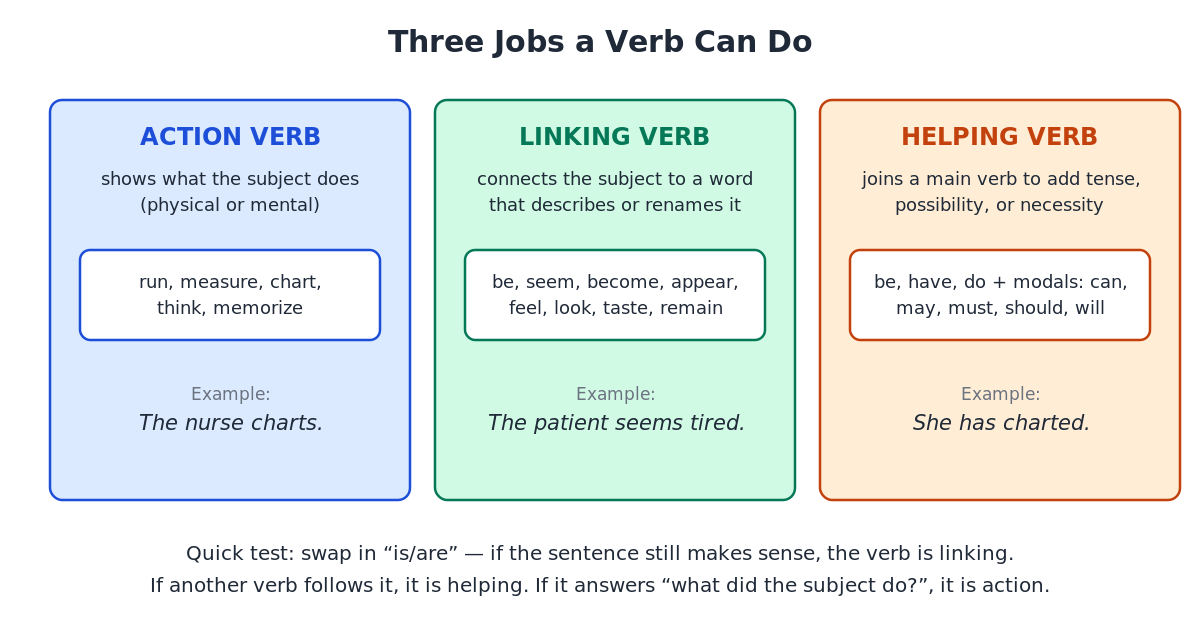
Every verb does one of three jobs. An action verb shows what the subject does: the nurse charts. A linking verb connects the subject to a word that describes or renames it: the patient seems tired. A helping verb joins a main verb to add tense or possibility: she has charted, he might sleep.
What does an action verb do?
An action verb tells you what the subject does, whether the action is physical or mental:
- The aide lifted the wheelchair over the threshold. (physical)
- The student memorized the dosage chart. (mental – still an action)
- The monitor beeped twice.
Mental actions trip people up. Think, believe, consider, remember are all action verbs even though nothing visibly moves. If the subject is doing something – even inside their head – the verb is an action verb.
What does a linking verb do?
A linking verb does not transfer any action. It works like an equals sign, connecting the subject to a subject complement – a word that describes or renames it:
- The incision looks clean. (incision = clean)
- Mr. Ortiz is a veteran. (Mr. Ortiz = veteran)
- The hallway smelled faintly of antiseptic.
The most common linking verb is be in all its forms (am, is, are, was, were, been, being). Others describe states or senses: seem, become, appear, feel, look, sound, taste, smell, grow, remain, stay.
Here is the catch: many of these words can also be action verbs. The nurse felt the pulse – that is an action, something she did with her hands. The nurse felt dizzy – that is linking, describing her state. The word alone does not tell you; the job in the sentence does.
The substitution test: replace the verb with is or are. If the sentence still makes sense, the verb is linking. “The soup tasted salty” → “The soup is salty.” Works, so tasted is linking there. “The dietitian tasted the soup” → “The dietitian is the soup.” Nonsense, so tasted is an action verb there.
What does a helping verb do?
A helping verb (also called an auxiliary) never appears alone. It teams up with a main verb to build a verb phrase, adding information about time, possibility, necessity, or emphasis:
- The lab results have arrived. (completed recently)
- You should review the medication list. (advice)
- The patient was sleeping when the family visited. (ongoing past action)
Three verbs – be, have, do – moonlight as helpers, and nine modals are helpers only: can, could, may, might, must, shall, should, will, would. A verb phrase can stack several helpers: She must have been waiting for an hour. The last verb in the chain (waiting) is always the main verb.
One more wrinkle: words like not, always, and never can sit inside a verb phrase without being part of it. In “He does not remember,” the verb phrase is does remember; not is an adverb.
How do I tell the three types apart quickly?
| Type | Job | Quick test | Example |
|---|---|---|---|
| Action | Shows what the subject does | Can you ask “What did the subject do?” | The tech calibrated the scale. |
| Linking | Connects subject to a description | Swap in is/are – does it still make sense? | The reading seems high. |
| Helping | Supports a main verb | Is another verb right after it? | The reading has stabilized. |
And here is a numbered routine you can run on any sentence:
- Find the whole verb phrase – every verb word, including any stacked helpers.
- Look at the last verb in the phrase. That is the main verb; everything before it is helping.
- Ask what follows the main verb. A description or rename of the subject points to linking; a “what did they do” answer points to action.
- Run the substitution test on sense verbs (feel, look, taste, smell, sound, grow) – swap in is and see if the meaning survives.
- Ignore interrupters like not, never, always – they are adverbs, not verbs.
Watch: A Short Video Lesson
Ryan Hill walks through this skill clearly in a few minutes. It is a helpful companion to the reading above:
Practice: action, linking, or helping?
Identify the role of the bolded verb in each sentence.
- The new resident appears confident during rounds.
- The charge nurse has updated the schedule.
- The charge nurse has three patients this morning.
- The bandage felt tight around his wrist.
- You might need a second signature for that medication.
- The volunteers grew vegetables for the shelter kitchen.
Answers
- Linking – “The resident is confident” makes sense; confident describes the subject.
- Helping – has supports the main verb updated in the phrase has updated.
- Action – here has stands alone and means “possesses”; no other verb follows it.
- Linking – “The bandage is tight” works; tight describes the bandage.
- Helping – the modal might supports the main verb need.
- Action – “The volunteers are vegetables” fails the test; grew is something they did.
Where this fits
Verbs are the engine of every sentence, and this lesson is part of our English and language usage study hub. From here, a natural next step is making subjects and verbs agree, then the trickier cases in agreement in complex sentences. To see how verb phrases carry time and voice, read verb tenses, forms, and voice, and to see verbs at work inside clause structure, visit complete sentences and clauses.
Recommended Prep Books
These study guides and practice books help you keep building momentum as you prepare:

Related to This Article
More math articles
- The Best Grade 5 ELA Practice Tests for Ohio Students
- Ratio Tables
- Colorado Algebra 1 Free Worksheets: Printable Algebra 1 Practice with Full Solutions
- Top 10 Free Websites for TABE Math Preparation
- 3rd Grade OSTP Math Worksheets: FREE & Printable
- Geometry Puzzle – Challenge 59
- 3rd Grade PSSA Math Worksheets: FREE & Printable
- District courts
- What Does the CBEST Test Qualify You For?
- Courts, Civil Liberties, and Equal Protection





















What people say about "Action, Linking, and Helping Verbs Made Simple"?
No one replied yet.