Complete Sentences and Clauses
Almost every editing question on the reading and writing section rests on one idea: the difference between a group of words that truly is a sentence and a group that only looks like one. Get this straight, and fragments, run-ons, and comma errors all become far easier to spot.
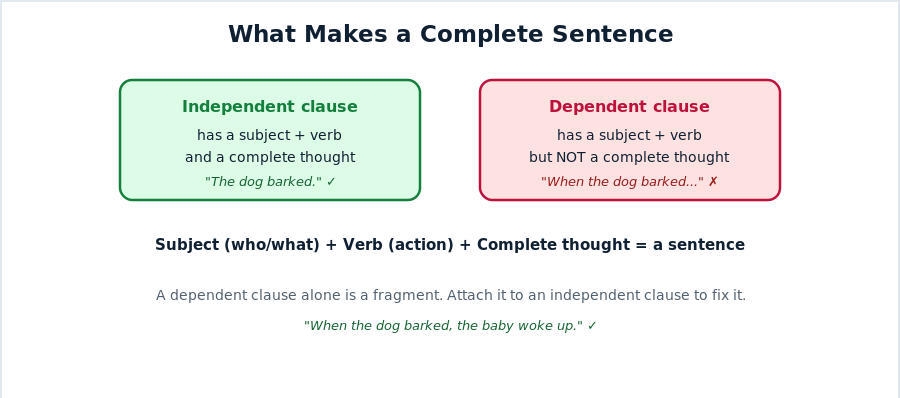
A complete sentence needs three things: a subject (who or what it is about), a verb (the action or state of being), and a complete thought that can stand on its own. A word group with all three is an independent clause; one that cannot stand alone is a dependent clause.
Subject, Verb, and a Complete Thought
To test a sentence, ask two questions: Who or what is this about? What are they doing or being? If you can answer both and the words feel finished, you have a sentence. The delivery truck stopped. That works — “truck” is the subject, “stopped” is the verb, and the thought is complete. Now look at a group missing a verb: The delivery truck near the loading dock. Your ear waits for something more, because nothing has happened yet. Add a verb and the thought closes: The delivery truck near the loading dock idled for an hour. A complete thought is the piece students forget most. Because the road was closed has a subject and a verb, yet it still cannot stand alone — it leaves you asking, “Then what?”
Independent vs. Dependent Clauses
Both kinds of clauses have a subject and a verb. The difference is whether the clause can stand alone. An independent clause expresses a complete thought: The library closed early. A dependent clause starts with a word like “because,” “although,” “when,” “if,” or “since,” and that word leaves the thought unfinished: Although the library closed early. Read it aloud and you can hear that it is only half of an idea. Wrong: Although the library closed early. That is a fragment standing on its own. Corrected: Although the library closed early, I finished my reading. Now the dependent clause leans on an independent clause, and the sentence is complete. Learning to hear that unfinished feeling is one of the most useful editing skills you can build.
Watch: A Short Video Lesson
Khan Academy gives a clear overview to go with this lesson:
A Routine for Checking Sentences
- Find the subject — who or what the sentence is about.
- Find the verb — the action or state of being.
- Ask whether the thought feels finished on its own.
- Watch for opening words like “because” or “although” that create a dependent clause.
Practice
- What three things does a complete sentence need?
- What is an independent clause?
- What is a dependent clause?
- Is “When the bell rang” a complete sentence?
- Name two words that often begin a dependent clause.
- Fix this: “Since we were late.”
Answers
- A subject, a verb, and a complete thought.
- A clause that has a subject and verb and can stand alone.
- A clause that has a subject and verb but cannot stand alone.
- No — it is a dependent clause, so it is a fragment.
- Any of: because, although, when, if, since.
- Add an independent clause: “Since we were late, we missed the opening.”
Where This Fits in Your RLA Prep
This skill is the foundation for fixing sentence fragments and run-ons and comma splices. See every topic on the Language Arts Prep Hub.
Recommended Prep Books
Keep building momentum with a full study guide and practice tests:

Related to This Article
More math articles
- The Best Grade 7 ELA Practice Tests for South Dakota Students
- National conventions
- Top 10 Tips to Overcome AFOQT Math Anxiety
- The Best Grade 8 ELA Practice Tests for North Carolina Students
- Top 10 Tips to Overcome ASTB Math Anxiety
- Preparing for the SAT or ACT? Here’s How to Stay Mentally Sharp Without Burning Out
- Standard, Formal English
- FREE 3rd Grade MAP Math Practice Test
- Romantic Nationalism in Art and Literature: Cole, Emerson and Landscape
- How to Teach Math in Elementary Grades





















What people say about "Complete Sentences and Clauses"?
No one replied yet.