Verb Tenses, Forms, and Voice
English verbs answer three questions at once: when did it happen (tense), what shape does the verb take (form), and who is doing the acting (voice). Most verb errors on tests and in real writing – resumes, care notes, emails – come from mixing up one of these three settings.
The system is smaller than it looks. Twelve tenses all come from combining three time zones with four aspects, every verb has just five forms, and voice is a single switch with two positions. Let’s take them in order.
Tense places an action in time: past, present, or future, each in simple, progressive, perfect, or perfect progressive aspect. Form is the shape of the verb itself: base, -s, -ing, past, and past participle. Voice tells whether the subject acts (active: the nurse gave the dose) or is acted upon (passive: the dose was given).
What are the five verb forms?
Every tense in English is built from five raw pieces. For a regular verb like check:
- Base: check
- Present (-s): checks
- Present participle (-ing): checking
- Past: checked
- Past participle: checked
Regular verbs share one -ed form for past and past participle. Irregular verbs split them, and that split causes most errors: go/went/gone, take/took/taken, begin/began/begun, write/wrote/written, lie/lay/lain. The rule to remember: the past form stands alone; the past participle always needs a helping verb. She went home is correct; she has went home is not, because after has you need the participle: she has gone home.
How do the twelve tenses fit together?
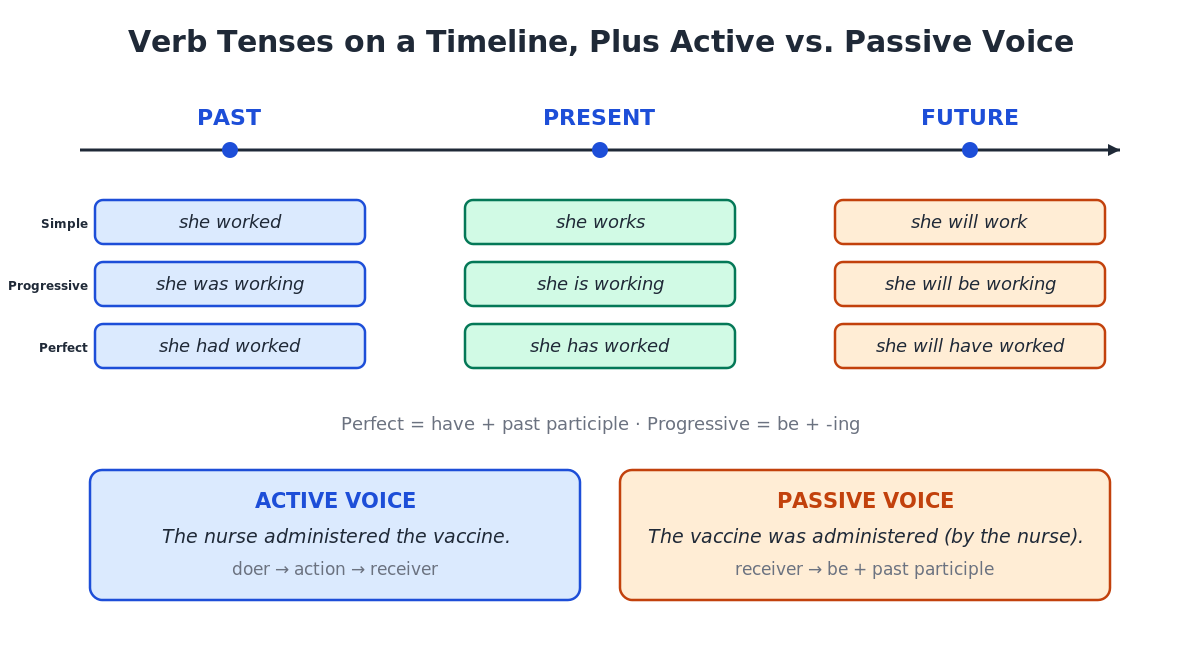
Three times (past, present, future) times four aspects (simple, progressive, perfect, perfect progressive) gives the full grid. You do not need all twelve daily, but you should recognize what each aspect signals:
- Simple – a fact or habit: She works nights. She worked nights. She will work nights.
- Progressive (be + -ing) – in progress at that moment: She is working. She was working when the alarm sounded.
- Perfect (have + past participle) – completed before another point: She has worked here for two years. She had worked a double before the storm hit.
- Perfect progressive (have been + -ing) – ongoing up to a point: She has been working since seven.
The most tested skill is not naming tenses – it is consistency. Stay in one time zone unless the meaning genuinely shifts: “The aide walked in and takes the tray” jumps from past to present for no reason; make both past. A legitimate shift looks like this: The clinic opened in 2010 and serves three counties today – the times really are different.

What is the difference between active and passive voice?
Voice is about who sits in the subject seat:
| Active voice | Passive voice | |
|---|---|---|
| Pattern | Doer + verb + receiver | Receiver + be + past participle (+ by doer) |
| Example | The nurse administered the vaccine. | The vaccine was administered by the nurse. |
| Emphasis | Who did it | What was done |
| Best when | The doer matters – most writing | The doer is unknown or unimportant – lab reports, procedures |
Passive voice is not an error. “The sample was contaminated” is exactly right when nobody knows who did it, and clinical documentation uses passive constantly for that reason. But active voice is shorter and clearer, so when a question asks for the “most effective” revision, the active version usually wins. To convert passive to active, find the real doer (often hiding in a by phrase) and promote it to subject.
One caution: not every be verb signals passive. “The patient was resting” is active (past progressive – the patient is doing the resting). Passive needs be plus a past participle acting on the subject: was moved, was given, was seen.
Watch: A Short Video Lesson
Ellii walks through this skill clearly in a few minutes. It is a helpful companion to the reading above:
What routine catches verb errors fast?
- Circle every verb phrase and its helpers.
- Check the participle rule: after have/has/had, demand a past participle (has gone, had written), never a bare past form.
- Check consistency: scan the time words (yesterday, currently, by next week) and make sure each verb matches its clue.
- Identify the voice: if the subject receives the action, it is passive – decide whether the doer deserves the subject seat instead.
- Read the sentence aloud (or subvocalize) – irregular-verb errors like had went usually sound wrong before they look wrong.
Practice: tense, form, and voice
- Fix the verb: By the time the doctor arrived, the seizure had already stop.
- Choose the correct form: She has (drank / drunk) the contrast solution.
- Fix the tense shift: The intern reviewed the labs and calls the pharmacy.
- Identify the voice: The medication error was reported within the hour.
- Rewrite in active voice: The discharge plan was explained by the case manager.
- Choose the correct tense: Next month she (works / will have worked) here for a full year.
Answers
- had already stopped – the helper had requires the past participle.
- drunk – drank is the standalone past; after has, use the participle.
- Make both past: The intern reviewed the labs and called the pharmacy.
- Passive – the subject (error) receives the action; the doer is unnamed, which is a reasonable use of passive.
- The case manager explained the discharge plan.
- will have worked – future perfect, for an action completed by a future point.
Where this fits
Verb control ties together several lessons in our English and language usage study hub. Start with the three verb jobs in action, linking, and helping verbs, then make every verb match its subject in subject-verb agreement and the harder cases in agreement in complex sentences. Since tense and voice choices are also register choices, finish with formal versus informal language.
Recommended Prep Books
These study guides and practice books help you keep building momentum as you prepare:


Related to This Article
More math articles
- 10 Most Common 6th Grade ACT Aspire Math Questions
- Top 10 4th Grade PARCC Math Practice Questions
- The Ultimate SBAC Algebra 1 Course (+FREE Worksheets)
- Geometry Puzzle – Critical Thinking 18
- The Best Algebra 1 Book for New Jersey Students
- SAT Math vs. ACT Math: the Key Differences
- How much Does It Cost to Retake the CBEST Test?
- Words for Agreement, Conflict, Power, and Law
- 7th Grade MAAP Math Worksheets: FREE & Printable
- The Ultimate SAT Math Course (+FREE Worksheets & Tests)















What people say about "Verb Tenses, Forms, and Voice: A Complete Review"?
No one replied yet.