Prohibition, Organized Crime, and the Twenty-first Amendment
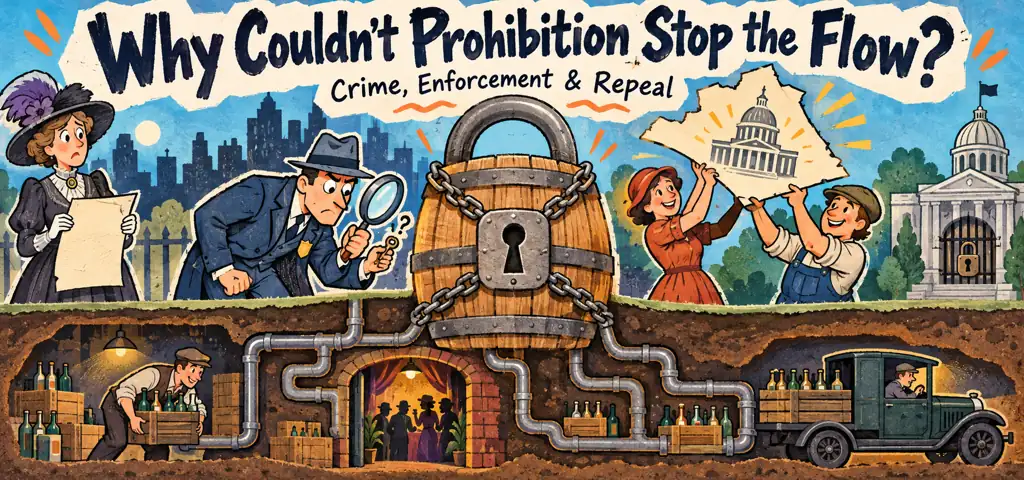
Chapter 8 of the CLEP History of the United States II study guide on Effortless Math covers Prohibition, Organized Crime, and the Twenty-first Amendment: the key terms, the core ideas, and worked examples showing how this topic is tested on the exam.
CLEP History of the United States II, Chapter 8
National prohibition completed a long political campaign
Temperance reform had roots in churches, women's activism, workplace discipline, and nineteenth-century moral reform. By the early twentieth century, the Anti-Saloon League concentrated on electing or defeating candidates according to one issue rather than building a separate party. State prohibition and wartime restrictions strengthened the dry coalition. Ratified in 1919, the Eighteenth Amendment prohibited the manufacture, sale, and transportation of intoxicating liquors for beverage purposes; it took effect in January 1920. It did not criminalize the mere drinking of alcohol.
The Volstead Act supplied definitions and machinery
The National Prohibition Act, commonly called the Volstead Act, defined intoxicating beverages, set penalties, authorized enforcement, and provided limited exceptions for medicinal, sacramental, and certain industrial uses. Congress enacted it over President Wilson's veto in 1919. The constitutional amendment created the national prohibition rule; the statute translated that rule into administration. When an item asks which instrument defined enforcement, the Volstead Act is more precise than the Eighteenth Amendment.
Concurrent power fragmented responsibility
The Eighteenth Amendment gave Congress and the states concurrent power to enforce prohibition. Federal agents worked with customs officials, the Coast Guard, prosecutors, and local police, but staffing and commitment varied. Some states adopted strict laws, while others weakened or repealed their enforcement statutes. Divided responsibility allowed each level to blame another. A national constitutional rule did not produce uniform local enforcement.
Illegal supply adapted to geography and demand
Bootleggers smuggled liquor across Canadian and Mexican borders, landed it from ships outside territorial waters, diverted industrial alcohol, operated stills, and supplied speakeasies. Households also made beer or wine. Enforcement raised the cost and risk of distribution without eliminating a large consumer market. The result differed by community and class: some drinking declined, while visible urban defiance made failure appear universal. Evidence about consumption and evidence about enforcement legitimacy answer different questions.
Organized crime expanded where protection could be sold
Illicit alcohol required capital, transportation, storage, wholesale networks, retail outlets, and protection from arrest. Criminal organizations could profit by coordinating these functions and bribing police or officials. Violence often concerned control of routes and markets. Prohibition did not invent organized crime, gambling, prostitution, or municipal corruption, but it created a large illegal commodity market whose customers did not necessarily regard purchase as morally discrediting. That combination increased profits and opportunities for corruption.
Capone became a symbol, not the whole system
Al Capone's Chicago organization gained income from beer, liquor, gambling, and other enterprises while using violence and political protection. The 1929 St. Valentine's Day Massacre, in which seven men associated with a rival gang were killed, intensified public identification of prohibition with gangster violence. Federal prosecutors ultimately convicted Capone of income-tax evasion in 1931, not of ordering the massacre. The conviction shows how government used financial records when witnesses and local enforcement were unreliable.
Enforcement also created civil-liberties conflicts
Agents conducted searches, seized vehicles, and pursued smugglers across jurisdictions. Courts had to apply Fourth Amendment rules to new forms of mobility and enforcement. In Carroll v. United States (1925), the Supreme Court recognized that officers with probable cause could search a readily mobile automobile without first obtaining a warrant. The automobile exception did not authorize suspicionless searches of every car. Prohibition helped produce lasting legal doctrine even as the policy itself lost support.
Corruption weakened the dry claim to moral order
Bribes, selective raids, political favoritism, and patronage appointments damaged enforcement agencies. The Harding administration's "Ohio Gang" scandals and local machine corruption were not all caused by prohibition, yet liquor enforcement created another valuable stream of favors. When lawbreaking becomes common among otherwise law-abiding citizens, selective enforcement can magnify inequality: those with money or connections purchase privacy, while less protected sellers and drinkers bear more risk.
Support and opposition crossed simple party lines
Rural and small-town Protestants were often dry, while many urban immigrant and Catholic communities opposed prohibition, but neither side was socially uniform. Women reformers had been central to temperance, yet Pauline Sabin organized the Women's Organization for National Prohibition Reform after deciding that the amendment encouraged hypocrisy and crime. Business groups weighed productivity against enforcement cost and tax revenue. The wet-dry divide interacted with region, religion, class, and ideas about federal power.
The Depression changed the repeal calculation
By 1929 enforcement credibility was already weak. After the economic collapse, repeal advocates added fiscal arguments: legal alcohol could create jobs and produce tax revenue, while enforcement consumed public funds. Franklin Roosevelt supported repeal in 1932. Congress proposed the Twenty-first Amendment in February 1933, and ratification was completed that December. Depression did not begin the opposition, but it altered the political weight of revenue and employment.
Repeal used an exceptional constitutional procedure
The Twenty-first Amendment repealed the Eighteenth and is the only amendment ratified by conventions in the states rather than by state legislatures. Congress selected conventions partly to bypass dry legislative districts and obtain a more direct verdict. Section 2 preserved substantial state authority over importation and distribution of liquor. Repeal ended national constitutional prohibition; it did not require every state or county to permit alcohol sales.
separate failure mechanisms
A question lists continuing demand, few agents, local resistance, bribery, and criminal consolidation.
Prohibition had mixed effects and a durable legacy
Studies disagree over exact consumption levels, but alcohol use appears to have declined sharply at first and later recovered without necessarily reaching prewar levels during the 1920s. Arrests, poisoning from unsafe liquor, and organized distribution generated new harms. The episode demonstrates that a policy can change behavior and still lose legitimacy because its costs, enforcement pattern, and promises diverge. It also left federal policing experience, search doctrine, and a continuing system of state and local alcohol regulation.
Watch the history in motion
This short lesson adds voices, images, and chronology to the ideas you just studied.
Video: U.S. Prohibition (1920-33), Simple History.
Try four CLEP-style questions
- Why did concurrent federal and state authority produce uneven prohibition enforcement?
- Jurisdictions differed in resources and commitment, producing sharply unequal enforcement.
- It required local juries nationwide to share one attitude toward alcohol and federal authority.
- It assigned every investigation to Treasury agents while states retained no related police power.
- It prevented both levels from enacting penalties, hiring officers, or defining illegal beverages.
- It made enforcement depend on constitutional conventions rather than legislatures, agencies, police, and courts.
- Why did illegal alcohol encourage larger criminal organizations?
- Illegal distribution rewarded groups coordinating capital, routes, outlets, and official protection.
- Breweries operated legally only when owners paid protection money to municipal political machines.
- The Constitution granted exclusive territorial liquor franchises to organizations led by convicted gangsters.
- The Volstead Act legalized gambling enterprises whenever their owners also distributed liquor.
- Federal agents lacked authority to investigate any alcohol transported across state lines.
- What does Capone's conviction most directly illustrate about federal enforcement?
- Federal tax investigators could prosecute local homicide because the violence supported an illegal business.
- Illegal income remained exempt from federal taxation until Congress amended the revenue laws in 1931.
- Financial charges could succeed when violent or liquor offenses were difficult to prove.
- Prosecutors used liquor possession because financial records were inadmissible in federal court.
- The tax conviction transferred prohibition enforcement from the Treasury to Chicago police.
- Which statement best describes repeal under the Twenty-first Amendment?
- It took effect through a presidential executive order rather than state ratifying conventions.
- It ended the Eighteenth Amendment but retained state alcohol-control authority.
- It preserved constitutional prohibition while reducing federal criminal penalties for possession.
- It abolished all state and local restrictions governing liquor licensing, sale, and distribution.
- It was ratified by Congress acting alone without approval from state conventions.
Check your answers and reasoning
Independent preparation. CLEP is a registered trademark of the College Board, which does not endorse this lesson.

Related to This Article
More math articles
- CLEP U.S. History I 074: Romantic Nationalism in Art and Literature
- Top 10 SSAT Upper Level Prep Books (Our 2023 Favorite Picks)
- Louisiana LEAP Grade 6 Math Free Worksheets: Free PDF Math Worksheets with Clear Answer Keys
- Top 10 4th Grade NYSE Math Practice Questions
- 5 Best Math Books for College Students: A Comprehensive Review
- 8th Grade SBAC Math FREE Sample Practice Questions
- Free Grade 6 English Worksheets for Florida Students
- 3rd Grade SC Ready Math Worksheets: FREE & Printable
- 4th Grade OSTP Math Worksheets: FREE & Printable
- Top 10 CHSPE Math Practice Questions








What people say about "Prohibition, Crime, and Repeal"?
No one replied yet.