Quotas, Eugenics, the Second Klan, and the Election of 1928
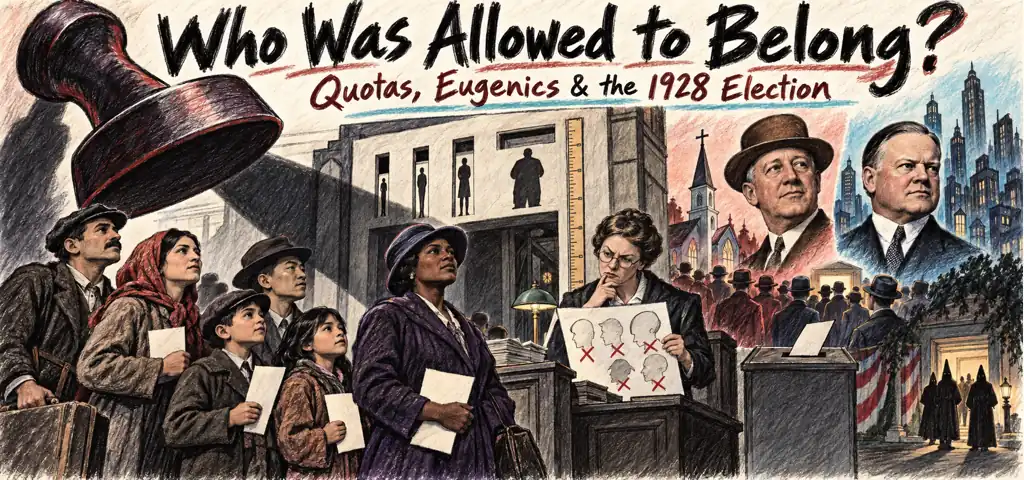
Chapter 8 of the CLEP History of the United States II study guide on Effortless Math covers Quotas, Eugenics, the Second Klan, and the Election of 1928: the key terms, the core ideas, and worked examples showing how this topic is tested on the exam.
CLEP History of the United States II, Chapter 8
Postwar restriction built on older exclusions
The 1920s quota system did not begin American nativism. Chinese exclusion, the Gentlemen's Agreement, the Immigration Restriction League, and state alien-land laws had already tied admission and citizenship to race and nationality. The Immigration Act of 1917 required most immigrants over sixteen to pass a literacy test and created an Asiatic barred zone stretching from parts of the Middle East through South and Southeast Asia. Congress enacted it over Woodrow Wilson's veto. The law broadened Asian exclusion without yet imposing a general national quota.
The Emergency Quota Act created a numerical system
The 1921 law limited immigration from a country to 3 percent of the number of foreign-born residents from that country counted in the 1910 census. It responded to postwar arrivals and fears of radicalism, labor competition, and cultural change. Because the 1910 foreign-born population included many southern and eastern Europeans, restrictionists considered the formula too permissive. Quotas did not apply uniformly to every part of the world, and the system counted ancestry through categories created by government.
The 1924 law redesigned the national hierarchy
The Johnson-Reed, or National Origins, Act set annual quotas at 2 percent of each nationality's foreign-born population in the 1890 census before a later national-origins formula took effect. Using 1890 favored northern and western European migration because it preceded much later migration from Italy, Poland, Russia, and other regions. The law also excluded aliens ineligible for citizenship, effectively barring Japanese immigration after the Supreme Court had classified Japanese immigrants outside the statutory white category for naturalization.
The Luce-Celler Act opened two narrow doors
Wartime alliance and postwar independence weakened parts of the Asian exclusion system without ending it. The Luce-Celler Act of 1946 made persons from India and the Philippines eligible for naturalization and assigned each country an annual immigration quota of one hundred. The measure did not abolish the national-origins structure, restore United States national status to Filipinos after Philippine independence, or yet extend the same naturalization change to every Asian nationality. It was a small but important break in a racial eligibility system that Congress dismantled more broadly in 1952.
Western Hemisphere migration followed a different rule
The numerical national-origins quotas did not cover countries of the Western Hemisphere. Employers in agriculture, railroads, mines, and industry continued to recruit Mexican workers, while northern mills and packinghouses also drew Black workers moving from the South. Mexicans still faced border inspection, local discrimination, and later deportation and repatriation drives. Filipinos could migrate as American nationals until the Tydings-McDuffie Act of 1934 promised Philippine independence and reclassified them as aliens subject to a tiny quota. A quota exemption never meant freedom from racialized control.
Restrictionists combined several arguments
Supporters claimed that newcomers depressed wages, crowded cities, brought disease or radical politics, and resisted assimilation. They also used intelligence tests and racial rankings to declare southern and eastern Europeans inferior. Critics such as Horace Kallen and Randolph Bourne defended cultural pluralism, arguing that democracy could include inherited cultures rather than dissolve them into a single type. Occupational skill preferences were not the organizing principle of the 1920s national-origins system.
Eugenics converted prejudice into hereditarian policy
American eugenicists asserted that intelligence, criminality, dependency, and other complex traits were largely inherited and that selective reproduction could improve the population. "Positive" eugenics encouraged those judged fit to have children; "negative" eugenics promoted marriage restrictions, institutionalization, and compulsory sterilization. The movement borrowed the authority of science while relying on biased measures and false simplifications. Environment, poverty, education, and discriminatory testing were often treated as hereditary defects.
Buck v. Bell gave sterilization constitutional protection
In Buck v. Bell (1927), the Supreme Court upheld Virginia's compulsory sterilization law in an opinion by Justice Oliver Wendell Holmes Jr. The decision accepted a flawed institutional record concerning Carrie Buck and permitted states to use procedural hearings to authorize sterilization. It did not require sterilization nationwide. The case shows how legal procedure can ratify pseudoscientific assumptions rather than test them adequately. Thousands were sterilized under state programs, with poor, disabled, institutionalized, and minority people especially vulnerable.
The second Klan nationalized a wider nativism
Revived in 1915, the Ku Klux Klan grew into a mass membership organization in the early 1920s, powerful beyond the South in states such as Indiana, Colorado, Ohio, and Oregon. It defended white Protestant supremacy and targeted Black Americans, Catholics, Jews, immigrants, and alleged moral offenders. Parades, electoral endorsements, boycotts, and local intimidation combined public respectability with violence. Prohibition enforcement offered one language for policing community boundaries.
Klan power depended on ordinary institutions
The second Klan recruited through churches, fraternal culture, paid organizers, and local politics. In Indiana, grand dragon D. C. Stephenson exerted influence over Republican officials before his 1925 conviction for abduction, rape, and second-degree murder exposed corruption and brutality. Membership declined amid scandal, factionalism, and unfulfilled promises. Its fall does not erase the fact that millions had treated its exclusions as compatible with civic respectability.
The Cable Act made citizenship independent but unequal
Since 1907 an American woman generally lost citizenship by marrying an alien. The Cable Act of 1922 made married women's nationality more independent, but an American-born woman could still lose citizenship if she married a man racially ineligible for naturalization. Later amendments removed the discrimination. The act illustrates partial change: woman suffrage strengthened claims to independent citizenship, while racial eligibility rules continued to qualify that independence.
The 1928 election joined religion, city, and prosperity
Democrat Al Smith, New York governor, Catholic, opponent of Prohibition, and child of an urban immigrant neighborhood, faced Republican Herbert Hoover. Smith's candidacy mobilized many urban ethnic voters but provoked intense anti-Catholic opposition. Hoover associated Republican rule with prosperity and defended individual initiative. He won decisively, including several traditionally Democratic southern states. The result reflected prosperity and Republican strength as well as religious and cultural conflict; anti-Catholicism alone does not explain the margin.
separate admission, citizenship, and status
A prompt compares a Mexican worker, a Japanese applicant, a Filipino national, and an American woman marrying an Asian immigrant in 1925.
Restriction outlived the decade in changing forms
Strict "likely to become a public charge" instructions helped admissions collapse during the Depression. The 1952 Immigration and Nationality Act retained national-origins quotas while ending racial bars to naturalization and adding skill and family preferences. The 1965 law later abolished the national-origins quota system. Those later changes belong to subsequent immigration history, but they clarify what the 1920s built: a durable federal hierarchy of national origin rather than a temporary pause in arrivals.
Watch the history in motion
This short lesson adds voices, images, and chronology to the ideas you just studied.
Video: Cultural & Political CONTROVERSIES in the 1920s [APUSH Review], Heimler's History.
Try four CLEP-style questions
- Why did using the 1890 census make the 1924 quota system especially restrictive toward southern and eastern Europeans?
- It preceded much of their mass migration, yielding smaller quota bases for those nationalities.
- The census excluded foreign-born residents from southern and eastern Europe who lived outside major cities.
- It counted only immigrants who had completed naturalization before the census date.
- It assigned European residents to one nationality regardless of birthplace or ancestry.
- It was the first census to include Western Hemisphere residents in national-origin totals.
- Which statement correctly distinguishes Western Hemisphere migration from Japanese immigration under the 1924 law?
- Both received equal national quotas based on the 1890 census.
- Mexican migration lay outside the numerical national-origins quotas, while the racial-eligibility provision barred Japanese immigrants.
- Japanese immigrants entered as nonquota workers, while Mexicans were barred as aliens ineligible for citizenship.
- Neither group faced inspection or other federal admission rules.
- Both could enter only through employer contracts negotiated by their governments.
- Klan candidates win local offices and members recruit through churches, lodges, parades, and newspapers. What does this evidence add to an account centered only on masked violence?
- It shows that officeholding caused the organization to abandon intimidation and ritual secrecy.
- It demonstrates that membership was restricted to appointed officials within the federal executive branch.
- It proves that one national Klan government formally owned participating churches and newspapers.
- Its public activity displaced secrecy and coercion as sources of the movement's power.
- Its influence also used civic networks and elections to normalize exclusion.
- How did eugenic reasoning strengthen immigration restriction even though quota laws regulated national origin rather than individual medical diagnosis?
- It rejected hereditary explanations and treated migration exclusively as a temporary labor-market question.
- It required immigrants to complete naturalization before physicians could conduct an admission inspection.
- It dressed population ranking and national discrimination in supposedly scientific language.
- It separated racial hierarchy from claims concerning inherited intelligence, fitness, disease, and behavior.
- It replaced national quotas with equal regional admission based on current population size.
Check your answers and reasoning
Independent preparation. CLEP is a registered trademark of the College Board, which does not endorse this lesson.

Related to This Article
More math articles
- Public appeals and the “bully pulpit”
- 4th Grade MCAS Math Practice Test Questions
- Kentucky KSA Grade 6 Math Free Worksheets: Printable Standards-Based Practice, No Signup
- Product Predictions: How to Estimate Multiplication in Word Problems
- Building Strong Body Paragraphs
- Hand Tool Care: Edges, Handles, and Storage
- Ripeness
- Negative Numbers Explained: They Aren’t as Scary as They Look
- How to Develop a Mindset for Math in 7 Steps?
- Trigonometry Books: Compare 3 Effortless Math Titles




















What people say about "Quotas, Eugenics, the Klan, and 1928"?
No one replied yet.