Interwar Diplomacy from the Washington Conference to Kellogg-Briand
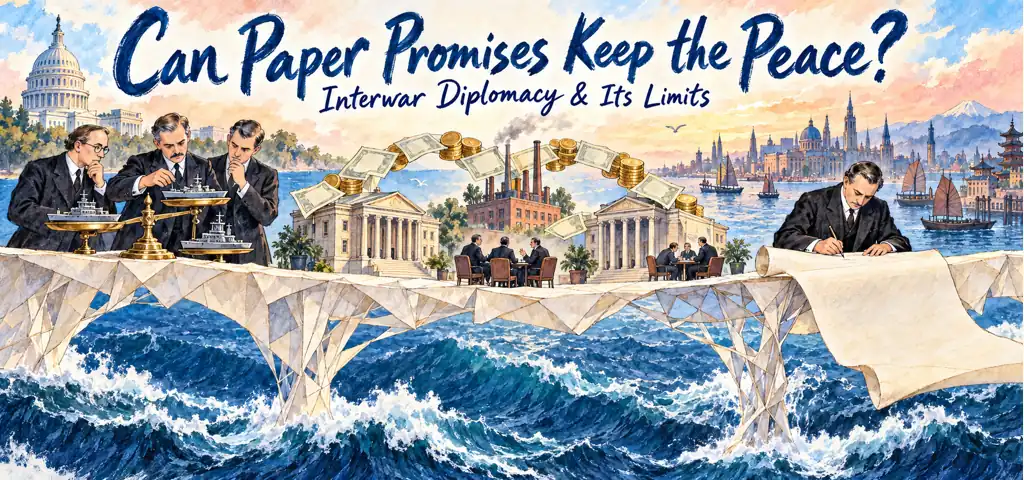
Chapter 8 of the CLEP History of the United States II study guide on Effortless Math covers Interwar Diplomacy from the Washington Conference to Kellogg-Briand: the key terms, the core ideas, and worked examples showing how this topic is tested on the exam.
CLEP History of the United States II, Chapter 8
Rejection of the League did not end engagement
The Senate's rejection of the Treaty of Versailles kept the United States outside the League of Nations, but American officials, bankers, observers, and diplomats remained deeply involved abroad. They negotiated arms limits, addressed war debts and reparations, promoted arbitration, and participated informally in international discussions. The useful distinction is between isolation from binding League membership and selective internationalism. The United States avoided some standing commitments while pursuing arrangements it believed would protect trade, stability, and peace.
Naval competition produced a negotiated pause
After World War I, the United States, Britain, and Japan faced costly naval competition and conflicting Pacific interests. Secretary of State Charles Evans Hughes opened the Washington Conference in 1921 with a dramatic proposal to scrap ships and halt construction. Three major agreements emerged. They overlapped geographically but did different work, so "the Washington treaties" is not a sufficient answer when a question asks about a specific obligation.
The Five-Power Treaty limited capital ships
The United States, Britain, Japan, France, and Italy accepted limits on capital-ship tonnage in an approximate ratio of 5:5:3:1.75:1.75, scrapped designated ships, and observed a ten-year building holiday. Restrictions on fortifying certain Pacific possessions also mattered to Japan and the Western powers. The agreement did not outlaw all war, cover every type of vessel equally, or create a general defense alliance. It was a quantified naval-limitation treaty.
London extended limits to auxiliary warships
The 1930 London Naval Treaty carried arms limitation beyond the capital ships emphasized at Washington. Britain, the United States, and Japan accepted tonnage ceilings and detailed rules for cruisers, destroyers, and submarines, while also extending the capital-ship building pause. The agreement did not give the three navies equal strength in every category, abolish submarines, or create an international enforcement agency. Its importance was narrower and concrete: diplomats placed additional classes of warships under negotiated quantitative restraint, even as disputes over ratios and Pacific security continued.
The Four-Power Treaty replaced an alliance with consultation
The United States, Britain, Japan, and France agreed to respect one another's rights in Pacific island possessions and to consult if a controversy arose. It replaced the Anglo-Japanese alliance. Consultation was not a promise of automatic military defense. That difference helped make the agreement acceptable in the United States after the League controversy: officials could claim cooperation without conceding that an international body could commit American forces.
The Nine-Power Treaty applied Open Door principles to China
Nine signatories affirmed China's sovereignty and territorial integrity and supported equal commercial opportunity. The arrangement internationalized the Open Door idea, but it lacked a strong enforcement mechanism. Its language could restrain diplomacy only if powers chose to respond to violations. A statement of principle and a sanctioning institution are different. That gap became important when Japan occupied Manchuria in the early 1930s.
War debts and reparations formed a circular problem
Allied governments owed wartime debts to the United States. Germany owed reparations to the Allies. American officials formally rejected cancellation or a simple legal linkage, yet the payment streams were economically connected: American private loans helped Germany pay reparations, and Allied governments used receipts to service American debts. French occupation of the Ruhr in 1923 after German default showed how financial claims could become a security crisis.
The Dawes Plan rescheduled payments and mobilized credit
The 1924 Dawes Plan did not cancel German reparations or settle the final total. It reorganized annual payments, helped end the Ruhr occupation, stabilized German currency and administration, and opened a large American loan. The plan eased immediate pressure by placing American capital into the payment circuit. That made recovery possible but also made European finance more dependent on continued American lending.
The Young Plan altered terms before depression overtook it
The Young Plan of 1929 reduced the overall reparations obligation, extended the payment period, and established the Bank for International Settlements. The Great Depression soon disrupted the arrangement. Hoover's 1931 moratorium paused intergovernmental payments, and the Lausanne Conference of 1932 effectively ended reparations, though the United States did not agree to cancel Allied war debts. Sequence matters: Dawes handled the immediate 1924 crisis; Young attempted a more final settlement; depression made both frameworks untenable.
Kellogg-Briand renounced war without supplying force
French foreign minister Aristide Briand first proposed a bilateral pact with the United States. Secretary of State Frank Kellogg broadened it into a multilateral treaty. In 1928 the signatories renounced war as an instrument of national policy and promised peaceful settlement of disputes. The pact contained no automatic sanctions or military enforcement. Its weakness was not that no nation signed it; many did. The problem was the distance between a legal-normative promise and machinery capable of stopping aggression.
Peace instruments rested on different mechanisms
Naval ratios reduced particular capabilities. Consultation promised discussion. Open Door language stated rules for China. Financial plans restructured payments with private credit. Arbitration treaties and the World Court sought legal settlement. Kellogg-Briand stigmatized war. Each instrument could contribute to order, but none was interchangeable with collective security. A strong answer names what behavior was constrained, which actors were covered, and what happened after violation.
identify obligation and enforcement
An item contrasts the Five-Power, Four-Power, Nine-Power, and Kellogg-Briand agreements.
The Stimson Doctrine exposed the structure's limit
After Japan seized Manchuria in 1931, Secretary of State Henry Stimson announced in January 1932 that the United States would not recognize territorial changes produced in violation of treaty obligations. Nonrecognition defended the Nine-Power and Kellogg-Briand principles but carried no immediate economic or military pressure. Japan did not withdraw. This belongs to the road-to-war story as a test of the 1920s order: legal principles survived, while enforcement remained weak.
Internationalism without the League had real reach and limits
The decade's diplomacy reduced capital-ship competition for a time, stabilized European payments temporarily, and generated widely accepted norms. It also depended on cooperation, credit, and voluntary compliance. The United States was neither sealed off nor willing to construct binding collective security. The Crash and aggression revealed how heavily the system relied on economic confidence and restraint by states whose interests diverged.
Watch the history in motion
This short lesson adds voices, images, and chronology to the ideas you just studied.
Video: Interwar Foreign Policy, Jason Thomason.
Try four CLEP-style questions
- Which obligation belonged specifically to the Four-Power Treaty?
- Maintaining fixed capital-ship ratios
- Guaranteeing China's borders with military force
- Cancelling German reparations
- Renouncing war as an instrument of national policy
- Consulting over disputes involving Pacific island possessions
- Why were American loans central to the Dawes arrangement?
- They allowed Germany to pay only in exports protected by American tariffs.
- They cancelled the principal of both reparations and war debts.
- They transferred the Ruhr permanently to American administration.
- They financed German payments that helped Allies service obligations to the United States.
- They made the League of Nations responsible for collecting American war debts.
- Why did American officials resist treating Allied war debts and German reparations as one legal obligation even though the payment streams were economically connected?
- The debts involved different parties and agreements despite economically connected payment flows.
- The Treaty of Versailles transferred all Allied obligations to Germany through its liability clause.
- German reparations were owed directly to the United States Treasury under American wartime contracts.
- The Allies had discharged their American debts before Dawes reorganized German payment schedules.
- The Four-Power Treaty prohibited governments from linking European debts to reparations or private loans.
- Which conclusion best describes American foreign policy in the 1920s?
- The United States accepted automatic defense obligations in the Pacific but not Europe.
- The Senate's treaty vote ended official contact with European and Asian governments.
- Disarmament diplomacy replaced every earlier Open Door commitment in China.
- Private American capital withdrew from Germany after the Ruhr crisis.
- Avoidance of League membership coexisted with selective arms, financial, and legal diplomacy.
Check your answers and reasoning
Independent preparation. CLEP is a registered trademark of the College Board, which does not endorse this lesson.

Related to This Article
More math articles
- Factors and Factor Pairs for 4th Grade
- Adding Fractions with Like Denominators for 4th Grade
- Peaks and Valleys: A Journey Through the Extreme Value Theorem
- Free Grade 7 English Worksheets for Texas Students
- The Best Grade 4 Math Book for Pennsylvania Students
- The Best Grade 6 ELA Practice Tests for Maine Students
- Full-Length 7th Grade GMAS Math Practice Test
- The Best Grade 6 ELA Practice Tests for Maryland Students
- Cruel and unusual punishment
- Social Class, Work, Power, and Mobility





















What people say about "Interwar Diplomacy to Kellogg-Briand"?
No one replied yet.