10 Must-Have Math Teacher Supplies
Heads up: some of the links below are affiliate links, so we may earn a small commission if you buy through them. It never costs you anything extra.
The right supplies make math teaching smoother and more hands-on, helping every student take part and letting you model ideas clearly. These are the must-have math teacher supplies for 2026, the durable, reusable items that earn their place in your classroom day after day.
Quick answer: The most useful math teacher supplies help every student take part and help you model ideas clearly. Start with a class set of dry-erase lapboards and good markers, a document camera, and a few manipulatives that fit your grade, such as ten-frames for young learners or algebra tiles for middle school. Add a planner to stay organized.
At a glance
| Product | Best for | Type | Price | |
|---|---|---|---|---|
| Magicfly Mini Whiteboards (26-pack) | Best whole-class tool | Dry-erase lapboards | $ | Check price → |
| EXPO Low-Odor Dry Erase Markers | Daily essential | Dry-erase markers | $ | Check price → |
| Giant Magnetic Ten-Frame Set | Best for number sense | Magnetic manipulative | $ | Check price → |
| IPEVO V4K Document Camera | Best for showing work | USB document camera | $$ | Check price → |
| Learning Resources Foam Dice | Best for games | Soft foam dice | $ | Check price → |
| Teacher Lesson Planner (2025-2026) | Best for organization | Dated lesson planner | $ | Check price → |
1. Magicfly Mini Whiteboards (26-pack) – Best whole-class tool
A class set of double-sided dry-erase lapboards is one of the most useful things a math teacher can own. Students work problems, hold up answers, and you see everyone’s thinking at a glance, perfect for quick checks and exit tickets.

What’s good:
- Instant whole-class checks
- Double-sided and durable
- Comes with pens and erasers
- Great for any grade
Worth knowing:
- You will refill markers over time
2. EXPO Low-Odor Dry Erase Markers – Daily essential
The classic teacher marker for a reason: EXPO low-odor markers are vivid, long-lasting, and easy on the nose during a full day at the board. A staple you’ll reach for constantly.

What’s good:
- Bold, easy-to-read colors
- Low odor
- Long-lasting
- The classroom standard
Worth knowing:
- Caps go missing, buy spares
3. Giant Magnetic Ten-Frame Set – Best for number sense
Stick this giant magnetic ten-frame on the board and number sense, addition, and subtraction suddenly become visual. A top pick for demonstrating early math concepts to the whole room.

What’s good:
- Big, board-friendly demo tool
- Builds number sense
- Magnetic counters included
- Great for K-3
Worth knowing:
- Mainly for early grades
4. IPEVO V4K Document Camera – Best for showing work
The IPEVO V4K is the document camera teachers rave about, plug it into USB and project worksheets, textbook pages, or manipulatives in sharp 8MP detail. Indispensable for modeling math problems live, in class or online.

What’s good:
- Sharp 8MP image
- Plug-and-play USB
- Flexible jointed stand
- Works in class or on Zoom
Worth knowing:
- Needs a computer to use
5. Learning Resources Foam Dice – Best for games
Quiet foam dice keep math games and probability lessons fun without the clatter of plastic. A small, cheap addition that gets a lot of classroom use.

What’s good:
- Quiet and safe
- Great for games and probability
- Cheap and durable
- Big and easy to handle
Worth knowing:
- Basic, single-purpose
6. Teacher Lesson Planner (2025-2026) – Best for organization
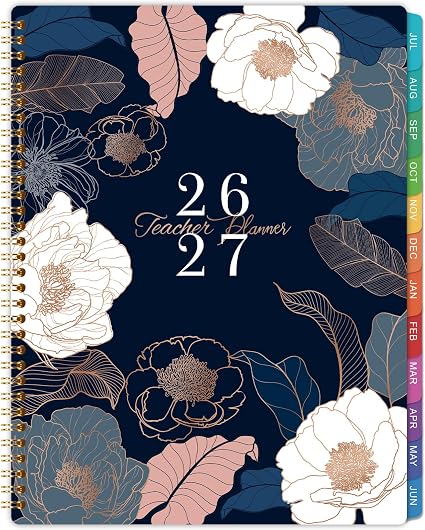
A good dated planner keeps your lessons, schedule, and to-dos in one place. This weekly-and-monthly teacher planner is a simple way to stay on top of a busy math-teaching year.
What’s good:
- Weekly and monthly layouts
- Keeps lessons organized
- Sturdy and portable
- Affordable
Worth knowing:
- Dated, so buy the current year
4 more supplies to complete your math classroom
The six picks above cover participation and modeling. These four types of supplies round out the list and work across many lessons.
7. XY-grid dry-erase boards
Lapboards with a coordinate grid printed on one side save endless time drawing axes. Students can plot points, sketch lines and compare slopes, then wipe and try again. They are useful from upper elementary through Algebra 2.
8. Fraction tiles or fraction strips
Fractions are where many students get stuck. Color-coded tiles let them see that 2/4 and 1/2 cover the same length, and why 1/3 is bigger than 1/4 even though 4 is bigger than 3. Magnetic versions are great for demonstrating on the board.
9. Algebra tiles
Algebra tiles turn expressions like x² + 3x + 2 into a rectangle students can build and take apart. They make combining like terms, solving equations and factoring feel concrete before students move to symbols only.
10. Rulers, protractors and a class set of calculators
Clear rulers and protractors are a must for geometry and measurement, and they disappear fast, so buy extras. A class set of calculators that matches what students will use on state tests lets you teach calculator skills without relying on phones.
Choose based on your grade. A second-grade room gets more from base-ten blocks and counters than from algebra tiles, while a seventh-grade room will use fraction and algebra tiles all year.
What every math teacher needs
The best math supplies do one of two things: help every student participate (lapboards, manipulatives) or help you model clearly (a document camera, a big demo manipulative). Prioritize durable, reusable items for daily use, and a few manipulatives that make abstract ideas concrete. Add a good planner to keep the year organized.
If you buy just a few things, start with a class set of Magicfly lapboards for whole-class work and an IPEVO V4K document camera for modeling problems. Add EXPO markers, a demo manipulative, and a good planner, and your math classroom is well equipped.
Math supplies by grade level
The best supplies depend on the math your students are learning. Use this table to decide what to buy first.
| Grades | Key ideas | Supplies that help most |
|---|---|---|
| K to 2 | Counting, number sense, adding and subtracting | Ten-frames, counters, base-ten blocks, foam dice, number lines |
| 3 to 5 | Place value, multiplication, fractions, area | Base-ten blocks, fraction tiles, grid paper, rulers, lapboards |
| 6 to 8 | Ratios, integers, expressions, equations, geometry | Algebra tiles, XY-grid lapboards, protractors, calculators, colored pencils |
| 9 to 12 | Functions, graphing, geometry proofs, statistics | Graphing or scientific calculators, compasses, protractors, graph paper, a document camera |
Some supplies work at every level. Lapboards, markers, dice and a document camera are just as useful in Algebra 1 as in first grade, because they support quick checks, games and clear modeling.
When you plan a new unit, ask one question: what will students hold, move or draw to understand this idea? If the answer is “nothing”, a manipulative or a lapboard activity is often the missing piece. Start with one set your whole team can share, and see how often it gets used before you buy more.
How to store and manage shared math supplies
Supplies only help if students can find them quickly and they come back complete. A few simple routines keep things running.
- Make a bin for each table group. Put lapboards, markers, erasers, a ruler and a small bag of counters or tiles in each one. One student per group gets the bin and returns it.
- Label everything with words and a picture. Younger students can match the picture, and everyone puts things back faster.
- Count sets at the end of class. Number the bags or bins. A ten-second count before the bell stops pieces from walking away.
- Test markers on Fridays. Toss dry ones and refill bins so Monday’s warm-up doesn’t stall.
- Teach a routine for manipulatives. Give two minutes of free exploration the first time, then set clear rules for using them as tools, not toys.
- Clean shared items regularly. Wipe boards and wash foam or plastic pieces at the end of each unit.
On a budget? Start with the items students use every day, such as lapboards and markers, and add one manipulative set per term. Ask your school or parent group about classroom funds, and check whether colleagues have sets they rarely use. Shared supplies stretch further when grade-level teams plan units together.
Frequently asked questions
What supplies does a math teacher need most?
A class set of dry-erase lapboards (for whole-class checks), reliable markers, a document camera for modeling problems, and a few key manipulatives. Together they cover participation and clear instruction, the two things that matter most.
Is a document camera worth it for math?
Yes. A document camera like the IPEVO V4K lets you project worksheets, textbook pages, and manipulatives in sharp detail, so students see exactly how to work a problem, in class or on a video call.
What’s the best way to check whole-class understanding?
Dry-erase lapboards. Students solve a problem and hold up their boards, and you instantly see who’s got it and who needs help, far faster than collecting papers.
What math supplies do middle school teachers need?
Middle school math teachers get the most use from dry-erase lapboards with an XY grid, algebra tiles, fraction tiles, protractors, rulers and a class set of calculators. A document camera helps you model equations and student work. Foam dice and playing cards are cheap extras for probability and integer games. Add graph paper and colored pencils for graphing and geometry.
What math manipulatives should every classroom have?
Most classrooms benefit from a core set: counters, base-ten blocks, fraction tiles, dice and a number line. Middle and high school rooms should add algebra tiles and geometry tools such as protractors and compasses. Choose manipulatives that match the ideas you teach most often, and buy enough for small groups to share rather than one display set.
What should be on a math school supply list for students?
A simple student list for math usually includes pencils, erasers, a ruler, graph paper or a graph-ruled notebook, a folder for worksheets and a calculator if your school requires one. Middle and high school students may also need a protractor and compass. Check the teacher’s list first, since many classrooms provide shared manipulatives and lapboards.
How can teachers get math supplies on a budget?
Buy the everyday items first, such as lapboards and markers, and add one manipulative set each term. Share sets with your grade-level team, ask your school or parent group about classroom funds, and look for supplies colleagues no longer use. Many manipulatives can also be made from paper templates or household items like beans, buttons and playing cards.

Related to This Article
More math articles
- 4th Grade English Worksheets for Utah (RISE): 57 Free Printable PDFs
- Characteristics and Organization of Life
- FTCE General Knowledge Math Formulas
- The Significance of the Unit Circle in Trigonometric Functions
- Louisiana Grade 2 Math Worksheets — Free Printable PDFs
- Joint committees
- Gay Liberation and Disability Rights: Organizing and Access
- Individual contributions
- 8th Grade PSSA Math Worksheets: FREE & Printable
- Federalists and Anti-Federalists










What people say about "Math Teacher Supplies: 10 Must-Haves for Your Classroom"?
No one replied yet.