Fordism, Consumer Credit, and Weakness beneath the Boom
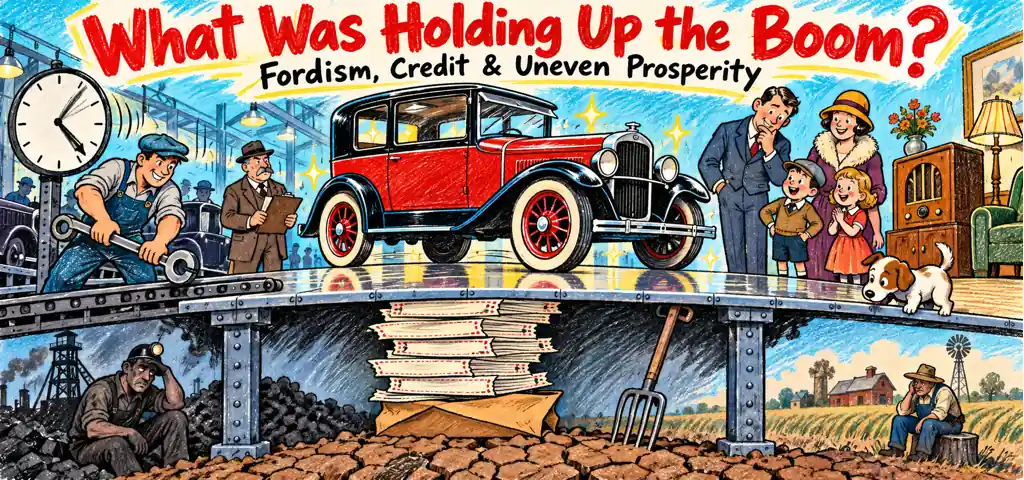
Chapter 8 of the CLEP History of the United States II study guide on Effortless Math covers Fordism, Consumer Credit, and Weakness beneath the Boom: the key terms, the core ideas, and worked examples showing how this topic is tested on the exam.
CLEP History of the United States II, Chapter 8
A cheaper car represented a production system
The Ford Model T's price fell from about $850 in 1908 to under $300 by the mid-1920s. The moving assembly line, introduced at Highland Park in 1913, sharply reduced the labor time needed per car. Standardized parts, specialized machinery, huge output, and vertical integration lowered unit costs. "Fordism" names this linked system of mass production and a mass market. It does not mean Henry Ford invented every element, nor that all industries could standardize products as completely as automobiles.
The five-dollar day joined efficiency to control
Ford announced a five-dollar daily wage in 1914 for qualifying workers, more than many competitors paid. Higher pay helped reduce costly turnover and made workers potential consumers. Eligibility initially came with intrusive investigation by the company's Sociological Department, and the exhausting pace of assembly work remained. Fordism therefore combined higher wages for some workers with managerial control and repetitive labor. It was not simply generosity or a general national minimum wage.
General Motors sold difference as well as volume
Under Alfred P. Sloan, General Motors organized semi-autonomous divisions around a graded ladder of models, from Chevrolet upward, while coordinating finance and policy centrally. Annual model changes encouraged replacement. Ford long emphasized one durable, inexpensive car in immense volume; GM offered "a car for every purse and purpose." Both used mass production. Their difference lay in product variety, decentralized divisional management, and marketing strategy, not in one firm using machines while the other relied on craft production.
Installment credit moved demand forward in time
Automobiles, radios, refrigerators, and furniture cost more than many households could pay at once. Installment plans required a down payment followed by regular payments, allowing buyers to use future income for present consumption. Credit enlarged the market for durable goods and made monthly obligations a normal part of household budgeting. It did not create income. A family that lost wages still owed the payments, so credit expanded both purchasing power and vulnerability.
Advertising made wants legible and repeatable
National magazines, billboards, chain stores, and commercial radio linked producers to mass audiences. Advertising increasingly associated goods with status, youth, health, efficiency, or personal fulfillment. Bruce Barton's The Man Nobody Knows presented Jesus as an energetic organizer and executive, blending religious language with business ideals. Such messages did not prove that consumers were passive. They show how corporations sold meanings and identities along with objects.
Distribution systems reinforced scale
Chains such as A&P and Woolworth bought large quantities, dealt directly with producers, standardized stores, and spread management and advertising costs across many outlets. Mail-order firms and department stores had already expanded markets before the war; chains intensified centralized purchasing. Independent merchants protested unfair competition and promoted chain-store taxes. Low price came from purchasing and organizational scale, not a general exemption from law or possession of a secret manufacturing process.
Welfare capitalism sought loyalty without unions
Large employers offered pensions, stock plans, recreation, cafeterias, safety programs, company magazines, or employee representation plans. Managers hoped benefits would reduce turnover and weaken independent unions. These programs were discretionary and often tied workers' savings or representation to the employer. A company union was not a contract bargained by an independent national union. Welfare capitalism could improve conditions while leaving the employer with decisive control.
Productivity gains were distributed unevenly
Manufacturing output and labor productivity rose, but union membership fell after the postwar strike defeats. Real wages improved for many industrial workers, yet gains varied by occupation, race, sex, and region. Domestic and agricultural labor remained outside the most celebrated corporate arrangements. Mechanized industry could raise total production while displacing skills or workers. Aggregate prosperity therefore cannot establish that every household gained in the same way.
Agriculture entered depression before the nation did
European wartime demand and high prices had encouraged American farmers to borrow for land and machinery. After European production recovered, crop prices fell sharply. The index of prices farmers received dropped faster than many costs they paid, weakening purchasing power. Increased productivity could worsen the problem when more output entered an already glutted market. Farm distress was not caused chiefly by the 1929 stock crash; it was a persistent weakness throughout much of the decade.
Old industries and new construction moved differently
Automobiles, electrical goods, chemicals, and residential construction helped lead growth. Coal mining, railroads, and New England textiles faced excess capacity, new competitors, or shifting energy and location patterns. Housing construction peaked before the decade ended. A boom can therefore contain declining sectors and turn before its most famous financial break. Sectoral timing is evidence against explaining the 1930s collapse with a single October event.
Finance multiplied control and risk
Utility promoter Samuel Insull built pyramids of holding companies in which a relatively small investment at the top controlled much larger operating assets below. Borrowed funds and layered ownership could magnify returns while revenues grew. They also made the structure fragile when earnings or security prices fell. The pyramid did not guarantee rates or eliminate state commissions. It separated the amount of control exercised from the equity actually at risk near the top.
test a prosperity claim
Suppose an item cites rising factory output, more installment purchases, falling farm purchasing power, and declining union membership.
The 1920-1921 contraction warns against simple analogy
Wholesale prices fell dramatically in 1920-1921, yet output recovered quickly by 1922. The later Great Depression involved a much longer collapse of spending, banking, employment, and prices. The contrast shows that a sharp initial decline does not determine a downturn's duration. Institutions, debt, policy, and feedback effects matter. By 1929, consumer obligations, weak farm income, unequal purchasing power, construction slowdown, and leveraged finance did not make catastrophe inevitable, but they reduced resilience when shocks arrived.
Watch the history in motion
This short lesson adds voices, images, and chronology to the ideas you just studied.
Video: Why the 1920s Were SO PROSPEROUS [APUSH Review], Heimler's History.
Try four CLEP-style questions
- A company offers pensions, recreation, and employee representation but keeps final control of benefits and rejects independent unions. What purpose best explains this arrangement?
- It promotes loyalty and retention while preserving managerial control and discouraging independent organization.
- It creates an industrywide collective-bargaining contract administered and enforced by a federal labor board.
- It replaces managerial authority with elected worker control of investment and production schedules.
- It guarantees that every benefit remains legally vested during a decline in company sales.
- It transfers company ownership to employees through compulsory stock voting and profit distribution.
- Why could installment buying enlarge both demand and household vulnerability?
- It replaced monthly obligations with wage deductions collected only during periods of prosperity.
- It transferred legal title of financed durable goods to the federal government until final payment.
- It prohibited lenders and retailers from repossessing goods after repeated missed payments.
- It let buyers use future income but left fixed payments when earnings fell.
- It reduced retail prices by eliminating advertising, distribution, and fixed production costs.
- Automobile, electrical, and construction firms expand while coal and textile districts lose jobs or investment. What conclusion best fits the pattern?
- Declining regions transferred workers and capital to new industries without substantial adjustment costs.
- Aggregate prosperity could coexist with decline where demand and technology shifted unevenly.
- Industrial decline occurred chiefly where agriculture rather than manufacturing dominated employment.
- New consumer sectors ended regional dependence on older industries and inherited capital stocks.
- Productivity growth moved displaced workers directly into expanding consumer industries at comparable wages.
- A small amount of equity at the top of several holding companies controls a much larger set of operating utilities. What risk follows most directly?
- State rate regulation becomes stronger as ownership is concentrated in a distant parent company.
- Subsidiaries must distribute part of each dividend directly to utility customers rather than shareholders.
- Insolvency disperses voting control among utility customers rather than among creditors and investors.
- Parent-company dividends are senior to subsidiary debts, insulating the control layer from operating losses.
- Losses below can rapidly undermine a highly leveraged chain of control.
Check your answers and reasoning
Independent preparation. CLEP is a registered trademark of the College Board, which does not endorse this lesson.

Related to This Article
More math articles
- The Best Grade 4 Math Book for Maryland Students
- Framing
- 5 Best Programmable Calculators
- Congruent Figures: Complete Guide with Video and Examples
- Managing Math Fear as an Adult
- Single-Skill Grade 3 Math for New York (NYSTP): 49 Free Practice PDFs, No Signup
- FTCE Math Practice Test Questions
- Full-Length 8th Grade ACT Aspire Math Practice Test-Answers and Explanations
- Louisiana LEAP Grade 3 Math: 49 Free Single-Page Printables, One Skill Each, Answer Keys Included
- Free Grade 4 English Worksheets for Georgia Students




















What people say about "Fordism, Credit, and Weakness in the Boom"?
No one replied yet.