Republican Governance, Tax Policy, and Normalcy
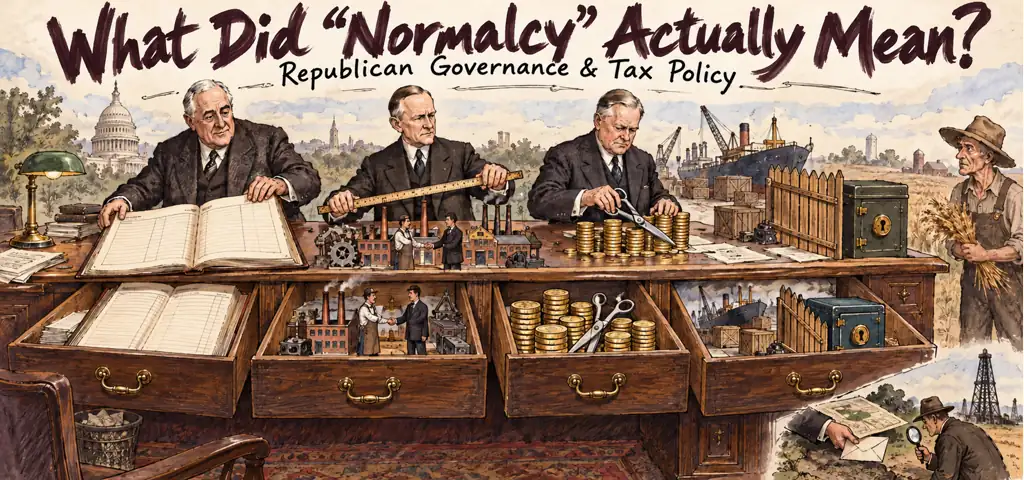
Chapter 8 of the CLEP History of the United States II study guide on Effortless Math covers Republican Governance, Tax Policy, and Normalcy: the key terms, the core ideas, and worked examples showing how this topic is tested on the exam.
CLEP History of the United States II, Chapter 8
Normalcy promised distance from wartime strain
Warren G. Harding's 1920 call for "normalcy" answered exhaustion after war, inflation, strikes, raids, and the League fight. It did not promise to erase government. Harding proposed a different use of it: remove wartime controls, reduce taxes and debt, protect domestic producers, and rely on business expertise and voluntary cooperation. Republicans won the presidency and large congressional majorities. Their victory joined public reaction against the Wilson years to a positive faith that private enterprise, stable budgets, and administrative order could restore prosperity.
Budget reform strengthened executive management
The Budget and Accounting Act of 1921 required the president to submit a unified federal budget, created the Bureau of the Budget in the executive branch, and established the General Accounting Office under the comptroller general to audit spending for Congress. The law reduced the older practice in which departments sent separate requests directly to congressional committees. A pro-business era could therefore enlarge presidential coordination even while its leaders spoke of economy. Lower spending and stronger management were compatible aims.
Mellon shifted the federal tax mix
Treasury Secretary Andrew Mellon argued that very high wartime tax rates discouraged investment and produced less revenue than lower rates would. Revenue acts in the 1920s cut the top individual income-tax rate in stages, from wartime heights to 25 percent by 1925. Congress did not simply enact every Mellon proposal: it retained estate taxes and adopted a gift tax in 1924 before repealing that gift tax two years later. Federal revenue also depended less on progressive income taxation and more on consumption taxes and tariffs than wartime arrangements had suggested.
Tariffs protected producers but complicated recovery
The Fordney-McCumber Tariff of 1922 raised duties on many imports and authorized presidential adjustment of rates after investigation. Protection pleased manufacturers and agricultural interests facing foreign competition. Yet European governments needed export earnings to obtain dollars for American war-debt payments, while American producers wanted overseas customers. High barriers therefore exposed a tension: the United States could be a creditor and exporter while restricting the foreign sales that helped other countries earn dollars. Tariff policy and debt diplomacy cannot be analyzed separately.
Associationalism offered coordination without command
Commerce Secretary Herbert Hoover promoted "associationalism": trade associations, technical experts, local governments, and federal agencies would share information and set voluntary standards. The department helped standardize products, encouraged data collection, and convened industries. Hoover treated competition as wasteful when firms used incompatible sizes or duplicated effort, but he resisted routine federal ownership and detailed compulsion. This was activist administration in service of voluntary cooperation, not a return to a government that merely watched from the sidelines.
Harding's circle mixed ability and patronage
Harding appointed respected officials such as Mellon, Hoover, and Secretary of State Charles Evans Hughes. He also placed old political associates in positions of trust. Some members of the so-called Ohio Gang exploited access, while other scandals involved officials outside that informal circle. The analytical point is not that every Harding appointee was corrupt. It is that personal loyalty and weak supervision created opportunities that professional administration was supposed to prevent. Cabinet quality varied sharply inside the same presidency.
Teapot Dome revealed a lease-for-bribes scheme
Naval petroleum reserves at Teapot Dome, Wyoming, and Elk Hills, California, had been set aside for emergencies. Interior Secretary Albert B. Fall obtained control of them and leased them without competitive bidding to oilmen Harry Sinclair and Edward Doheny. Fall secretly received loans and gifts. A Senate investigation led by Thomas Walsh traced the transactions; Fall was later convicted of accepting a bribe. The scandal concerned corrupt transfer of public resources, not proof that every private lease or conservation policy was unlawful.
Coolidge separated limited government from no government
Calvin Coolidge succeeded Harding in August 1923 and won election in 1924. He favored budget restraint, tax reduction, protective tariffs, and a friendly climate for business. He also accepted federal institutions already built, enforced antitrust law selectively, and supported regulatory commissions. Coolidge's restraint was comparative: he rejected ambitious federal management of prices and production, especially proposals to buy farm surpluses, but he did not dismantle the modern administrative state.
Farm policy exposed the coalition's limits
Agriculture did not share fully in urban-industrial prosperity. The McNary-Haugen bills proposed a federal corporation that would buy selected farm products at prices tied to prewar purchasing power, sell surpluses abroad, and charge participating producers for losses. Coolidge vetoed the measure in 1927 and 1928, arguing that price fixing and government buying would encourage overproduction. The veto clarified whose risks the administration would socialize: it supported tariffs and business coordination but resisted a permanent federal guarantee for farm prices.
La Follette tested discontent in 1924
Wisconsin senator Robert La Follette ran for president in 1924 with Progressive support, organized labor, socialists, and many farm reformers. He attacked monopoly, demanded public control of utilities and railroads, defended civil liberties, and proposed stronger congressional power over federal courts. He won Wisconsin and finished third nationally. Theodore Roosevelt's Progressive campaign in 1912 had finished second and carried six states; La Follette carried one. The comparison shows that progressive discontent survived without recreating the broader 1912 rupture in the Republican Party.
classify government activity
A question describes unified budgeting, voluntary industry standards, lower tax rates, and the Teapot Dome leases.
Hoover extended the decade's governing creed
In 1928 Hoover defended "rugged individualism" against what he portrayed as European state direction. He credited private initiative, voluntary association, and equal opportunity for American growth. This did not contradict his energetic Commerce Department. He believed government should collect knowledge, coordinate, and stabilize conditions without routinely owning enterprise or guaranteeing outcomes. The era's central question was therefore where public capacity should stop, not whether it existed. The Depression would test that boundary far more severely.
Watch the history in motion
This short lesson adds voices, images, and chronology to the ideas you just studied.
Video: 3.1 – 1920s Politics and Economy, Zach Baer.
Try four CLEP-style questions
- Which development best illustrates that Republican economy in government could strengthen presidential administration?
- Federal purchase and overseas resale of farm surpluses under McNary-Haugen
- Transfer of regulatory commissions to privately governed trade associations without continuing federal oversight
- Abolition of congressional audits and executive reporting on annual federal expenditures
- Creation of a unified executive budget under the Budget and Accounting Act
- Nationalization of the railroads after private wartime operation had formally ended
- Why did protective tariffs create a problem for the United States as a creditor nation?
- They forced American banks to cancel every private loan previously issued to European borrowers.
- They required European governments to repay debts in their own currencies under fixed exchange rules.
- They reduced opportunities for foreign producers to earn the dollars needed for debt payments.
- They transferred tariff-setting authority from Congress to the League of Nations and creditor committees.
- They prohibited American manufacturers from selling finished goods in any foreign market.
- Which comparison between Hoover's associationalism and Coolidge's McNary-Haugen veto is most accurate?
- Both required federal purchase and overseas resale of agricultural surpluses through mandatory fees.
- Associationalism coordinated voluntary private action, while the veto rejected a continuing federal price-support mechanism.
- Associationalism transferred business ownership and production schedules to permanent federal planning agencies.
- Both denied federal agencies any role in collecting, publishing, or interpreting economic information.
- The veto ended protective tariffs on farm goods, while associationalism restored those duties.
- What most clearly made Teapot Dome a corruption scandal rather than merely a disagreement over resource policy?
- Congress had prohibited creating petroleum reserves for later naval use during emergencies.
- Oil companies were constitutionally barred from leasing or developing any federally owned land.
- The Navy had exhausted the reserves and begun commercial extraction before the disputed leases.
- The leases followed an open competitive auction with publicly disclosed bids and terms.
- Fall secretly received valuable loans and gifts from beneficiaries of the leases.
Check your answers and reasoning
Independent preparation. CLEP is a registered trademark of the College Board, which does not endorse this lesson.

Related to This Article
More math articles
- Geometry Puzzle – Challenge 70
- 10 Most Common 7th Grade STAAR Math Questions
- PERT Math FREE Sample Practice Questions
- Your Quick Guide to the Best Tablets for Teachers
- Chapter 6: Federalism
- 4th Grade Scantron Math Worksheets: FREE & Printable
- Best Calculators for the PSAT 10 Math Test
- Family
- How to Construct the Incircle of a Triangle
- STAAR Math 2026: A Texas Parent’s Complete Survival Guide (Grades 3–8)















What people say about "Republican Governance, Taxes, and Normalcy"?
No one replied yet.