CPA FAR Blueprint: What to Recheck in a Course (2027 Prep)
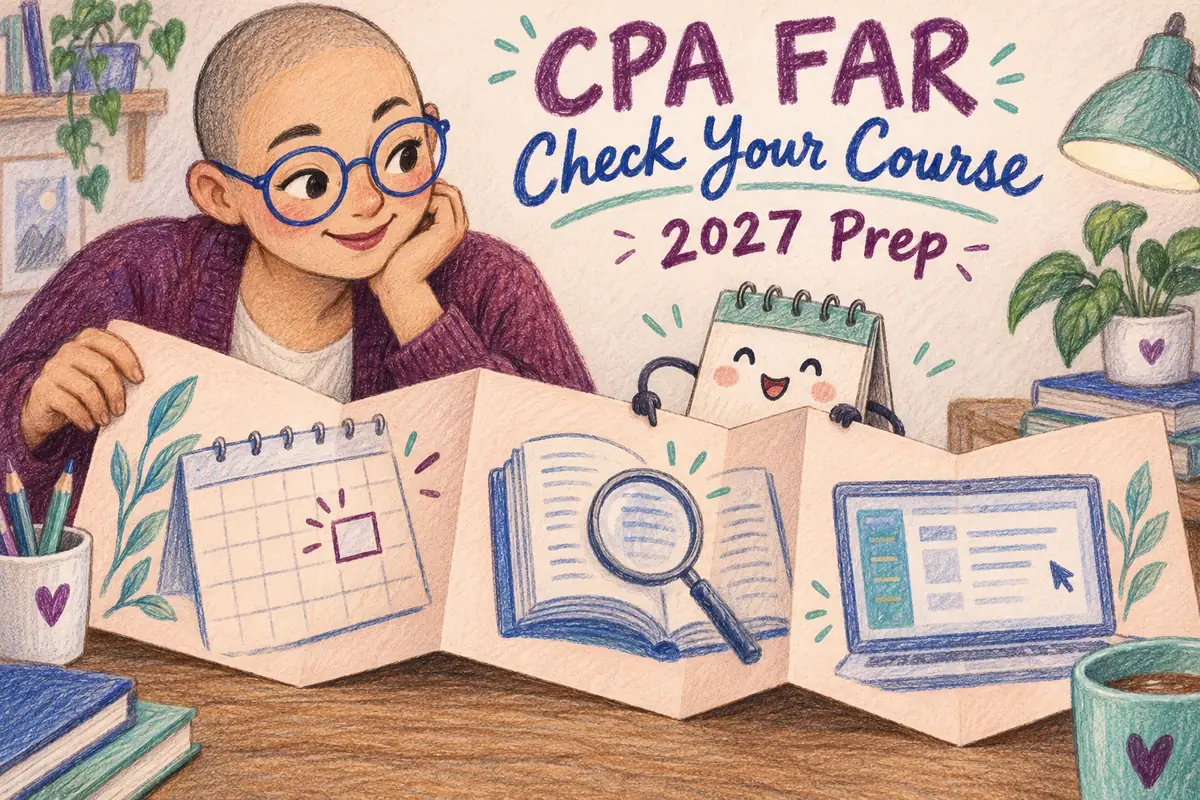
Your FAR course says it is updated, but the book on your desk still carries an earlier year. Can you keep using it for an exam planned in 2027?
Start with your testing date. Then check the specific course version, its update notes and the materials actually available in your account. A new cover year alone cannot establish that an older lesson has been corrected.
This guide provides an original evidence record for that check, using a fictional learner whose printed book and online course disagree. It helps you identify what is confirmed and what still needs an answer, without pretending a general checklist is a verified list of FAR topic changes.
Match the blueprint to the exam date
The AICPA exam-content page currently lists blueprints effective January 1, 2026 and January 1, 2027, plus a summary of changes effective January 1, 2027. For a planned February 2027 exam, begin with the version effective January 1, 2027 and confirm the current listing again before testing.
Record the effective date. The date you purchased a course, printed a book or started studying does not choose the blueprint for your later appointment. If the appointment changes, reopen this part of the record.
The same page describes blueprint contents. It also publishes the policy for testing new pronouncements, so check dated course updates alongside the annual label when assessing which material applies to your appointment.
Keep the scope clear. This article verifies the public HTML listing and explains a course-checking process. It does not provide a topic-by-topic comparison of the linked blueprint files, so it cannot certify which individual FAR objectives changed.
Keep content evidence separate from interface news
The AICPA platform announcement describes a planned July 2027 delivery-platform transition, with target testing unavailability July 1-11 and resumption July 12. It also describes an adjusted score-release schedule for 12 months after launch. These are current targets, not a promise about future appointment availability.
Treat that as a separate record. A news item about navigation or screen layout cannot show whether your particular accounting lesson matches the applicable content requirements. Likewise, an updated chapter does not establish that a practice interface matches a future platform.
For the course audit, label the issue. Use content coverage for the lesson and update evidence, interface practice for screen-related familiarity, and scheduling for appointment constraints. This prevents a reassuring answer about one issue from closing an unanswered question about another.
Recheck official guidance near your appointment. This lesson does not reproduce a full testing calendar, predict how difficult the new interface will feel or recommend moving an exam solely to avoid a platform change.
Create one record for the materials you actually use
Dani has four study resources. In our original fictional case, they are a printed FAR book purchased in 2026, downloaded lecture notes, an online FAR lesson and an online question bank. The tentative exam date is February 18, 2027, subject to authorization and availability. No appointment is booked in this example, and the unnamed provider is fictional.
Name each resource separately. An account banner saying updated does not tell Dani which printed pages need replacing or whether the downloaded notes are the same revision as the online lesson. Mixing these resources into a single course-version field would hide that uncertainty.
Dani creates a row for the printed chapter. Another row covers the corresponding online lesson and its update notice, while a third covers the question bank's explanation revision. Each row keeps the source location, date checked and unresolved question together.
Give a correction a destination. If an update note identifies a changed explanation, record the exact chapter, lesson or local page label where Dani will use the correction. A saved notice that never reaches the study materials leaves the old explanation available for reuse.
Read a provider claim at the level it supports
Dani's fictional provider notice, dated October 9, says its online FAR lessons target exams from January 1, 2027. It also says printed-book corrections are available, but Dani cannot locate the correction list for the book edition on the desk.
That notice answers one question. It identifies the online product's stated target period. It does not establish that Dani has opened the right lesson revision, installed an available update or found every correction for the printed edition.
Leave the book row unresolved. Dani needs the matching correction list or a specific provider answer identifying the applicable edition and affected pages. The article's table records that missing evidence without inventing a changed topic.
The question-bank row remains separate. Dani can see a revision label but has no dated explanation of what the label means. Until the provider connects it to the target period or relevant update, the row records a visible version label and an open applicability question.
| Resource or check | Evidence in the fictional case | Narrow audit result |
|---|---|---|
| Exam version | Public listing: effective January 1, 2027 | Confirmed listing, not objective comparison |
| Online lesson | Provider target-period notice | Needs actual lesson-version check |
| Printed book | Matching correction list not found | Needs clarification |
| Question bank | Revision label without target-period explanation | Needs clarification |
| Offline notes | Saved file has no revision information | Needs clarification |
| Interface planning | Official July transition announcement | Separate from content applicability |
Use evidence states without converting them into a pass score
The record allows three local audit states. Confirmed means the stated evidence supports the narrow claim in that row, needs clarification means an applicability detail remains missing, and unavailable means the required item cannot currently be accessed.
These are organizational labels. They are not AICPA categories, an assessment of the provider's overall quality or a prediction of Dani's exam result. A confirmed row can still require study, and an unresolved row can concern a small correction.
Count the open questions if useful. Do not turn the fraction of confirmed rows into a percentage of blueprint coverage, because the rows differ in scope and were selected for this example. Four confirmed records out of six would describe record status only.
Keep the question specific. Ask which edition a correction list serves, where the replacement explanation appears and which exam-effective period the provider intends. A response that merely repeats current or updated should leave the applicability field open.
Decide what to study while a correction is unresolved
Dani can continue work on a clearly identified resource while investigating the printed-book correction list. The unresolved row should point to the affected material and the next evidence needed, rather than shutting down every study session.
Avoid guessing the correction. If a notice supplies no changed topic or replacement explanation, Dani cannot infer one from a newer cover, a social post or another provider's chapter numbering. A guessed update could make an accurate passage wrong.
Set aside the disputed passage. Use the provider's currently identified explanation or an applicable authoritative reference once its relevance is established, and retain the question beside the older material until there is enough evidence to resolve it.
Record the learning issue separately. Even after a version question is settled, Dani may need another explanation of a journal entry or calculation. A current resource and a well-understood concept are different observations, both useful in planning the next session.
Check access and update delivery before paying again
An older printed book does not by itself establish that the whole course must be replaced. First identify the missing correction and the update access included with your actual purchase, using the provider's terms and account details.
Make the access question concrete. Can you retrieve the correction for your edition, open the revised lesson and keep using it through your intended study period? An update promise is difficult to use if the relevant account access has already expired.
Check each format you rely on. A corrected online explanation may coexist with an older offline download or app copy, so compare their visible revision information where available. Do not assume that refreshing one resource updates every saved file.
Keep a dated access note. This article does not verify any provider's subscription terms or recommend a purchase. The purpose is to establish the missing item and available remedy before making a spending decision.
Use the worked record to ask a useful question
Download the worked course-audit record (CSV) for Dani's six original audit rows, including the unresolved printed-book and question-bank checks. The blank course-audit record (CSV) gives you fields for your own resource, effective period, evidence location, status and next action.
Use your resource's own labels. Our fictional version names are placeholders for the teaching example, not actual provider releases or a mapping to official FAR objectives. Keep confidential account information out of anything you share publicly.
Dani's next request is precise. For the printed FAR book edition shown in the purchase record, where is the correction list supporting exams from January 1, 2027, and how should it be applied to the printed pages? A useful answer should identify the edition and location.
Save the response beside that row. Then check the material it names, record what changed in your study copy and retain the earlier uncertainty in the audit history. A support reply becomes useful evidence when it connects to the resource you will actually use.
Reopen the record when a relevant fact changes
Revisit the audit after an appointment change, a provider update notice, a new official listing or a change in access. You can keep studying between those events while leaving a clear route back to the unanswered resource checks.
Use the CPA FAR Online Center for additional original FAR practice and feedback, and use the official links above to verify current exam guidance. This course-audit record does not reproduce official test items, certify a complete objective comparison or replace the governing requirements.
Before your next session, choose one unresolved row. Write the missing evidence in plain language and identify where you will look for it, such as the edition-specific correction list in your provider account. Keep the correction beside the page or lesson it changes.
2027 preparation edition. Public HTML sources checked October 11, 2026. Dani, provider notice, version labels and audit records are original fictional teaching material. No linked blueprint PDF or test contents were inspected. This is a source-applicability and course-evidence process, not a verified objective-change list, complete blueprint crosswalk, provider certification or outcome prediction. Future platform dates are targets subject to change. Cover is conceptual art.

Related to This Article
More math articles
- Top 10 TASC Math Prep Books (Our 2023 Favorite Picks)
- Volume of Cubes
- Reliability, Validity, and Bias
- Grade 2 Math Practice for Hawaii Second Graders
- What “Provably Fair” Actually Proves (And What It Doesn’t)
- Free Grade 5 Math Worksheet Library for Florida (FAST): 48 Printable Skill Pages
- How to Complete the Square: Step-by-Step Guide With Examples for 2026
- 49 Printable Tennessee TCAP Grade 3 Math Worksheets — Free Download with Step-by-Step Keys
- Converting Units of Length (Metric) for 4th Grade
- Oregon OSAS Grade 6 Math Free Worksheets: Printable Grade 6 Math Practice with Answer Keys





What people say about "CPA FAR Blueprint: What to Recheck in a Course (2027 Prep)"?
No one replied yet.