Uniform CPA Exam · AUD, FAR, REG + Discipline
CPA Exam Practice Test & Study Guide: Core and Discipline Sections
Start with the section you are preparing for. The CPA Exam has three required core sections and three discipline choices. You take AUD, FAR and REG, then choose one of BAR, ISC or TCP. This hub explains the six options and connects you with the study tools currently available.
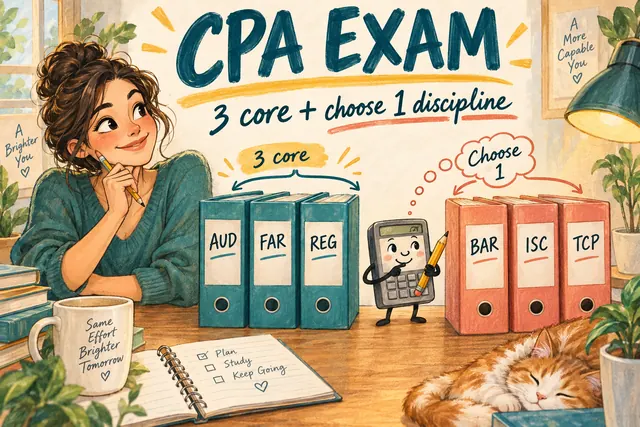
This is the main CPA Exam navigation and study-planning hub. It introduces all six sections. The complete original practice form currently linked here covers FAR only, with its own dedicated Online Center, flashcards and accounting review. The existing AUD study center is a separate reading resource. Other section outlines below link to official objectives rather than unpublished practice tests.
Three core sections and one discipline
Candidates take four sections in total: three core sections and one chosen discipline. Each section has four hours of examination time and five testlets. The first two testlets contain multiple-choice questions and the final three contain task-based simulations. Question counts differ by section.
The official passing score is 75 on a 0-99 scale. It is not a percentage correct. FAR practice accuracy is diagnostic study feedback, and it cannot be converted into an official CPA score. Completing the exam is part of the licensure pathway. Jurisdiction-specific education and experience requirements also apply.
Format checked October 16, 2026. The section counts below follow the blueprint effective January 1, 2026. AICPA also provides the January 2027 blueprint and a summary of changes. Use the version effective on your exam date, especially when planning tax study around testing-policy updates.
Explore all six CPA sections
Three core sections: all required
AUD · Auditing and Attestation
Core · 78 MCQs + 7 simulations
Ethics and professional responsibilities, risk assessment, audit evidence, conclusions and reporting.
FAR · Financial Accounting and Reporting
Core · 50 MCQs + 7 simulations
Financial reporting, selected balance sheet accounts and selected transactions.
REG · Taxation and Regulation
Core · 72 MCQs + 8 simulations
Professional responsibilities and federal tax procedures, business law, property transactions, individual taxation and entity taxation.
Three disciplines: choose one
BAR · Business Analysis and Reporting
Discipline · 50 MCQs + 7 simulations
Business analysis, technical accounting and reporting, and state and local government accounting.
ISC · Information Systems and Controls
Discipline · 82 MCQs + 6 simulations
Information systems and data management, security, confidentiality and privacy, and SOC engagement considerations.
TCP · Tax Compliance and Planning
Discipline · 68 MCQs + 7 simulations
Individual tax compliance and planning, personal financial planning, entity tax compliance, entity planning and property dispositions.
Start with the available FAR practice
FAR Full-Length Original Practice Test 1
The available full-length form covers FAR: 50 MCQs, seven documentary simulations and 70 response cells, with 240 answering minutes and worked explanations. It is one section's practice, not a complete four-section CPA examination.
Review the FAR accounting concepts
Fourteen accounting reviews include worked examples and common errors. The review supports FAR preparation. Use the six section guides below to understand the different demands of AUD, REG and the discipline choices.
Recall and explain the FAR rules
36 accounting cards cover financial reporting, balance sheet accounts and transactions. Open the FAR deck, recall an answer, and use its explanation to check your reasoning.
Choose a section and plan your study
Check your jurisdiction's eligibility and scheduling requirements before booking. Choose your discipline after reading the official objectives and comparing the knowledge they require with your preparation. Then choose a section, list the weak topics, and reserve time for both MCQs and document-based simulations. Start with the FAR tools here if FAR is your current focus. Review the reason behind a missed response before counting another practice attempt as progress.
BAR extends financial analysis and technical reporting. ISC emphasizes information systems, security and controls. TCP focuses on tax compliance and planning. Your discipline choice develops a particular area of knowledge within the common CPA licensure pathway. Choose based on the content and your preparation, rather than a pass-rate ranking that may reflect different candidate groups.
Read the six section study guides
Read a short guide for each core and discipline section, compare its focus with your coursework and work experience, and open the current official objectives. These guides introduce the areas you need to study. They do not replace a complete section course or full-length practice form.
CPA Exam questions, answered
Do I have to take all six sections?
No. Take the AUD, FAR and REG core sections and choose one discipline: BAR, ISC or TCP. That is four exam sections in total.
Which full-length practice is available here?
FAR Practice Test 1 is available, with 50 MCQs and seven simulations. This release does not offer complete original practice forms for AUD, REG, BAR, ISC or TCP.
What happened to BEC?
BEC is a retired section from the earlier CPA Exam structure. It is not one of the current discipline choices. Use current CPA Evolution guidance and your jurisdiction's records when dealing with any historical exam credit.
Does choosing a discipline create a different CPA license?
The discipline choice is part of the common CPA licensure model. It does not create a separate BAR, ISC or TCP license. Your jurisdiction determines its licensing requirements.
Is a score of 75 the same as getting 75% correct?
No. The official section score is scaled. Local practice accuracy helps identify study needs and cannot predict or reproduce the official score.
Should I use the 2026 or 2027 blueprint?
Use the blueprint effective on your exam date. This overview and the linked FAR form target 2026. AICPA's download page also lists the blueprint effective January 1, 2027 and its change summary.
Check the official guidance
Prepared by the Effortless Math team using current AICPA and NASBA exam guidance. These are independent study materials. Effortless Math is not endorsed by AICPA, NASBA or Prometric. Availability labels describe the tools actually linked from this release.
- AICPA CPA Exam blueprints and representative tasks
- AICPA scoring explanation
- NASBA CPA examination information
- Editorial standards
- About Effortless Math
Open the FAR Online Center for the full-length form, or use the section guides to plan your next area of study.