TOEFL Speaking Practice: Match Your Routine to the Current Tasks (2027 Prep)
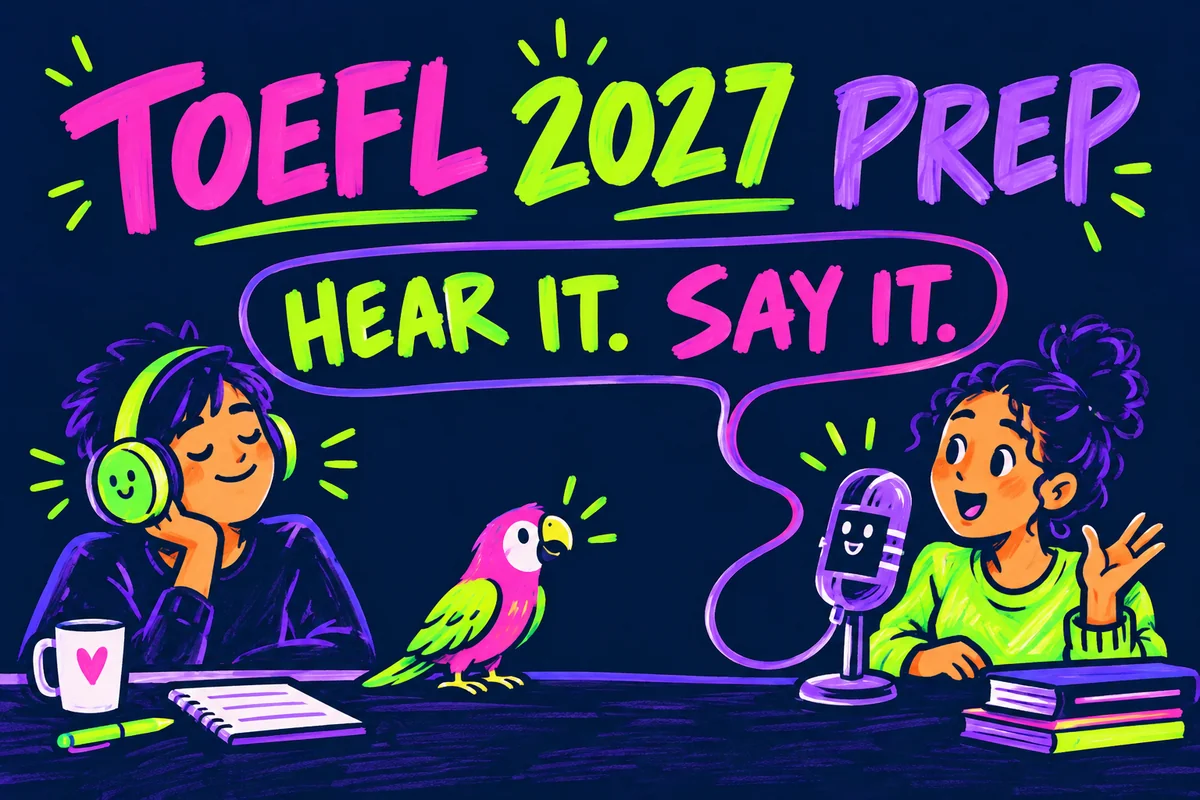
You listen to a sentence, understand it, and then change half its words when you repeat it. Later, an interview question arrives and you repeat the question instead of answering it. Both attempts involve speaking English, but the jobs are different.
Separate the practice. For repetition, you need to reproduce what you heard. For an interview, you need to respond to the question with your own relevant ideas. Review the actual recording. The examples below show how to identify an error or unclear idea, without inventing a TOEFL score from your home practice.
The examples are original language-learning activities. They are not official test questions, a full Speaking test or a simulation of its scoring.
Check which Speaking task you are practicing
ETS currently lists Listen and Repeat, where you reproduce short sentences exactly as you hear them, and a second task called Take an Interview. The second is a simulated academic or campus interview asking about experiences and opinions. ETS current Speaking task descriptions
That difference changes the feedback you need. An elegant paraphrase can still fail your repetition goal because you replaced the source wording, while an interview response can use your own words to answer the question.
The current test-content page lists eleven Speaking items and an approximate base time of eight minutes. ETS advises allowing about two hours for the whole test and notes that test time and item counts may vary as it adapts. ETS current test-content and timing page
Follow the instructions of the current official sample or test you open. The routine below is a suggested study session with time for review, so its length and number of activities do not represent an official section.
Listen once before checking a written sentence
Choose a short recording you are allowed to use, ideally from a current official sample when you are checking the task procedure. Keep its transcript out of view during the first attempt.
Record your response. Listen to the source again during review and compare what was actually said with what you produced. A transcript can help you locate an omission, but reading the transcript aloud tests a different activity from reproducing a sentence you have just heard.
For extra language practice, a study partner can record an original sentence while you look away from the text. Start at a length you can handle, then change the difficulty in response to a specific observed problem. Those partner recordings have no official calibration.
Protect the distinction in your notes. Mark an attempt as transcript-assisted if you saw the text, and keep it separate from a first-listen attempt when deciding what needs work.
A changed word can change the instruction
Consider this original sentence for a partner-recorded language exercise: "Please leave the blue folder beside the printer before lunch." Do the listening attempt before viewing the text if you want to use it as a memory exercise.
Imagine that your recording says, "Please leave blue folder by the printer after lunch." Some changes preserve the general topic, but "after" reverses the time relationship. Missing "the" also makes the wording differ from the source. Repetition aims at the actual sentence.
The table below separates the changes so you can choose what to review. These observations are descriptions of invented recordings, with no point deductions or band estimates attached.
Work on one change. You might listen again for the contrast between before and after, repeat the phrase during review, then try a fresh sentence containing a different time relationship. Repeating the original until it is memorized does not show whether that fresh attempt will hold together.
| Source phrase | Invented recorded phrase | Review observation |
|---|---|---|
| the blue folder | blue folder | Article omitted |
| beside the printer | by the printer | Wording changed despite similar meaning |
| before lunch | after lunch | Time relationship reversed |
Check intelligibility by listening to the recording
A written transcript can look accurate while the audio remains hard to follow. Listen to your actual recording at normal speed and identify the word or phrase that a listener would struggle to understand.
Use a listener if available. Ask what they heard before showing the source sentence, then compare the responses. Treat the feedback as a study aid. Your partner is helping you listen, without acting as an ETS rater or producing an official result.
Speech-to-text can supply another clue during home review, but its errors can come from the microphone, background noise or the software itself. A wrong transcription alone does not prove that your pronunciation was wrong, and a correct transcription does not validate a TOEFL band.
Check the audio yourself. If the recording clipped the first word, fix the recording conditions before deciding that your memory failed. Keep the original attempt so the next session can address a real observation.
Answer the interview question that was asked
For a separate original language exercise, imagine a campus interviewer asking, "What is one change you would make to the place where you study, and why?" This question was written for this article and is not an ETS item.
Name a change first. "I would add a small desk lamp" gives the listener a direct answer, whereas a long introduction about the importance of education delays the information the question asks for.
You could continue, "The ceiling light leaves my notes in shadow when I study in the evening. A lamp beside the notebook would help me read without moving everything to the kitchen table." The details explain the choice without requiring an elaborate story.
Use your own situation. You might choose a quieter room or a larger desk, provided you can explain a concrete detail that connects the proposed change to the place where you study. Check that connection in the recording.
Review an interview attempt without a template score
Listen back without reading a transcript. Can you identify the proposed change and its reason from the recording? If you cannot, note the exact point where the answer becomes difficult to follow.
Suppose your response starts with the desk lamp but switches to describing a friend's exam, leaving the interviewer to wonder how that story relates to your proposed change. Find the detour. Explain its connection to the question, and remove it in a later practice attempt if the connection is missing.
Keep language feedback specific. "I could not hear the ending of the word notes" or "I never explained why the lamp helps" gives tomorrow's practice a target. "My speaking is bad" does not identify what to change.
Avoid adding a band beside those comments. A classroom checklist helps you notice relevance and clarity, but it is not an ETS rubric, validated scoring model or prediction of your official result.
Build a short session with time to review
If you have twenty minutes this evening, you could spend two checking the current sample instructions, six on a few repetition attempts and their review, eight recording and reviewing interview responses, and four choosing a fresh follow-up activity. The minutes add to twenty. This is our optional study example, with no claim that this allocation improves scores fastest.
Adjust the session to what you observed. A recording problem may use the first few minutes, while one missed phrase may deserve most of the repetition block. You do not need to rush through a fixed number of homemade items.
Finish with fresh material. For repetition, choose a new sentence that contains the relationship you missed. For the interview, use a different question and check whether you answer it directly before adding details.
Write down the conditions. A second attempt after planning can be useful, but compare it honestly with a first response. Follow current official instructions when you move from skill review to format practice.
Save one useful observation for the next session
The blank Speaking practice review log (CSV) has separate fields for the task, source, attempt conditions, observed problem, next action and fresh follow-up. Record one issue you can check rather than a list of every hesitation.
ETS describes the interview task in terms of clear communication, natural pace and appropriate language. Its repetition task emphasizes accurate, intelligible speech. ETS current Speaking task descriptions Use those descriptions to understand the work, then inspect the current official TOEFL preparation page when you need official examples.
Our TOEFL study hub collects TOEFL study resources. After choosing a resource, return to the log and name the new sentence or question you will use to check whether yesterday's correction carried over. Keep that follow-up separate from any unofficial practice score a product displays.
2027 preparation edition. ETS sources checked October 11, 2026. Sentences, interview question, example response, recording comparison and twenty-minute routine are original language-learning examples, not official questions, a full test or validated score guidance. Follow current ETS instructions for your appointment.

Related to This Article
More math articles
- TExES Core Math FREE Sample Practice Questions
- Full-Length 8th Grade MCAS Math Practice Test
- The Best Grade 7 Math Book for Oklahoma Students
- 10 Most Common 8th Grade MEAP Math Questions
- Best equipment for online math teachers
- Essential Scientific Vocabulary
- How to Simplify Fractions? (+FREE Worksheet!)
- Urbanization, Urban Growth, Suburbanization, and Metropolitan Regions
- Trigonometric Ratios
- The Double V Campaign and the Second Great Migration



















What people say about "TOEFL Speaking Practice: Match Your Routine to the Current Tasks (2027 Prep)"?
No one replied yet.