TOEFL vs the Old Test: Which Practice Materials Still Fit? (2027 Prep)
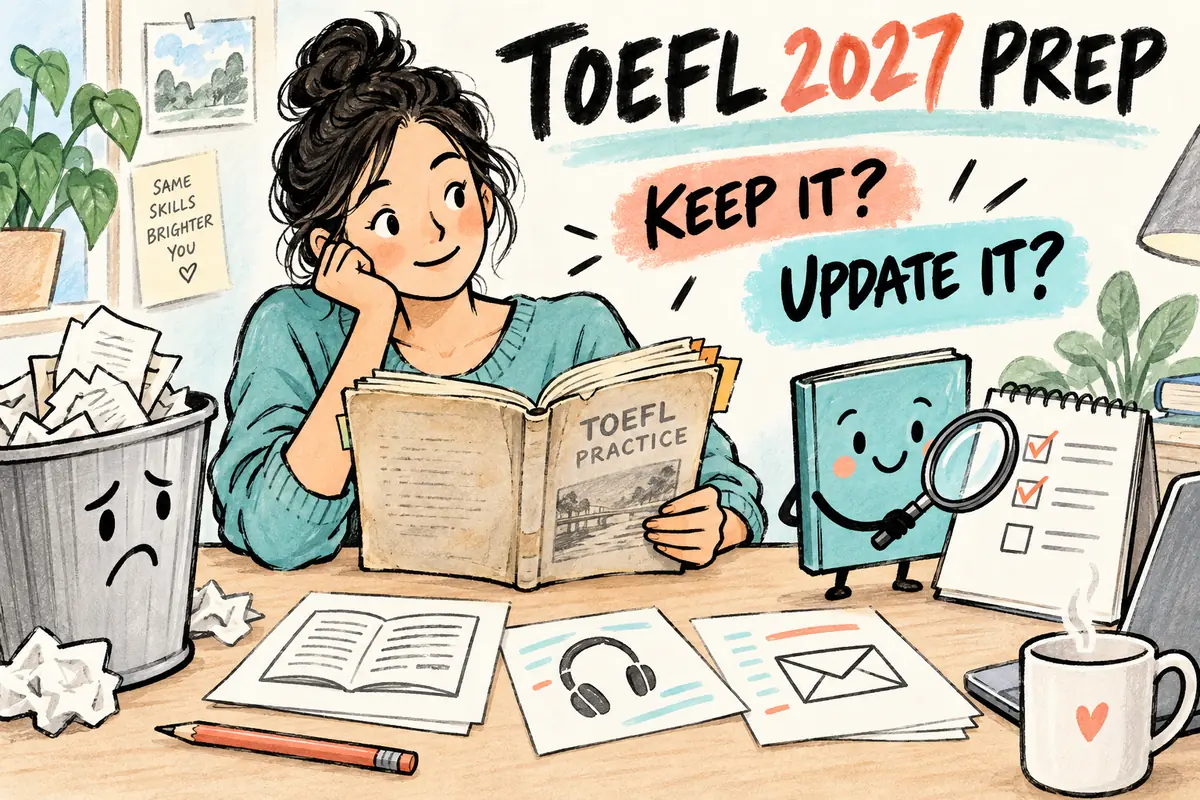
Your old TOEFL book has notes in the margins, bookmarked listening tracks and a writing chapter you have nearly finished. Then you open the current task list and see an email exercise. Does the whole book need replacing?
Start with one exercise. A book can contain useful English practice alongside instructions that no longer fit your appointment, so judging the cover date alone will miss what you can actually use.
This guide helps you audit the material you already own. The worked example uses an invented study folder, and the downloadable sheet leaves room for your own evidence. No purchase is required to complete the audit.
Check the task list before judging the book
ETS introduced the enhanced TOEFL iBT on January 21, 2026. The date matters when you compare older instructions with the current examination. ETS announcement of the January 21, 2026 enhancement
The 2027 label on this guide identifies its preparation edition. It does not announce another official redesign. Check the current ETS current task list and test structure against your intended appointment, especially if you are preparing several months ahead.
Open a sample exercise and write its exact task in plain language. "Listen to a lecture and answer comprehension questions" tells you something useful. "Listening chapter" leaves too much hidden.
Now compare the work you must do with a current official sample. Keep the original page number in your notes, because a later decision to buy a supplement should point to an actual gap rather than a vague feeling that everything is outdated.
Match the activity, then decide its use
The current official task list includes Reading activities called Complete the Words, Read in Daily Life and Read an Academic Passage. Listening includes choosing a response, a conversation, an announcement and an academic talk. ETS current task list and test structure
For Writing, ETS lists Build a Sentence, Write an Email and Write for an Academic Discussion. Speaking uses Listen and Repeat and Take an Interview. ETS current task list and test structure
You do not need to memorize those names before opening your book. Use them as labels for a coverage check. A long passage about geology might help you find textual support for an inference, while still leaving everyday reading and word completion uncovered.
Our audit uses four working labels. Keep means the exercise serves a stated learning purpose as it stands. Adapt means you can change your study method while preserving that purpose. Supplement records a missing task type. Retire from simulation means an exercise can no longer stand in for the current test experience. These are our planning labels, not ETS ratings.
One resource may receive several labels for different activities. Keep its vocabulary pages, supplement its missing email practice and retire its old full-test timing from your current simulation plan. That is a defensible decision even when the activities share a cover.
A worked audit of an invented study folder
Imagine that your folder contains six resources: a passage book, lecture recordings, grammar worksheets and three exam-focused sets. You have one evening to decide what belongs in next week's practice.
The entries below show the decision process. Each resource is fictional, and no commercial book or course has been evaluated. The suggestions are instructional choices rather than claims about a provider's quality.
Look at the grammar row. Rearranging a few words can expose a sentence-order problem, but changing a worksheet yourself does not establish that its difficulty, interface or scoring matches an official Build a Sentence task.
For that gap, inspect a current official example first. You can then decide whether the old worksheet offers useful extra grammar work and record the missing exam-format practice separately.
| Resource and observed activity | Decision | Reason and next action |
|---|---|---|
| Passage book: inference questions | Keep for skill work | Find text support. Add missing current task types |
| Lecture audio: main-point review | Adapt study conditions | Log replays. Compare current listening tasks |
| Grammar worksheets: word order | Keep and supplement format | Review syntax. Inspect Build a Sentence sample |
| Old lecture-summary writing set | Retire from current simulation | Keep grammar review. Add current Writing tasks |
| Read-listen-speak response set | Supplement current procedure | Add repetition and interview task practice |
| Fixed older full test | Retire from current simulation | Use selected drills. Verify current delivery separately |
Reuse an old passage for a narrow reading goal
Suppose an old passage explains why a campus changed its bus route. You choose an answer claiming that lower costs caused the change, but the passage only mentions construction blocking the usual road.
Return to the evidence. Underline the sentence giving the reason. Explain its support, then describe why the cost claim goes beyond what the passage says. This invented language exercise carries no official TOEFL question, timing or score rule, so use it to practice explaining evidence in your own words.
You can use that review method with a passage you are permitted to study. Give the session a narrow label such as "support an inference from the text." Calling it a current Reading module would require additional evidence about the task mix and delivery.
Stop when the explanation is clear. Repeating the same passage until you remember its answers may help recall, but a fresh passage is needed to check whether you can apply the reasoning to unfamiliar text.
Keep useful audio without preserving an old timer
A lecture recording can help you track a speaker's main point and examples. During review, locate the moment when an example begins and explain how it supports the point, using the transcript if your resource provides one.
Record the conditions. A first listen, a replay and a transcript-assisted review answer different study questions. If you replayed the difficult sentence three times, your note should say so before you compare that result with a fresh timed attempt.
For current format practice, follow the instructions of the official resource you have opened. ETS describes Reading and Listening as multistage adaptive, with performance in the first module guiding the second and both stages contributing to the result. ETS teacher FAQ on multistage adaptation
A fixed collection of recordings does not reproduce that process merely because its topics are academic. Keep it for the listening skill you identified, then use current task examples to check the additional demands you have not practiced.
Inspect Writing and Speaking instructions closely
An older activity asking you to summarize a lecture in writing can still reveal a grammar problem. However, its response instructions do not establish preparation for the current email task. Write down that distinction before spending the week polishing a response you will not be asked to produce in that form.
For an email practice example, imagine that a reserved reading is missing from your library account and you need to ask an assistant where to find it. Identify the recipient. Draft your request and check whether that person can tell what help you need from the message. This is our own language exercise. No official word limit, timing or scoring is attached.
Compare a current official task before using a timed email drill. The prompt may require details that your homemade situation does not include, and a generic template cannot decide which information belongs in the response.
Speaking deserves its own check. An old read-listen-speak activity trains a different response procedure from repeating a sentence or answering an interview question. Preserve useful pronunciation work if it addresses an observed problem, and obtain current task practice for the procedure you still need to learn.
Separate a resource audit from a score prediction
An old practice score describes an attempt under that resource's conditions. It cannot establish your result on a different test format, and the number of exercises you kept does not predict a score either.
The current ETS content page reports section and overall results on a 1–6 scale, with a comparable overall 0–120 result during the transition period. ETS current task list and test structure
Inspect the scoring explanation. Before relying on a new product's estimate, ask the provider how it checked that estimate against actual results and what limits apply. A band number on the screen leaves that question unanswered.
This audit measures coverage. It records which tasks have suitable practice and which gaps remain, without converting classroom accuracy, study hours or completed pages into a TOEFL band.
Finish one row before planning the week
Download the blank TOEFL materials-audit sheet (CSV) and open the first resource you want to check. Record its title or file name, page or lesson, observed activity, intended study purpose and the current official reference you compared it with.
Choose a label and explain your reason. For a missing task, write a concrete next action such as "open the official email sample and compare the response instructions." The blank sheet has twelve rows, so you can add further activities without overwriting the first decision.
ETS links its preparation resources from the official TOEFL preparation page. Inspect the samples and current coverage before choosing a supplement, including any paid option. You may find that a free official example answers the format question that triggered the audit.
Our TOEFL study hub brings TOEFL study resources together. Return to your audit afterward and select one missing task for your next session, keeping the resource name and comparison link beside the decision so you can check it again.
2027 preparation edition. Official sources checked October 11, 2026. The study folder, audit labels and language situations are original hypothetical teaching examples. They are not official test questions, scoring rules or evaluations of named products. Verify current ETS instructions for your appointment.

Related to This Article
More math articles
- New Deal coalition
- Shared powers
- How to Determine the Missing Number when Multiplying Decimals by Powers of 10
- Necessary and Proper Clause
- Motion: Speed, Velocity, and Acceleration
- Free Grade 3 English Worksheets for New Mexico Students
- How Writing Math Journals Can Boost Students’ Problem-Solving Skills
- The Best Grade 4 Math Book for California Students
- Rotation, Torque, and Balance
- Algebra 2 Formula Flashcards










What people say about "TOEFL vs the Old Test: Which Practice Materials Still Fit? (2027 Prep) - Effortless Math"?
No one replied yet.