Neutrality, Submarine Warfare, and American Entry
Chapter 7 of the CLEP History of the United States II study guide on Effortless Math covers Neutrality, Submarine Warfare, and American Entry: the key terms, the core ideas, and worked examples showing how this topic is tested on the exam.
CLEP History of the United States II, Chapter 7
Neutrality was a policy under pressure
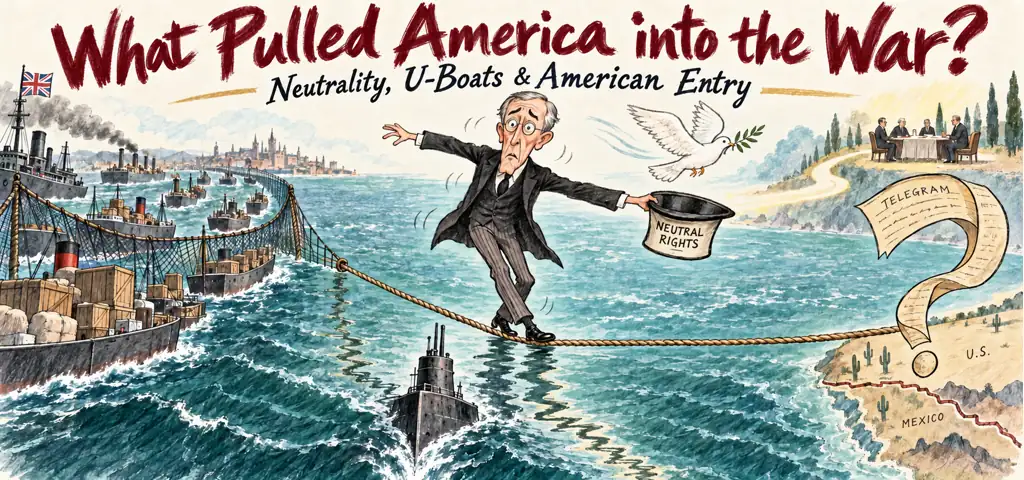
When war began in Europe in August 1914, Woodrow Wilson proclaimed American neutrality and urged citizens to be impartial in thought as well as action. Neutrality did not mean indifference. German, Irish, British, and eastern European Americans viewed the belligerents through different histories, while pacifists, preparedness advocates, exporters, bankers, and international lawyers disputed what neutral conduct required. The central problem was that legal neutrality operated inside an economy and an Atlantic controlled unequally by the warring powers.
Trade tilted toward the Allies
Britain's surface fleet imposed a blockade that made trade with Germany increasingly difficult. American exports and private credit to Britain and France grew enormously from 1914 through 1916, while commerce with Germany nearly disappeared. Wilson defended the right of neutral firms to trade and lend to belligerents, but the pattern tied American prosperity and creditor interests more closely to an Allied victory. A legal permission available to both sides did not produce materially equal access when one side controlled the sea lanes.
Submarine warfare attacked neutral rights
Germany answered British sea power with U-boats. A submarine could not readily stop, search, and place passengers in safety before sinking a vessel without losing surprise and exposing itself to attack. The sinking of the British liner Lusitania in May 1915 killed 1,198 people, including 128 Americans. Wilson demanded accountability and protection for neutral rights. The episode intensified conflict without producing immediate entry, because the administration still sought concessions through diplomacy.
Bryan proposed a different neutrality
Secretary of State William Jennings Bryan resigned in June 1915 rather than sign Wilson's second Lusitania note. Bryan wanted Americans warned away from belligerent passenger vessels and wanted British interference with neutral trade protested alongside German submarine attacks. Wilson instead insisted that citizens could exercise lawful travel rights and held Germany responsible for warning and safety. Both opposed war at that moment, but Bryan would reduce exposure through restraint by Americans while Wilson defended neutral rights through pressure on belligerents.
The Sussex pledge delayed the break
After a German submarine torpedoed the French passenger ferry Sussex in March 1916, injuring Americans, Wilson threatened to sever diplomatic relations. Germany's May pledge promised not to sink passenger ships and not to sink merchant vessels without warning and provision for those aboard, unless they resisted or tried to escape. The pledge reduced the immediate crisis. It also made later German abandonment of restrictions a sharp diplomatic reversal rather than a continuation of an unchanged policy.
Preparedness coexisted with mediation
Wilson supported expansion of the army and navy while campaigning in 1916 on having kept the nation out of war. Colonel Edward House simultaneously explored mediation. The House-Grey memorandum of February 1916 contemplated a Wilson-called peace conference and possible American belligerency if Germany refused reasonable terms. In January 1917 Wilson publicly urged "peace without victory," arguing that humiliation imposed by a victor would not endure. Mediation, preparedness, and conditional pressure were overlapping strategies, not a straight march toward war.
Germany made a calculated gamble
German leaders announced unrestricted submarine warfare beginning February 1, 1917. They expected U-boats to cut Britain's supplies before American forces could matter. Wilson broke diplomatic relations on February 3. Sinkings of American merchant ships then demonstrated that the new policy threatened commerce and citizens as a continuing system, not as one disputed incident. The decision changed the administration's calculation because the Sussex framework for managing neutral rights had collapsed.
The Zimmermann Telegram widened the threat
British intelligence intercepted and shared a German message proposing that Mexico ally with Germany if the United States entered the war. Germany offered support for recovery of Texas, New Mexico, and Arizona. Publication in March 1917 made the European war appear connected to American continental security. Mexico was in no position to reconquer the territory, but the proposal mattered politically because it joined submarine attacks at sea to an explicit diplomatic threat nearer home.
Entry combined causes and a changed claim
Wilson asked Congress for war on April 2, and Congress declared war on Germany on April 6, 1917. Unrestricted submarine warfare was the immediate trigger; the telegram, the accumulated trade pattern, defense of neutral rights, and hopes for shaping the peace reinforced the decision. The fall of the Russian tsar also made it easier to present the Allied side as democratic. Wilson now argued that the world must be made safe for democracy, turning a neutral-rights dispute into a larger war aim.
Intellectuals divided over means and ends
John Dewey believed participation could give reform-minded Americans influence in organizing a more democratic international order. His former student Randolph Bourne warned that intellectuals fascinated by organization and technique were neglecting the ends war served. War, Bourne argued, enlarged state power and disciplined dissent. Their dispute was not simply courage versus cowardice. It asked whether efficient mobilization could be trusted to produce democratic purposes or would transform the institutions and citizens conducting it.
rank causes by timing
Suppose a prompt lists Allied loans, the Lusitania, unrestricted submarine warfare, and the Zimmermann Telegram.
Neutrality failed through interaction
No single development made entry automatic. Economic attachment mattered because the blockade distributed neutral trade unevenly. Submarine warfare mattered because Germany challenged rights Wilson chose to defend. The telegram mattered because it changed public perception of distance and danger. Wilson's peace ambitions mattered because belligerency might give him a seat at the settlement. Strong historical reasoning therefore identifies mechanism, sequence, and interaction instead of reciting a list as though every cause had the same weight.
Watch the history in motion
This short lesson adds voices, images, and chronology to the ideas you just studied.
Video: WORLD WAR I: Military & Diplomacy [APUSH Review Unit 7 Topic 5] Period 7: 1898-1945, Heimler's History.
Try four CLEP-style questions
- If Britain had permitted equally effective American trade with Germany, which argument about neutrality would have weakened most directly?
- That legal trading rights produced a materially one-sided economic relationship
- That mediation might fail without military preparedness
- That German diplomacy could threaten continental security
- That submarine warfare created dangers for passengers
- That intellectuals disagreed about the wartime growth of state power
- Bryan questioned defending travel rights without restraining citizens, while Bourne later questioned efficient war organization without examining its ends. What concern links them?
- Neutral rights and administrative efficiency necessarily create democratic outcomes without political judgment.
- Avoiding war and criticizing state organization both depended on outright support for German victory.
- Citizenship duties required travelers and intellectuals to accept executive policy during every crisis.
- British blockade policy made debate over American state power and mobilization irrelevant.
- Legal rights or efficient means can obscure the risks and purposes of expanding commitment.
- A decoded German message proposes an alliance with Mexico if the United States enters the war, but Mexico never accepts the offer. Which conclusion stays within the evidence?
- The proposal replaced unrestricted submarine warfare as Germany's condition for American intervention.
- The message proves Mexican forces had begun coordinated operations alongside German submarine commanders.
- Mexican rejection made the document evidence that Germany wanted continued American neutrality.
- The proposal revealed German intent to widen conflict, but not Mexican participation.
- The message established that Britain designed and transmitted the proposed territorial bargain.
- Taken together, the House-Grey memorandum and the "peace without victory" speech best support which conclusion?
- Wilson had renounced mediation by early 1916.
- Wilson pursued mediation while considering pressure that could compromise strict noninvolvement.
- Wilson promised Germany that the United States would remain neutral under any terms.
- Public peace language meant the administration had made no conditional commitments abroad.
- Preparedness prevented the administration from seeking a negotiated settlement.
Check your answers and reasoning
Independent preparation. CLEP is a registered trademark of the College Board, which does not endorse this lesson.

Related to This Article
More math articles
- From Neutrality Acts to Pearl Harbor
- 3rd Grade NSCAS Math Worksheets: FREE & Printable
- Region
- Full-Length 7th Grade STAAR Math Practice Test-Answers and Explanations
- High-Volatility Slots: A Math Profile of Big-Swing Games
- The Best Grade 2 English Worksheets for Pennsylvania Kids
- Environmental Science: Pollution, Exposure, and Safer Design
- How to Use a Calculator on Standardized Math Tests
- Free Grade 3 English Worksheets for Wisconsin Students
- Free Colorado Grade 2 Math Worksheets




















What people say about "Neutrality, Submarines, and American Entry"?
No one replied yet.